Taking practice as benchmark for institutional refinement
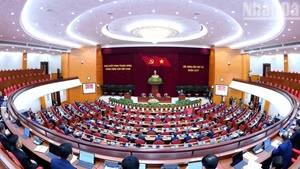
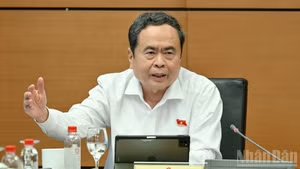
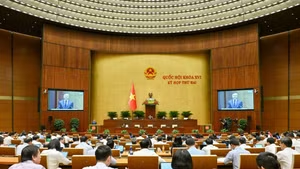
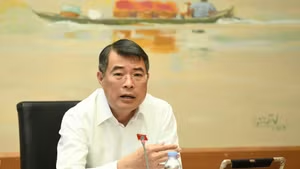
At this session, the NA passed 51 laws and 39 resolutions, representing an exceptionally large workload over nearly two months. Assessing the outcomes of the session, deputy Tran Hoang Ngan (Ho Chi Minh City) stressed that at this session and the preceding 9th session, the NA promptly institutionalised a series of major resolutions that form the fundamental and core basis for rapid and sustainable growth in the new period.
He described this as “a development-oriented legal system”, clearly reflecting the viewpoint of promoting decentralisation and devolution of authority, assigning greater powers to localities under the principle of “local decision-making, local implementation, and local accountability”.
At the same time, the adopted laws and resolutions have contributed to improving the investment and business environment, advancing administrative reform, and reducing unnecessary procedures, thereby facilitating the attraction of investors.
The deputy highly commended the efforts of drafting bodies and the Government for “listening thoroughly, reasonably, and empathetically” to deputies’ opinions. As a result, when put to a vote, most draft laws received very high approval rates.

He said that many of his recommendations had been taken on board, particularly in the amendments to the Law on Personal Income Tax, the Law on Value-Added Tax, and tax policies for household businesses. “This reflects an exceptionally high level of responsiveness,” the lawmaker stressed.
In addition, the NA accompanied the Government in removing infrastructure bottlenecks and addressing difficulties in key localities, approving a range of special mechanisms and policies for Ha Noi, Ho Chi Minh City, Da Nang, Hai Phong, and other major growth poles.
From this practical perspective, Tran Hoang Ngan assessed the 10th session as “highly impressive and leaving a positive mark”, as the NA continued to implement the three strategic breakthroughs set out in the Resolution of the 13th National Party Congress: breakthroughs in institutions, infrastructure, and high-quality human resources.
“These are extremely important foundations that allow us to confidently enter a new era — the era of national resurgence — with the aim of achieving rapid and sustainable development, becoming a high-income country at an early stage, and building a prosperous, civilised, and happy nation,” the lawmaker stressed.
He also expressed strong confidence that, under the wise leadership of the Party, with the close accompaniment of the NA and the determination of the Government, Viet Nam will achieve these stated goals.
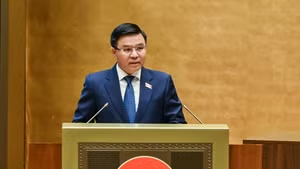
Assessing the key highlights of the 10th session, deputy Truong Xuan Cu (Ha Noi) noted that the most significant feature was the record number of laws amended and supplemented compared with many previous sessions.

He underlined that preparations for this session were meticulous and timely, demonstrating a breakthrough in institutional development aimed at removing bottlenecks in the country’s development process.
The lawmaker noted that deputies engaged in the discussions with a high level of responsibility, commitment, and practical effectiveness, while the law-drafting agencies showed a constructive and receptive attitude, carefully and responsibly incorporating feedback.
As a result, approval rates for resolutions passed at the session were very high, reflecting mature deliberations and broad consensus.
From an implementation perspective, Truong Xuan Cu observed that no matter how carefully preparations are made, reality always evolves faster and is more diverse and complex. Therefore, alongside the development of well-crafted, long-term strategic laws, the NA must also pay close attention to issues arising directly from practice in order to respond in a timely manner.
He cited land legislation as an example: although the Land Law is comprehensive, determining land prices for compensation remains difficult. Consequently, guiding decrees and circulars must be issued promptly to prevent legal provisions from becoming bottlenecks for development, particularly in the context of deep international integration.
Amid growing global uncertainties that directly impact the national economy, timely responses are essential. The lawmaker proposed that the 16th National Assembly should not only pursue its legislative programme, but also identify and swiftly resolve unresolved bottlenecks from earlier phases at each session to meet pressing practical needs.
He cited public investment as an example, noting that while it has been promoted with strong determination and the legal framework is largely in place, disbursement remains slow. “So where exactly is the bottleneck?” he asked, stressing that the answer must come directly from real-world implementation, and that institutions must be adjusted in a timely manner to remove obstacles.
“Using practical realities as the benchmark for refining institutions is the most effective way to respond to the pressing challenges currently facing society,” lawmaker Truong Xuan Cu affirmed.
Broad socio-economic impact, paving the way for innovation and sustainable development
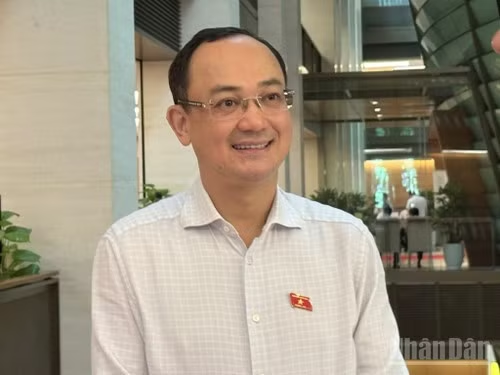
Speaking to reporters on the sidelines of the NA, deputy Nguyen Ngoc Son (Hai Phong) assessed that the adoption of a large volume of laws and resolutions at this session will help consolidate the national financial and budgetary framework in a transparent and disciplined manner, creating room for macroeconomic stability and enhancing the economy’s resilience to shocks.
According to him, groups of laws on land, investment, planning, and infrastructure open up new development space and remove long-standing bottlenecks. Laws on population, disease prevention, residence, and public employees further clarify citizens’ rights and obligations, improve the quality of public services, and strengthen social discipline and order.
At the same time, laws on cybersecurity, state secrets, drug prevention, and defence industries will form a comprehensive security shield.
Notably, legislation related to science and technology, digital transformation, artificial intelligence, intellectual property, and education and training will pave the way for innovation and the development of high-quality human resources — decisive factors for productivity and national competitiveness.
Meanwhile, the resolution on oversight of the implementation of the Law on Environmental Protection underscores the pillar of sustainable development, promoting the circular economy and environmental industries.
He emphasised that through its legislative work, the NA plays a guiding and enabling role, ensuring that all policies are directed towards building a modern, sustainable, and highly competitive Viet Nam in the coming decade.
Deputy Nguyen Thi Viet Nga (Hai Phong) shared that this was a session marked by multiple records, with an exceptionally long working period and an unprecedented volume of content.
She stressed that the adopted laws and resolutions are closely linked to people’s daily lives, covering areas from personal income tax, education, healthcare, and land to social security policies, exemptions and reductions in hospital fees, textbooks, and allowances for teachers and healthcare workers.

Innovations in the Law on Disease Prevention, the Population Law, and regulations on grassroots healthcare were assessed as delivering direct and tangible benefits, enabling people to access education and healthcare services more comprehensively.
Looking ahead to the 16th NA, the deputy noted that the tasks ahead will be extremely demanding yet highly honourable. Elections of NA deputies and People’s Council members at all levels will be held early, immediately following the 14th National Party Congress, in order to promptly institutionalise new policies of the Party. Amid rapid global changes — from the Fourth Industrial Revolution to climate change — the workload facing the 16th NA will be immense.
Building on its 80-year tradition and the achievements of the 15th tenure, the lawmaker voiced confidence that the 16th National Assembly will continue the reform momentum and effectively advance the Digital National Assembly model already firmly established.