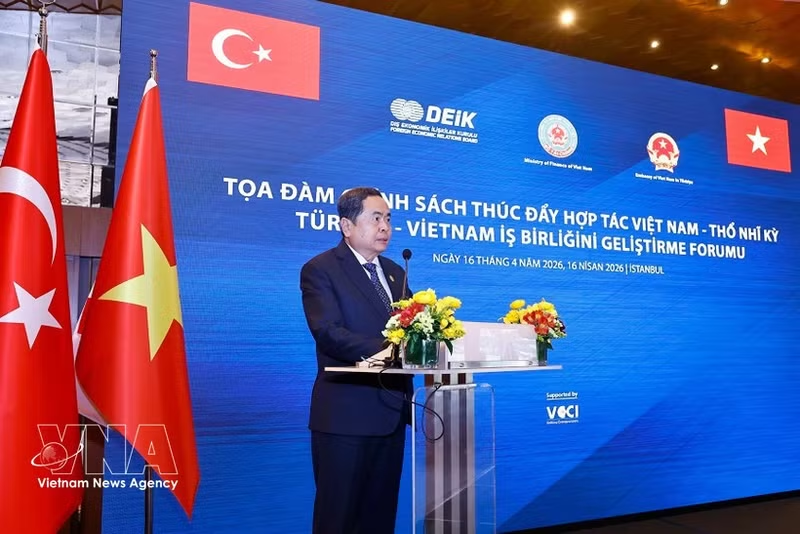
Speaking at the dialogue, a representative of the Foreign Economic Relations Board of Türkiye said that in the context of increasing global uncertainties, maintaining international cooperation is of great importance. Viet Nam and Türkiye are both dynamic and fast-growing economies in their respective regions, with bilateral relations gaining strong momentum not only in economic terms but also across political and strategic dimensions.
The Turkish side noted significant potential for cooperation with Viet Nam in areas such as energy, defence, infrastructure development, tourism, technology, and particularly the Halal industry, which can help elevate bilateral ties to a new level and further deepen and broaden collaboration across all fields.
Viet Nam has emerged as one of the leading destinations for Turkish investors, with more than 40 Turkish enterprises currently operating in the country, reflecting growing interest and substantial potential for expanding two-way investment.
Chairman Man commended Viet Nam’s Ministry of Finance and the Vietnamese Embassy in Türkiye for coordinating with Turkish agencies and business associations in organising the event. He noted that the dialogue not only provides an important platform for enterprises from both countries to exchange views and explore investment and trade opportunities, but also serves as a vivid symbol of nearly 50 years of traditional friendship built on trust, mutual understanding and goodwill.
He emphasised that Viet Nam has steadily affirmed its position as a stable, friendly and safe country, an attractive investment destination, a dynamic manufacturing hub, and a highly open economy. In 2025, its economy was estimated at 514 billion USD, ranking 32nd globally and fourth in ASEAN. Per capita income reached 5,026 USD, placing Viet Nam among upper-middle-income countries.
Viet Nam is among the top 15 developing countries in attracting foreign direct investment (FDI), with cumulative registered capital of around 530 billion USD. In 2025 alone, total registered FDI exceeded 38.4 billion USD, reaffirming Viet Nam as a stable and sustainable destination for global capital flows. These achievements, the top legislator stressed, are underpinned by a consistently stable socio-political environment that inspires confidence among investors and businesses.
Viet Nam’s investment climate continues to improve, supported by a network of 17 free trade agreements with over 60 countries and territories, helping diversify markets, products and supply chains. Legislative reforms have also been accelerated, with the National Assembly passing key laws to streamline administrative procedures, enhance transparency, protect investors’ rights and promote innovation, thereby fostering a more competitive business environment.
With advantages including competitive production costs, a young and adaptable workforce, and increasingly modern infrastructure and logistics systems, Viet Nam has become an attractive destination for multinational corporations, he stated.
NA Chairman Man also highlighted that Viet Nam’s international standing and credibility are rising steadily. With a foreign policy of independence, self-reliance and diversification and multilateralisation, the country has built its image as a reliable and responsible partner in the international community, facilitating market access and attracting investment, technology and knowledge from around the world.
In its new development phase, Viet Nam aims to become a competitive hub for manufacturing, services and innovation in Asia, as well as a strategic partner and a reliable link in regional and global supply chains. Viet Nam, he noted, seeks not only to participate but to move up the value chain, shifting from manufacturing to innovation, design and technological mastery.

The NA Chairman emphasised that Viet Nam and Türkiye share a strong tradition of friendship, built on mutual respect, mutual benefit, and a shared commitment to sustainable development. Since the establishment of diplomatic relations, the two countries have continuously strengthened and expanded cooperation across multiple fields. Political-diplomatic ties have been maintained through high-level visits and contacts, while economic-trade cooperation has seen positive progress. Cultural exchanges and people-to-people ties have also continued to grow.
Türkiye is one of Viet Nam’s key partners in the region, serving as a strategic bridge between Asia and Europe. Conversely, Viet Nam, with its dynamic and fast-growing economy, is an important gateway for Türkiye to access Southeast Asian and Asia-Pacific markets. These complementary advantages provide a solid foundation for the two countries to further deepen their cooperation in the coming period.
However, Chairman Man noted that the current scale and outcomes of cooperation have yet to match the full potential and strengths of both sides. Bilateral trade reached only around 2.3 billion USD in 2025. “In the context of strong global economic shifts, supply chain restructuring, and the rise of digital transformation and green transition, elevating Viet Nam–Türkiye cooperation is both an urgent requirement and a long-term strategic priority,” he stressed.
With that in mind, he outlined several key directions for future collaboration. Both sides should continue to strengthen political trust through increased high-level exchanges, including parliamentary cooperation, and maintain regular dialogue and policy consultation mechanisms to build a solid foundation for comprehensive cooperation.
At the same time, the two countries should step up cooperation in trade, investment, and tourism - considered key pillars of bilateral relations. Efforts should be made to boost trade in a balanced and sustainable manner, while creating more favourable conditions for businesses to access markets, expand investment, and integrate more deeply into global value chains.
The top Vietnamese legislator also called for expanded cooperation in sectors where both sides have complementary strengths, including processing and manufacturing industries, textiles, footwear, high-tech agriculture, tourism, energy, transport infrastructure, and logistics. In addition, strategic emerging areas such as digital transformation, innovation, the green economy, the circular economy, and renewable energy should be prioritised. In particular, developing transport corridors and enhancing supply chain connectivity between the two regions will serve as a key driver for the two nations to enhance competitiveness and attain sustainable growth in the long term.
He further underscored the important role of parliaments in improving legal frameworks, overseeing the implementation of cooperation commitments, and fostering a stable, transparent, and business-friendly investment environment. Chairman Man reaffirmed that Viet Nam’s National Assembly remains committed to working alongside the Government to refine institutions, improve the investment climate, and effectively support cooperation between Viet Nam and Türkiye.
He expressed confidence that with strong political will, close coordination between legislative and executive bodies, and the dynamism of the business communities, Viet Nam–Türkiye cooperation will enter a new phase of deeper, more substantive, and more effective development, creating momentum for each country’s growth and contributing to peace, stability, and development in both regions and beyond.
At the forum, representatives from associations and businesses of both countries discussed cooperation potential in trade, investment, and sustainable development, while sharing experience in improving the business environment, mobilising resources, and fostering innovation.