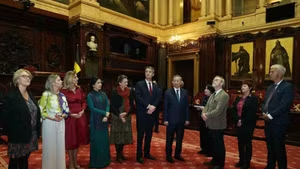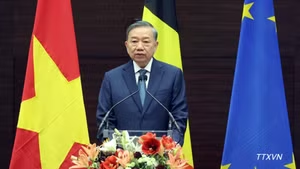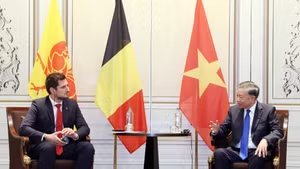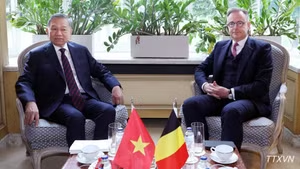
Within this overall development, National Assembly diplomacy has become an important diplomatic channel, together with Party diplomacy, State diplomacy, and people-to-people diplomacy, creating combined strength for Viet Nam’s professional and modern diplomacy. It contributes to enhancing the country’s position in the international arena, promoting rapid and sustainable development, firmly safeguarding national sovereignty and interests, and consolidating a full and solid legal foundation for the process of deep international integration.
National Assembly diplomacy implemented in a systematic and comprehensive manner
Practical experience in recent years shows that the diplomatic activities of the National Assembly have been implemented in an increasingly systematic and comprehensive manner, with a large workload and many important results achieved in various fields. In terms of law-making and supervision, the National Assembly has adopted many laws and ordinances directly related to external affairs, such as the Law on International Treaties, the Law on National Borders, the Law of the Sea of Viet Nam, the Law on International Agreements, the Law on Nationality, the Law on Entry, Exit, Transit and Residence of Foreigners in Viet Nam, and the Law on Viet Nam’s Overseas Representative Offices. It has also approved many important agreements, including the Comprehensive and Progressive Agreement for Trans-Pacific Partnership (CPTPP), the European Union (EU)–Viet Nam Free Trade Agreement (EVFTA), the EU–Viet Nam Investment Protection Agreement (EVIPA), and many new-generation free trade agreements.
Through these efforts, the National Assembly has made an important contribution to building and gradually improving a solid legal framework for the implementation of external activities suitable to national conditions, gradually meeting the requirements of international integration.
Assessments and critical opinions by National Assembly’s bodies and National Assembly deputies on external affairs and international integration have increased in number and are highly practical, making practical contributions to the planning and implementation of the Party and State's foreign policy.
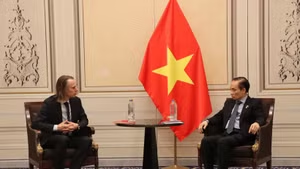
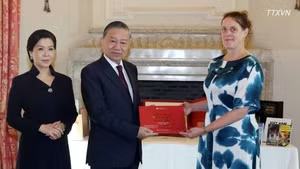
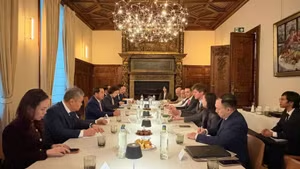
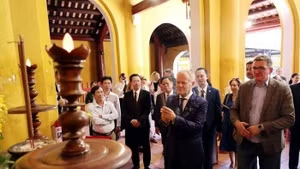
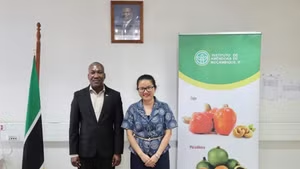
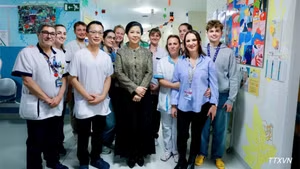
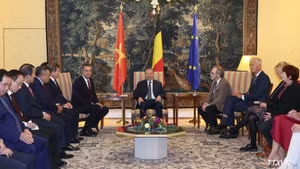
Bilateral parliamentary cooperation relations of the National Assembly have been actively and effectively promoted at many levels, with priority given to relations with neighbouring countries. This includes deepening and stabilising relations with strategic partners, consolidating friendly relations, and substantively promoting ties with major partners and traditional friends. It is especially prominent at the high level, with the active participation of the National Assembly Chairman and Vice Chairpersons, with a proactive, responsible, positive, flexible, and comprehensive approach in all fields.
So far, Viet Nam’s National Assembly has established relations with more than 140 parliaments and national assemblies, forming more than 50 friendship parliamentarian groups with the parliaments of other countries, and implemented many practical and effective activities.
In addition, exchanges of delegations between committees and professional agencies of the Vietnamese National Assembly and legislature agencies of other countries have been established and effectively implemented.
Fields and contents of cooperation have become increasingly diverse, not only in exchanging and learning from enxperience in law-making and promoting cooperation in supervising the implementation of laws and international commitments, but also in opening the way for development cooperation, addressing existing problems, creating trust, and enhancing mutual understanding with partner countries, contributing to affirming the image of a dynamic, innovative, professional, and effective National Assembly of Viet Nam.
So far, Viet Nam’s National Assembly has established relations with more than 140 parliaments and national assemblies; formed more than 50 friendship parliamentarian groups with the national assemblies of other countries; and implemented many practical and effective activities.
Viet Nam’s National Assembly has signed many cooperation agreements with parliaments (1), including agreements signed simultaneously with both the Senate and the House of Representatives (2).
The continuous expansion and deepening of cooperation between Viet Nam’s National Assembly and legislatures of other countries have contributed to promoting and creating favourable conditions for the implementation of state diplomatic relations in the fields of politics, diplomacy, defence-security, economics, trade, investment, sustainable development cooperation, science and technology, culture and education, and people-to-people exchanges.
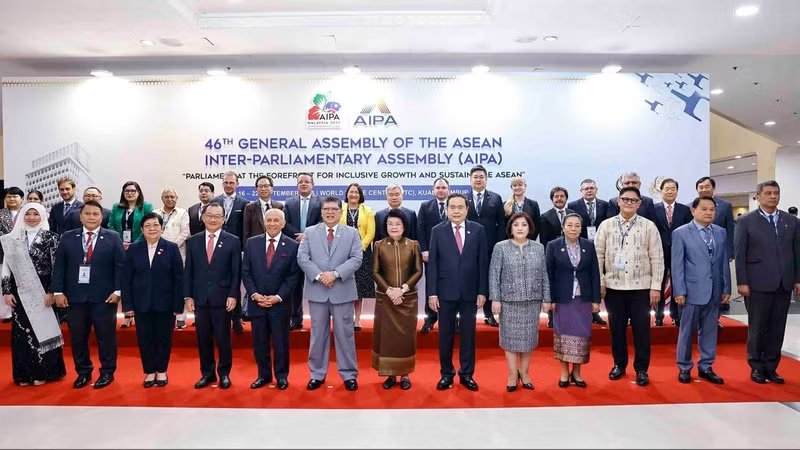
Within the framework of multilateral parliamentary cooperation, Viet Nam’s National Assembly is currently a member of many regional and global parliamentary organisations, such as the Inter-Parliamentary Union (IPU), the ASEAN Inter-Parliamentary Assembly (AIPA), the Asia-Pacific Parliamentary Forum (APPF), and the association of the parliaments of Francophone countries (APF).
In addition, Viet Nam’s National Assembly also participates in a number of other inter-parliamentary forums that operate irregularly. A notable hallmark of the Vietnamese National Assembly’s multilateral parliamentary diplomacy in recent years has been the hosting of important international and regional-scale multilateral conferences, such as the 132nd IPU Assembly in 2015 (IPU-132) , the 26th Asia-Pacific Parliamentary Forum (APPF-26, 2018), the 41st AIPA General Assembly (AIPA-41, 2020), the 9th Global Conference of Young Parliamentarians of the IPU in 2023, and the APF Executive Committee Meeting and the Francophone Parliamentary Forum on sustainable agriculture, food security and climate change response in 2025.
The external activities of the National Assembly have helped affirm that Viet Nam is ready to be a friend and a reliable partner. It is proactively and actively participating in regional and international parliamentary forums, and demonstrating responsibility in addressing regional and global issues.
Within multilateral parliamentary cooperation mechanisms, Viet Nam’s National Assembly has participated actively and proactively, proposing many initiatives to promote sustainable development, confidence-building measures, preventive diplomacy, conflict prevention, and the settlement of disputes by peaceful means on the basis of international law. These initiatives have been supported and highly valued by other countries.
At the same time, the National Assembly’s diplomatic activities have promoted dialogue, contributing to appropriately resolving many specific external issues, such as border and territorial matters, engagement on issues of religion, democracy, and human rights, external information and communication, and the handling of institutional obstacles or arising issues in bilateral cooperation.
The National Assembly’s diplomacy has also made many contributions to mobilising the overseas Vietnamese community to turn towards the homeland and join hands in building the country.
Through visits to foreign countries and exchanges with leaders of parliaments and national assemblies of countries hosting large numbers of overseas Vietnamese communities, National Assembly delegations have always paid attention to learning about the lives and activities of overseas Vietnamese. They have organised meetings with overseas Vietnamese communities to exchange information; helping overseas Vietnamese better understand the country’s socio-economic development achievements and new policies of the Party and the State, especially policies towards the overseas Vietnamese community; listened to their thoughts and aspirations; and encouraged them to look towards the homeland and the country.
The National Assembly’s diplomacy continues to promote its stature and position, contributing to mobilising resources to bring the country into a new era
The 14th National Congress of the Communist Party of Viet Nam is a specially important milestone for the country’s development path in the new period, taking place in a context where the world and the region continue to experience rapid changes with many unpredictable factors, which open both development opportunities but also pose considerable challenges to Viet Nam’s diplomacy.
In this context, the overarching objective of the National Assembly’s diplomacy is, together with other pillars of Viet Nam’s diplomacy, to closely follow the Party’s diplomatic policy decisions and guidelines, inherit achieved results, and continue to maintain a peaceful, stable, and favourable environment for national construction, protection, and development. It aims to successfully implement strategic tasks for socio-economic development, strive to carry out the national development goals to 2030 with a vision to 2045, and at the same time resolutely and persistently safeguard independence, sovereignty, and territorial integrity, ensure the nation’s core interests, complying with international law.
The National Assembly’s diplomacy needs to further strongly promote its role as one of the important components of comprehensive and modern diplomacy. It must proactively, actively, and responsibly participate in multilateral parliamentary mechanisms; promote bilateral relations with parliaments of other countries, especially with strategic partners and important partners; and at the same time improve the quality of law-making, approval, and supervision of the implementation of international treaties, ensuring harmony between national interests and international commitments.
Building a contingent of parliamentary diplomacy officials who are professional, resilient, proficient in foreign languages and technology, and knowledgeable about international law and practices is also a key factor in improving quality and effectiveness.
In the context of digital transformation and rapid changes of the international environment, the National Assembly also faces the requirement to strongly renew its methods of diplomatic activities to adapt to the new situation, including strengthening the application of information technology in organising activities, expanding forms of online dialogue and exchanges, and improving timeliness and effectiveness in parliamentary contacts and connections.
Building a contingent of parliamentary diplomacy officials who are professional, resilient, proficient in foreign languages and technology, and knowledgeable about international law and practices is also a key factor in improving quality and effectiveness.
In particular, following and studying the writings and directive speeches of General Secretary To Lam on international integration in the new situation and the mission of foreign affairs in the new era, the future journey of the National Assembly’s diplomacy needs to continue promoting its active role in realising the vision and aspiration of bringing our country “from deep integration to full integration, to the status of a rising nation”, as stated by General Secretary To Lam.
Under the light of the 14th National Congress of the Communist Party of Viet Nam, together with Party diplomacy, State diplomacy, and people-to-people diplomacy, the National Assembly’s diplomacy will continue to promote the stature and position affirmed over many years, synchronously implementing groups of solutions to ensure the Party’s leadership over the National Assembly’s diplomacy. This involves improving the quality of advisory work, enhancing professionalism in implementing diplomatic activities, and continuing to promote the active and proactive role of the National Assembly in both bilateral and multilateral channels, contributing to mobilising resources to bring the country into a new era, realising the aspiration to build a prosperous, happy, and thriving Viet Nam.
(1) Australia, Armenia, Argentina, India, Bangladesh, Belgium, Bulgaria, Cote d’Ivoire, Cambodia, Cuba, Hungary, Indonesia, Iran, Laos, Mozambique, Russian Federation, Japan, the Philippines, Singapore, China, Thailand, Uzbekistan, and Uruguay…
(2) Australia, Belgium, Uruguay.