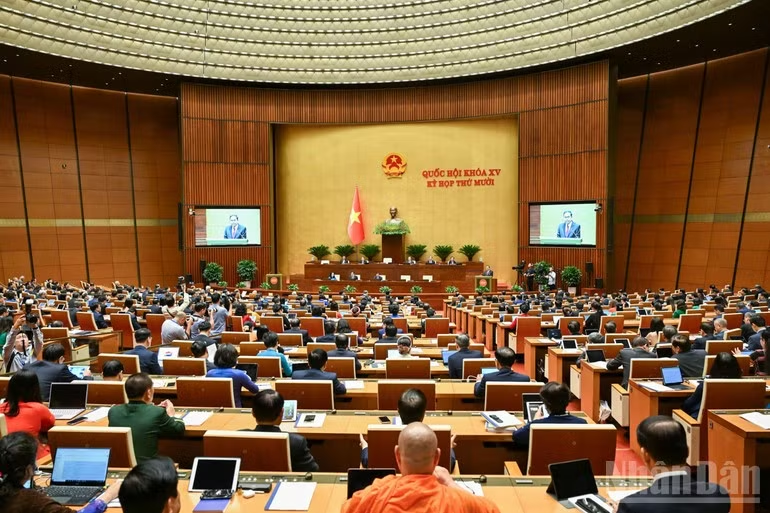
According to Dr Vo Toan Trung, a Vietnamese expatriate in France, Viet Nam's National Assembly has marked many outstanding milestones over its 80 years standing alongside the nation.
In Viet Nam's history, the date January 6, 1946, is always a special glorious milestone as it marks the first general election.
Responding to President Ho Chi Minh's call, Vietnamese people aged 18 and over across the country, regardless of gender, ethnicity, religion, or social background, enthusiastically participated in the first general election to elect Viet Nam's National Assembly.
That was the day Viet Nam's first National Assembly with a democratic electoral system was born. The victory of the general election is a brilliant milestone in the nation's history, opening a new development period for the Democratic Republic of Viet Nam, now the Socialist Republic of Viet Nam.
The victory of the general election is a brilliant milestone in the nation's history, opening a new development period for the Democratic Republic of Viet Nam, now the Socialist Republic of Viet Nam.
Following that was the event on March 2, 1946, when the first session of the first National Assembly convened in Ha Noi to officially establish the National Assembly, marking the beginning of Viet Nam's National Assembly activities.
A country that had just gained independence, after President Ho Chi Minh read the Declaration of Independence on September 2, 1945, had to step into two fierce resistance wars. In the prolonged resistance wars, Viet Nam's National Assembly made great contributions to steering the country through countless rapids and shoals to achieve national independence and unification.
Through those difficult periods of time, the National Assembly has accompanied the nation and matured remarkably with great contributions.
Viet Nam's National Assembly has truly been an institution embodying the nation's democratic regime under the leadership of the Communist Party of Viet Nam. The National Assembly and the Vietnamese State have jointly and closely managed Viet Nam's rhythm, demonstrating an institution elected by the people and working for the people. The National Assembly's great contributions have helped bring the country to today's glory.
Entering a new era and building a prosperous and strong nation, the National Assembly continues to play an immensely important role. That is rapidly institutionalising the Communist Party of Viet Nam's policies and guidelines into specific laws to build and open legal corridors and remove bottlenecks for the country to develop its full potential, placing the people at the centre of national development.
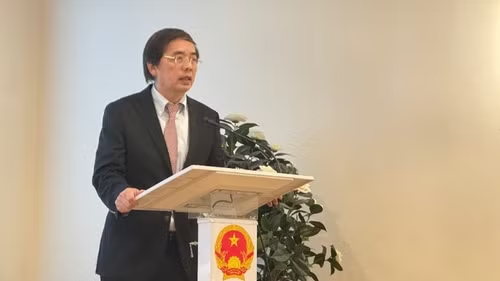
Dr Vo Toan Trung emphasised that looking back at the activities over one term, one can see the National Assembly's rapid changes to meet the country's development requirements.
The National Assembly has passed a huge number of laws and decrees across all fields, from healthcare and education to digital transformation and land laws suited to the new situation. Specifically, the Law on Vietnamese Nationality creates favourable conditions for over six million of Vietnamese expats living abroad to have the opportunity to regain Vietnamese citizenship.
The amended Law on Vietnamese Nationality 2025 has affirmed that the Party and state always consider Overseas Vietnamese as an inseparable part of the Vietnamese nation, contributing to building great national unity.
With a renewal mindset, the National Assembly has proactively renewed its legislative thinking, completing a record legislative workload with 150 laws and 49 regulatory resolutions. The rapid building, adoption, and amendment of laws has created a foundation for societal development.
In the time ahead, the adopted provisions will help Viet Nam clearly resolve knotty issues to unleash sources for investment and development, from society's core issues with laws on healthcare and education to science and technology development.

The healthcare and education laws will help the country realise the state's regulatory role. That is centring on people's health and education, placing human development at the core, and societal development.
When people, as the subjects, receive comprehensive healthcare and education, it will help the country become a liveable nation.
The amended Land Law contributes to unleashing resources and facilitating the legalisation of many existing land and ownership issues for the people, promoting economic development while building public trust.
The 2025 Law on Science, Technology, and Innovation will certainly help the country enter a new development era, unleashing all knowledge resources of Viet Nam at home and abroad.
The Law on Digital Transformation will contribute to shaping and developing the country in the future of the new era, propelling the nation into the group of developed countries worldwide.
The National Assembly's rapid lead will help Viet Nam join the group of countries building and operating a state based on clear laws, changing the country’s image on the international stage.
Additionally, the National Assembly's effective working methods reflect a renewal mindset in building a modern society. The National Assembly's rapid lead will help Viet Nam join the group of countries building and operating a state based on clear laws, changing the country’s image on the international stage, while creating international confidence in investing and cooperating for development with Viet Nam.
Along with passing a large number of legal documents on legislative work, organising the apparatus through resolutions amending the Constitution and laws on local government organisation has practically contributed to arranging the political system to suit the requirements of the new development stage.
Viet Nam's National Assembly has succeeded in supervisory activities, enhancing its supervision effectiveness. Live broadcasting National Assembly question sessions shows that the National Assembly's activities are truly democratic and effective, contributing to well-organised, in-depth supervision and realising the National Assembly's oversight role over state activities.
Modernising National Assembly activities through digital transformation application is a decisive step in building a modern National Assembly, enabling supervision of activities, and promoting the National Assembly's image to the people and international community. Foreign affairs activities to strengthen relations with other countries also bring practical effectiveness in foreign affairs.

According to ethnologist Dr Hoang Thi Hong Ha, January 6, 2026, is not only a special milestone when Viet Nam's National Assembly turns 80, but also marks the remarkable maturity of a democratic, law-governed institution.
This event, together with the 14th National Party Congress at the beginning of 2026, is opening the era of national rise.
Ha emphasised that over nearly eight decades, especially 40 years of Doi Moi (Renewal) process, Viet Nam has written a miraculous story. From a backward economy, Viet Nam has risen to be among the world's most open economies, in which people's living standards have improved markedly and the poverty rate has dropped sharply, an achievement internationally recognised as a bright spot.
Over the past 80 years, Viet Nam's National Assembly has played a key role in the journey of safeguarding, building, and developing the country since September 2, 1945, when President Ho Chi Minh read the Declaration of Independence.
On legislation, the National Assembly has built an increasingly synchronous and professional legal system, creating a solid corridor for the market economy.
On supervision, supreme supervisory activities have become more substantive, enhancing transparency and accountability.
On modern parliamentary operation, strong digital transformation in parliamentary activities has helped policies closely follow the pulse of life and voters' aspirations.
It can be said that over eight decades standing side by side the nation, Viet Nam's National Assembly has made commendable efforts across many fields, excellently fulfilling its role as the highest organ of state power and the highest representative body of the Vietnamese people.