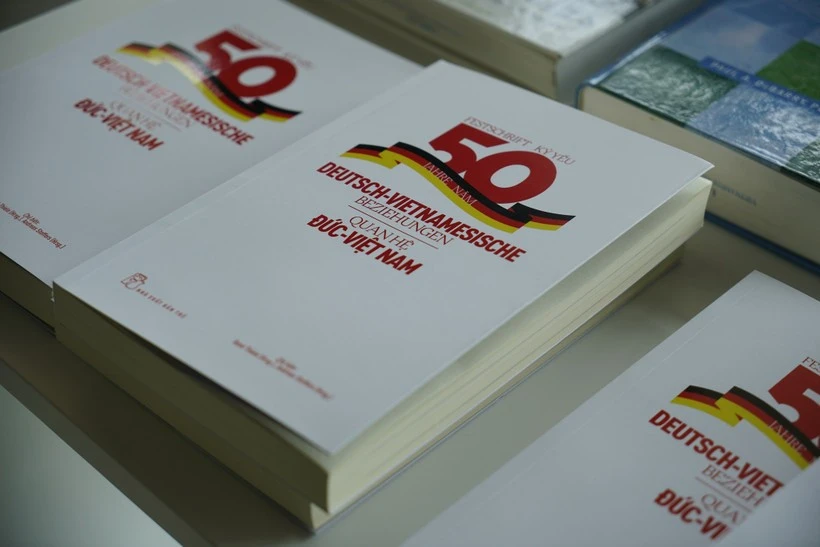
A commemorative publication titled “50 Years of Germany – Viet Nam Relations: Partners in the Past, Present and Future” offers a timely and comprehensive reflection not only on the 50th anniversary of bilateral diplomatic relations, but also on the strategic path ahead.
The book is co-edited by Professor Dr Rene Thiele, President of the Vietnamese – German University (VGU), and Professor Dr Andreas Stoffers, an expert on Southeast Asia and the Vietnamese economy at the FOM University of Applied Sciences in Essen.
The authors point out that the relationship between the two nations has been shaped by their shared experiences of division and reunification. As German Ambassador to Viet Nam Helga Margarete Barth writes in the book, ties between the two countries show that differences need not be an obstacle but can instead serve as a driving force. Germany and Viet Nam, she adds, share a determination to rise from the rubble to build prosperity.
From a political-economic perspective, Stoffers affirms that Viet Nam has become Germany’s “strategic anchor” in Southeast Asia. He argues that the shift from a donor – recipient model to a partnership of equals marks a defining turning point, demonstrating the special importance of bilateral relations.
Echoing this view, Marko Walde, Chief Representative of the German Chamber of Commerce and Industry in Viet Nam (AHK), notes that German companies do not come to Viet Nam merely in search of cheap labour, but to find innovative partners — helping position Viet Nam as an indispensable link in global green value chains.
The milestone “Ha Noi Declaration 2011”, which elevated the bilateral relationship to a Strategic Partnership, is highlighted as recognition of the highest level of political trust and as the foundation for deep and multifaceted cooperation in the following decade.
In the book, the entry into force of the EU – Viet Nam Free Trade Agreement (EVFTA) is described as the strongest economic catalyst in the relationship’s 50-year history. For Germany, the agreement, with clear commitments to investment protection and transparency, provides more favourable conditions for German businesses to access Viet Nam – a gateway to ASEAN, which is particularly important as Germany is seeking to diversify its global supply chains.
If the EVFTA is the “doorway”, the publication notes, Germany's core technologies and governance mindset serve as the “key”. The establishment of R&D centres by firms such as Bosch and Siemens is cited as evidence of the trust in Viet Nam’s brainpower, a strong shift from labour cooperation to innovation and Industry 4.0 partnerships.
Beyond economics, the over-200,000-strong Vietnamese community in Germany are viewed as “social capital” underpinning bilateral friendship, the book observes.
Viet Nam’s image in Germany has evolved from one associated with war to that of a dynamic economic partner and an influential country in ASEAN. The Vietnamese community here have conducted silent but thorough integration, not losing their national identify but using their fondness for learning and patience to enrich the multi-cultural society of Germany, said Vice Chairman of the Viet Nam – Germany Association Ludwig Graf Westarp, who is also a lecturer at the Dortmund University of Technology.
For Thiele, education remains the most sustainable cornerstone of partnership, with the VGU standing as a flagship project symbolising the two governments' mutual trust and long-term commitment to training future generations.
The publication concludes with a shared vision for a “Green Partnership”: Germany needs Viet Nam’s dynamism to help realise its climate commitments while Viet Nam requires Germany's green technology to drive its energy transition.
![[Infographic] Comprehensive strategic partnership between Viet Nam and Denmark](https://en-cdn.nhandan.vn/images/SCsTDAWshkugd_CR7euN3dJE8R5tBjXTeI_Ei3N1rqlMQ51GV2YGcjvxpQFD7-NjQniu1tgyhNBVDsDJmLSxVpkf6BzifI5ne9fyVawgZKkw1QSqvshBTU8QQcE1uc2tD2kFaBWIxM59QGKFzthJwQ/comprehensive-strategic-partnership-between-viet-nam-and-denmark-8462.png.avif)