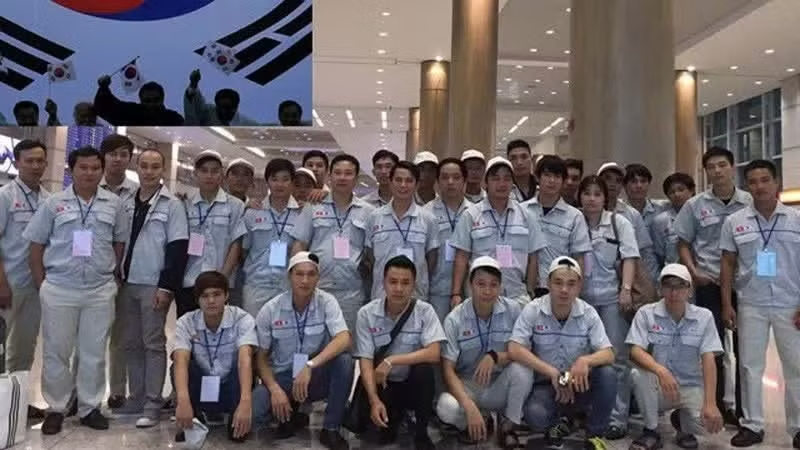
The Centre for Overseas Labour under the Ministry of Home Affairs stated that, in 2018, in response to labour shortages faced by enterprises in the RoK's root industry sector (welding and mould-making), the Ministry of Employment and Labour of the RoK requested that Viet Nam cooperate in implementing a recruitment project under the Employment Permit System (EPS) to supply workers for Korean enterprises operating in these industries.
Following this proposal, the Ministry of Labour, Invalids and Social Affairs (now the Ministry of Home Affairs) assigned the Centre for Overseas Labour to work with the Human Resources Development Service of Korea (HRD Korea) to implement the recruitment programme.
The project targets unskilled workers and does not require applicants to possess prior vocational skills. After successfully passing the preliminary screening, candidates receive basic vocational training in welding or mould-making, together with Korean language training, jointly organised by the Centre for Overseas Labour and vocational training institutions, before taking the Korean Language Proficiency Test and the skills assessment.
Competition in the manufacturing sector under the EPS programme is extremely intense. Applicants wishing to proceed to the skills assessment stage are normally required to achieve a Korean language test score of at least 110 points. In some recruitment rounds, the required score has been considerably higher. For example, candidates needed to score at least 150 points in 2024 and 180 points in 2025 before becoming eligible to submit an application to work in the RoK.
However, Vietnamese workers applying for positions in the root industry sector benefit from several preferential policies.
First, applicants are entitled to take the Korean Language Proficiency Test twice under a single registration. They need only achieve a minimum score of 90 out of 200 to qualify for the skills assessment and Korean-language interview conducted by the RoK. To pass the final assessment, candidates must obtain at least 120 out of 200 points in total, comprising a maximum of 120 points for the practical skills test and 80 points for the Korean-language interview. Those meeting this requirement are eligible to submit their applications for employment in the RoK.
Second, applicants are given priority by the RoK when being recommended to Korean employers.
Thanks to their basic vocational skills, together with the close cooperation between the Centre for Overseas Labour and HRD Korea, Korean employers consistently give priority to candidates recruited through this project. As a result, 100% of workers who successfully complete the selection process and submit their applications are offered employment contracts and subsequently depart for the RoK.
Through the six recruitment rounds since 2018, the Centre for Overseas Labour has selected and dispatched a total of 764 workers to the RoK under this particular project.
In 2025 alone, 669 workers successfully passed the selection process and submitted applications. To date, 449 workers have been selected by Korean employers and signed employment contracts, representing 67% of successful applicants, with 176 workers having already departed for the RoK. The Korean side will continue to give priority to introducing the remaining candidates to employers during subsequent recruitment rounds.
In 2026, the recruitment project for workers in the RoK's root industry sector under the EPS programme will continue. The Centre for Overseas Labour has already worked with HRD Korea to pre-select 518 workers, including 407 in welding and 111 in mould-making, who will attend vocational skills and Korean language training courses from July 6 to September 12, 2026.
The recruitment project for the root industry sector (welding and mould-making) under the 2026 EPS programme continues to offer numerous preferential policies, creating further opportunities for Vietnamese workers wishing to work in the RoK. Working in advanced Korean manufacturing facilities enables employees to develop specialised vocational skills. They also gain an advantage when applying to transfer to an E-7 visa for highly skilled workers, allowing them to remain and work in the RoK for the longer term. Meanwhile, upon returning to Viet Nam, they possess valuable high-level vocational skills that are highly sought after by major domestic enterprises.
Statistics from the Centre for Overseas Labour show that during the first six months of the year, nearly 2,900 workers departed for employment in the RoK under the EPS programme.
Between now and the end of the year, the centre will continue to work with HRD Korea to organise a range of activities, including skills assessments for minority occupations (fisheries, forestry, and services) for more than 800 workers who have met the Korean language requirements; Korean language examinations and skills tests for approximately 8,400 workers in the manufacturing sector; and vocational skills and Korean language training for around 520 workers applying to work in the RoK's root industry sector.