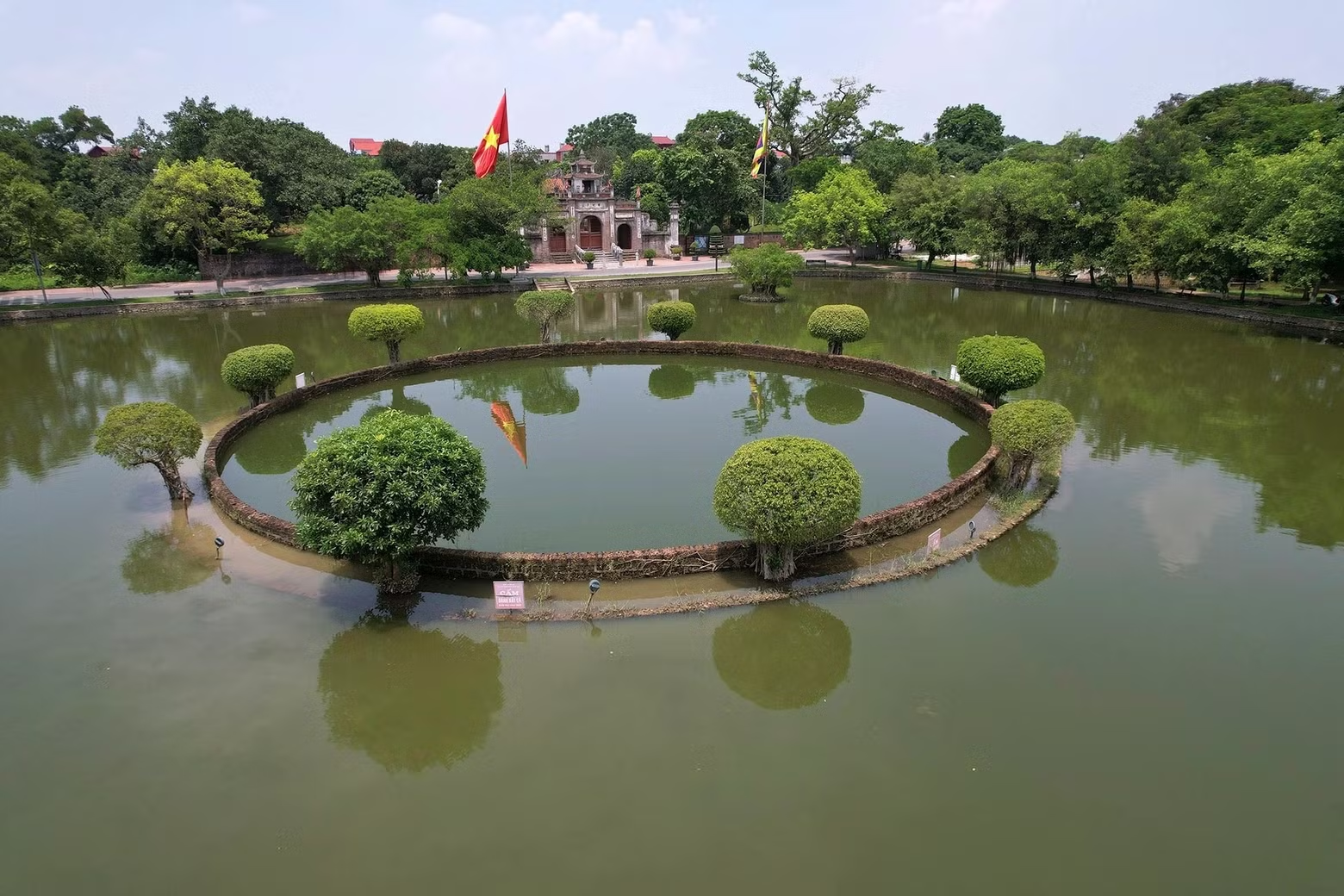
Ha Noi is currently finalising documentation to submit a summary of the nomination dossier for the Co Loa Relic Site to the World Heritage Centre, for consideration by the World Heritage Committee for inclusion on the Tentative List in early 2027.
Outstanding universal value
The ancient Co Loa Citadel, together with the historical narratives and legends surrounding the citadel and figures such as An Duong Vuong, My Chau, Trong Thuy, and Cao Lo, has been known for centuries.
Since 1959, dozens of archaeological sites have been uncovered, excavated, and studied, providing tangible evidence that substantiates historical accounts. The Co Loa Relic Site currently contains 17 archaeological sites and is one of the rare places to demonstrate the continuous development of four archaeological cultures: Phung Nguyen, Dong Dau, Go Mun and Dong Son.
Archaeological evidence indicates that communities inhabited the Co Loa area for approximately 2,000 years before An Duong Vuong built the citadel there. The most significant discoveries, however, pertain to the third century BC, when An Duong Vuong established his capital at Co Loa and founded the Au Lac State.
Archaeological excavations have revealed the structure and scale of the citadel walls, along with an extensive collection of artefacts. These include agricultural tools, most notably a collection of bronze ploughshares; weapons such as arrowheads, daggers, and battle axes; and various household utensils. Together, they provide compelling evidence of the flourishing Dong Son culture under An Duong Vuong. Of particular significance is the Co Loa bronze drum, which has been recognised as a National Treasure and is considered one of the finest bronze drums discovered to date.
Associate Professor Lai Van Toi from the Institute for Asian Civilisation Studies stated: “In addition to the three known ramparts of Co Loa that have been studied, we have discovered, some distance beyond the outer rampart, an advance defensive earthwork, a system of reinforced pile foundations, and traces of construction works. This demonstrates that the citadel was extremely complex in both scale and structure and extended beyond the three surviving ramparts.”
Associate Professor Tong Trung Tin, President of the Viet Nam Archaeological Association, noted that among the discoveries dating from the An Duong Vuong period were as many as 45 bronze-casting furnaces, indicating metallurgical production on a very large scale. The findings also demonstrate that Co Loa was both a centre receiving products from other areas and a production hub supplying bronze objects elsewhere.
The value of the Co Loa Relic Site has long been recognised. However, for it to be inscribed as a World Cultural Heritage Site, its Outstanding Universal Value must be clearly established in accordance with the criteria of the World Heritage Convention. Following extensive research and consultation with relevant professional bodies, Ha Noi has selected criteria (iii) and (iv) for the proposed nomination.
Dr Vu Van Quan from the University of Social Sciences and Humanities under Vietnam National University, Ha Noi, explained: “Co Loa meets criterion (iii) because few places in Southeast Asia preserve such complete and continuous cultural sequences reflecting the development of an indigenous civilisation over more than two millennia before state formation, culminating in the Au Lac period. These achievements were manifested in the form of a major centre of power of an early state. Even after the end of the Au Lac State, Co Loa was repeatedly chosen as a political and military centre. Its sacred landscape, including temples, shrines, legends, and festivals, has been continuously preserved for thousands of years. Under criterion (iv), Co Loa is an outstanding example of a large-scale earthen fortified settlement planned and constructed during the early stages of state formation in Southeast Asia.”
Preserving and promoting its values for the long term
On November 13, 2025, the Ha Noi Municipal People’s Committee dispatched a document to the Ministry of Culture, Sports, and Tourism, requesting consideration and submission to the Prime Minister for approval to prepare a nomination dossier for the Co Loa Relic Site for UNESCO World Cultural Heritage status. The city subsequently began the process of developing the heritage nomination dossier.
Professor Nguyen Quang Ngoc, Vice President of the Viet Nam Association of Historical Sciences, stated that in 2007–2008, following surveys of the Co Loa Relic Site, UNESCO experts recommended that Viet Nam promptly prepare a dossier to nominate Co Loa for World Heritage status. Recalling this, he noted, demonstrates that Co Loa’s heritage values have long received international recognition.
During the 2007–2008 period, following surveys of the Co Loa Relic Site, UNESCO experts recommended that Viet Nam promptly prepare a dossier to nominate Co Loa for World Heritage status. Recalling this shows that Co Loa’s heritage values have long received international recognition.
Following research and consultations with relevant agencies and scientists, Ha Noi is finalising a draft summary report for submission to UNESCO to request the inclusion of the Co Loa Relic Site on the Tentative List for World Heritage nomination. The report is expected to be submitted to the World Heritage Centre in September 2026 for consideration by the World Heritage Committee in February 2027. These constitute important steps towards the potential recognition of the Co Loa Relic Site as a World Cultural Heritage Site in the future.
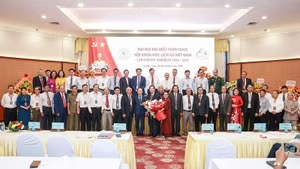
Speaking at a workshop on identifying the Outstanding Universal Value of the Co Loa Relic Site on August 12, 2026, Deputy Secretary of the Ha Noi Party Committee Nguyen Van Phong stressed: “Ha Noi has recently approved a 100-year vision for the planning, construction, and development of the capital. Under this vision, the northern area is identified as an important growth driver. The preservation and promotion of the Co Loa Relic Site must therefore be integrated into this development process.
“Ha Noi will commission scientists and direct specialised agencies to systematise existing knowledge and conduct comprehensive research on the Co Loa Relic Site as well as other heritage assets in the northern area, identify priority areas for resource allocation, and carry out digitalisation to support education, communication, and promotion. In the future, the Co Loa Relic Site will be developed into a heritage park. We therefore need to begin preparing early for appropriate management and operational models to ensure that the heritage park is utilised as effectively as possible.”