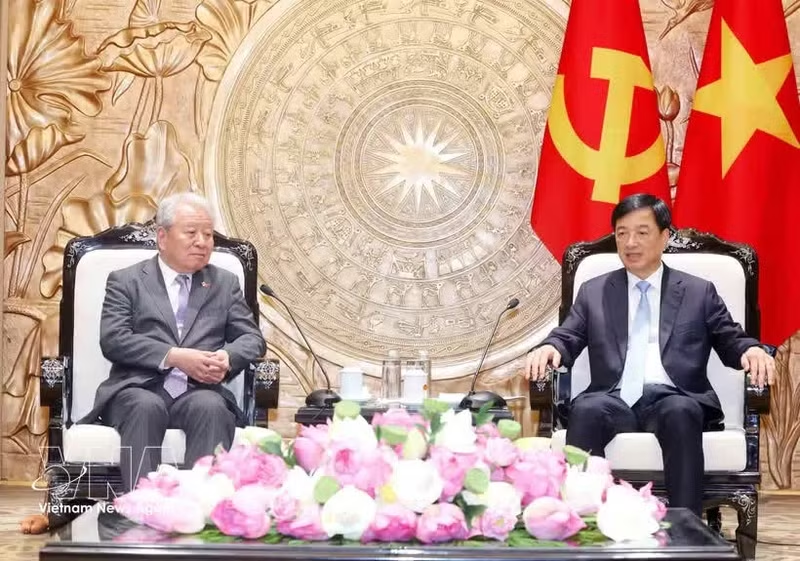
Politburo member, Secretary of the Party Central Committee and head of its Organisation Commission Nguyen Duy Ngoc hosted a reception in Ha Noi on June 9 for Tanaka Akihiko, President of the Japan International Cooperation Agency (JICA), during which the two sides discussed expanding cooperation in leadership and public-sector training.
Welcoming Tanaka and the JICA delegation, Ngoc highlighted the strong, substantive and effective development of the Viet Nam–Japan Comprehensive Strategic Partnership across politics, trade, investment, education, culture and people-to-people exchanges, underpinned by high political trust. He noted that Japanese Prime Minister Takaichi Sanae’s visit to Viet Nam in May further deepened bilateral cooperation and friendship.
Sharing Viet Nam’s development orientations and priorities following the 14th National Party Congress, Ngoc said the country aims to achieve average annual GDP growth of at least 10% during 2026–2030 through three strategic breakthroughs - institutional reform and execution; high-quality human resources development linked to science, technology and innovation; and modern, synchronised infrastructure.
He stressed that building a capable contingent of leaders and managers at all levels, particularly strategic-level officials, remains a key task. Amid the requirements of the Fourth Industrial Revolution and the rapid evolution of artificial intelligence, training programmes must transition decisively from knowledge transmission to the holistic development of leadership and managerial competencies.
Priority should be given to fostering strategic thinking, policy formulation capabilities, modern governance and risk management skills, as well as the capacity to drive digital transformation.The Party official also called for stronger integration of digital technologies into training programmes, including knowledge and skills related to data, artificial intelligence (AI), cybersecurity and other strategic technologies.
The two sides reviewed cooperation outcomes in cadre training, noting that nearly 490 Vietnamese officials have participated in programmes in Japan under JICA-supported projects aimed at developing strategic leaders and young local-government officials.
Looking ahead, the Party Central Committee’s Organisation Commission leader proposed that JICA continue implementing a leadership capacity-building project for 2026–2028, aligned with Viet Nam’s development priorities and four new pillars of bilateral cooperation - AI, digital transformation, smart cities and high-tech infrastructure; high-quality human resource development and institutional reform; green and circular economy development and disaster prevention; and social welfare, health care, elderly care and private-sector development.
The commission also suggested introducing medium-term training courses of one to three months for strategic-level officials, particularly in science, technology and AI, combined with policy research, practical exchanges and engagement with senior Japanese leaders.
Tanaka welcomed Viet Nam’s development goals and underscored the importance of leadership training in supporting the country’s next stage of development. He noted that bilateral cooperation in this field began in 2018 and said future programmes should incorporate emerging areas such as digital transformation, AI applications and evidence-based policymaking.
JICA, he said, will continue working closely with the Organisation Commission to design training programmes that are practical, relevant and effective.
Ngoc thanked JICA for continued support and voiced hope for deeper cooperation in areas where the agency has strengths and which align with Viet Nam’s strategic development priorities.
He expressed confidence that cooperation between the two sides will continue to deliver practical results, contributing to Viet Nam’s rapid and sustainable development goals while further strengthening the Viet Nam–Japan Comprehensive Strategic Partnership.
![[In Pictures] General Secretary and President To Lam and his spouse visit and present books to Royal Library of Belgium](https://en-cdn.nhandan.vn/images/3NY4Z6Du1Md1PrS_s0ZZOrwc5xDfq4rRua69depr-TBkwatGjBcD9lagzrI2BmGDo4nKYA9qjKDjuB3-yYloL_1KbNBr00klMZQFyHQxQ6Jq6GzFfAiY0m5agKw6jNtArN4QnVntX8RQeUmD7pdCq7nwvn3e235v3kufpokBN_s/1-tong-bi-thu-chu-tich-nuoc-va-phu-nhan-tham-tang-sach-cho-thu-vien-hoang-gia-bi.jpg.avif)