Strengthening confidence and building social consensus
In recent times, Party committees and organisations at all levels have proactively implemented various measures to counter the plots and tactics of hostile forces. Efforts have been made to dispel misinformation and expand the reach of positive, constructive content, thereby helping to safeguard the Party's ideological front — particularly as hostile forces exploit cyberspace to disseminate toxic information and distort the revolutionary cause of the Party and the people.
On October 22, 2018, the Political Bureau issued Resolution No. 35-NQ/TW on strengthening the protection of the Party's ideological foundation and countering erroneous and hostile views in the new situation.
Adhering closely to the resolution, Party committees and organisations have implemented a comprehensive set of solutions, prioritising education, communication, and raising awareness among officials and Party members.
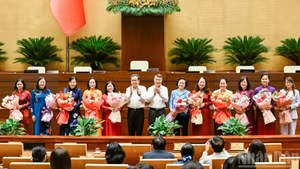
In 2021, the Party Committee of the Ho Chi Minh National Academy of Politics organised a political commentary contest on protecting the Party’s ideological foundation, specifically for officials and lecturers. Following the contest’s success, the Central Steering Committee 35 decided to elevate it to a national-level event.
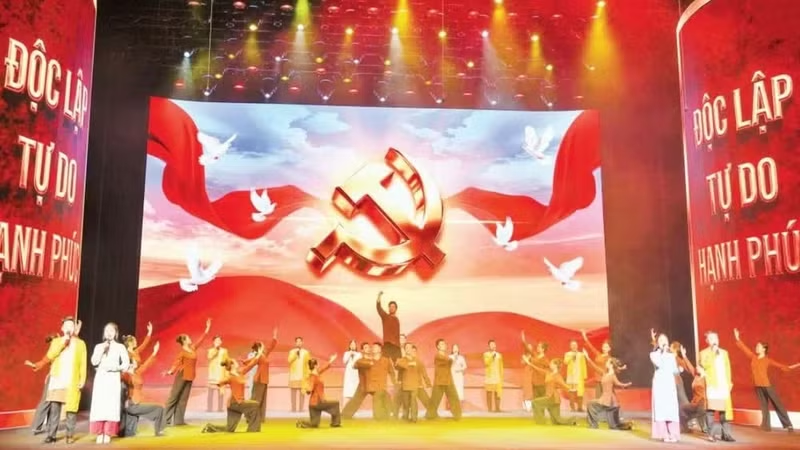
Over more than five years of implementation, the contest has evolved into a profound and widespread political activity, attracting participation from key members of Steering Committee 35 at all levels, theoretical research institutions, journalists, and a vast number of domestic and international authors across diverse social backgrounds, professions, and age groups. By 2026, the organising committee had received 905,681 entries (an increase of 363,915 entries compared to 2025).
To amplify positive information, the Party Central Committee’s Commission for Publicity has conducted numerous high-intensity communication campaigns centred on key national events.
Local publicity agencies have proactively advised Party committees on building core forces for online engagement and struggle, establishing and effectively operating official communication channels, and prioritising the enhancement of online communication and advocacy skills among officials, speakers, collaborators, and core personnel through professional training sessions, seminars, and experience-sharing forums.
In Tay Ninh province, competent authorities have established and managed 175 social media forums, publishing over 600,000 pieces of content and generating 900 million interactions and reach.

Fostering awareness and responsibility across society
During the process of thoroughly grasping and implementing Resolution No. 35-NQ/TW, Party committees at all levels have identified the protection of the Party's ideological foundation as a core task for Party organisations, rather than solely the responsibility of the publicity sector or “Steering Committee 35” bodies.
Party committees at all levels have directed efforts to step up the detection of, and engage in direct combat against, distorted narratives and slanderous claims propagated by hostile forces.
According to Senior Colonel Trinh Xuan Viet, Head of the Institute of Military Social Sciences and Humanities at the Military Political Academy under the Ministry of National Defence, the institute’s Party committee and leadership encourage officers and staff to uphold their sense of responsibility, improve the quality of articles countering erroneous and hostile views, and diversify their methods of engagement.
By thoroughly understanding the sabotage plots and tactics of hostile forces — and rapidly gathering and selecting relevant information and counter-arguments — the institute’s Party committee and leadership organise the publication of articles on dedicated pages and the Academy’s website, while enhancing the quality of direct rebuttals against erroneous and hostile views in the mass media.
Across many agencies, units, and localities, Party committees encourage officials, civil servants, and employees to leverage the strengths and specific characteristics of their assigned sectors and fields to proactively participate in protecting the Party's ideological foundation.
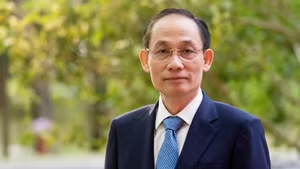
Le Van Loi, Member of the Party Central Committee and President of the Viet Nam Academy of Social Sciences (VASS), stated that the VASS Party Committee consistently integrates political and ideological Party-building efforts with the enhancement of scientific research quality to serve the nation.
In doing so, it leverages the research strengths of the Academy’s 18 specialised institutes and affiliated units to provide scientific arguments and refute erroneous or hostile viewpoints using data, documentation, evidence, and scientific methodology, thereby affirming that the social sciences and humanities serve as a potent weapon on the ideological front.
By establishing mechanisms for practical personnel rotation at the local level and recruiting Party members from among talented young researchers, the VASS Party Committee aims to link research with the lives of the people and to promptly detect and rectify manifestations of ideological degradation, deviation, excessive admiration for foreign models, individualism, and detachment from both theory and practice.
In practice, the younger generation has actively responded to efforts to safeguard the Party's ideological foundation. Many school-based Party committees are increasingly prioritising and intensifying political and ideological education while fostering a spirit of patriotism among students.
Nguyen Hieu, Deputy Secretary of the Party Committee and Permanent Vice President of Viet Nam National University, Ha Noi, noted that higher education is facing increasingly strong impacts from technology, market mechanisms, and competitive pressures.
Consequently, teaching must go beyond merely enhancing learners' capabilities; it must primarily aim to cultivate individuals who possess ideals, a sense of responsibility toward the country, political steadfastness, and a desire to contribute.
To help raise political awareness and strengthen the confidence of young people in the Party and the political system, the Youth Union of the Ho Chi Minh National Academy of Politics has established and maintains 12 fanpages and a dedicated group focused on defending the Party’s ideological foundation, attracting thousands of followers.
Luong Quang Huy, Secretary of the Academy’s Youth Union, shared that most video clips, infographics, and multimedia products are created by young lecturers, students, and trainees across the VASS system. These materials focus on conveying political theory using language that resonates with young people, combining academic accuracy with the engaging nature of digital media.
This approach harnesses the creativity of the youth in defending the Party's ideological foundation while simultaneously helping to nurture revolutionary ideals among students and trainees.
Amidst a complex global and regional landscape — where hostile forces employ increasingly sophisticated tactics to undermine the Party’s ideological foundation — enhancing the effectiveness of the struggle to safeguard that foundation has become an objective and urgent necessity.
The Party Central Committee has frankly acknowledged certain shortcomings: efforts to defend the Party’s ideological foundation have at times lacked sharpness; the workforce remains limited; and technical tools lack synchronisation. Furthermore, ideological work at some grassroots levels has failed to keep pace with requirements following the reorganisation of the apparatus and the restructuring of local government models.
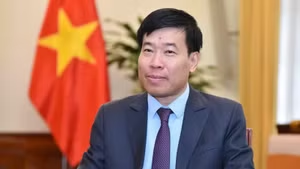
According to Trinh Van Quyet, Politburo Member, Secretary of the Party Central Committee, and Head of the PCC’s Commission for Publicity, the primary cause of these limitations is the absence of a comprehensive strategy for ideological work. The issue does not lie solely with the publicity sector itself but rather stems from the lack of a strategic framework of sufficient scope — one that effectively mandates responsibilities and secures the necessary resources.
Politburo Resolution No. 25-NQ/TW (dated August 22, 2026) serves as a pivotal strategic document; it introduces new mindsets, methods, and solutions designed to boost the effectiveness of defending the Party’s ideological foundation in the context of digital transformation, extensive international integration, and increasingly complex challenges in cyberspace.