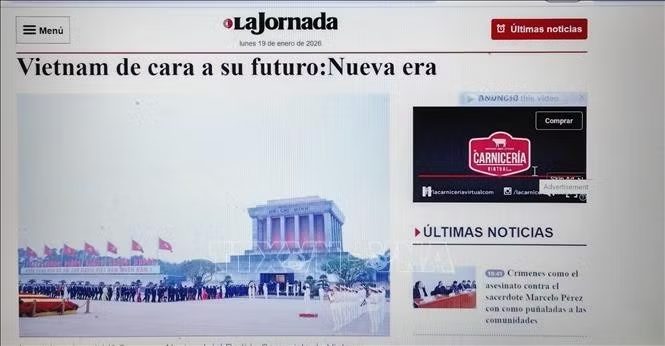
In a January 19 article for Mexico’s largest left-wing daily, La Jornada, Kyra Núñez highlighted Viet Nam’s historic successes in its fight for national liberation, defence, and nation-building. She noted how the country has gone from a poor state with limited post-reunification international ties to an active, responsible member of the global community, all while steadily improving citizens’ lives in areas like jobs, health care, education, culture, and security.
The article emphasised the 14th National Congress of the Communist Party of Viet Nam (CPV) as pivotal in setting higher development targets, adopting strategic resolutions for a new era, and shaping a vision through 2045 to achieve Viet Nam’s goal of becoming a developed, high-income nation.
According to the article, the implementation of the Resolution of the 13th Party Congress amid the COVID-19 pandemic and global fluctuations has demonstrated the resilience and dynamism of Viet Nam’s economy, with macroeconomic stability maintained and a strong trade surplus. In 2025 alone, the country’s GDP growth reached 8.02%, with a five-year average of 6.3%, ranking among the world’s highest.
Industry, services, and infrastructure have continued to improve, with the private sector emerging as a key driver of growth that promotes social progress and equity. Amid global volatility, Viet Nam has strengthened defence and security, creating a solid foundation for its 2026–2030 socio-economic development plan, it reported.
The article spotlighted Viet Nam’s foreign policy in the new era, shaped by the 13th National Party Congress. It also emphasised efforts to strengthen the Party building and rectification, combat corruption, wastefulness and negative practices, and streamline the state apparatus, including the implementation of a two-tier administration model – a breakthrough in organisation and management.
Viet Nam has also positioned itself as a country with an increasingly important role in the region and the world. According to Mexican scholars, Viet Nam’s success stems from the serious and consistent implementation of the CPV’s resolutions, enabling the country to enter a new era of development.
Kyra Núñez described Viet Nam as a “new tiger of Asia,” steadily becoming more integrated into the global community through diplomacy and trade. Mexico, the first Latin American nation to establish diplomatic ties with Viet Nam, has seen its relationship with the country grow rapidly, especially over the past 15 years.
The Mexican scholar cited Dr Alicia Girón, Director of the University Programme for Studies on Asia and Africa (PUEAA) at the National Autonomous University of Mexico (UNAM), who described Viet Nam as a global model of openness and integration, successfully harnessing its production potential, lifting tens of millions out of poverty, and achieving impressive economic growth.
Viet Nam’s active and constructive role in ASEAN and multilateral forums such as the Asia-Pacific Economic Cooperation (APEC) forum clearly demonstrates its diplomatic strength and commitment to peace, stability, and development in the region and the world, the article said.
According to the article, Mexico holds strategic significance for Viet Nam due to similarities in inclusive economic development orientation and its geostrategic position linking North America and South America. There is huge room for the two countries to boost cooperation in education and training, innovation, science and technology, culture, and multilateral coordination to address global geopolitical challenges.