
A new security frontline in Africa
The International Criminal Police Organisation (Interpol) has released its African Cyberthreat Assessment Report 2026, revealing that 55% of cyberattacks across Africa are enabled by artificial intelligence (AI).
#cybersecurity
The International Criminal Police Organisation (Interpol) has released its African Cyberthreat Assessment Report 2026, revealing that 55% of cyberattacks across Africa are enabled by artificial intelligence (AI).
Prime Minister Le Minh Hung attended a meeting marking Viet Nam Cybersecurity Day in Ha Noi on the morning of August 6.

Prime Minister Le Minh Hung has stressed that cybersecurity must combine the protection of information systems with the protection of people, describing citizens’ safety, security and well-being as the ultimate measure of all cyber policies.

Three Vietnamese students are taking part in the Positive Hack Camp 2026 in Moscow, an international cybersecurity training programme bringing together aspiring “white hat” hackers from around the world.

Minister of Public Security General Luong Tam Quang hosted a reception in Ha Noi on July 29 for a delegation from Italy's Leonardo S.p.A. led by Daniele Tavano, Director for Global Sales Air Traffic Management Systems, to discuss expanding high-tech cooperation in support of national security and public order.

Prime Minister Le Minh Hung has ordered developing a national digital architecture framework that will ensure seamless interoperability across Viet Nam's political system, paving the way for data-driven governance and more efficient public services.

Viet Nam has called for broader international participation in the United Nations Convention against Cybercrime (Ha Noi Convention), highlighting the need for stronger global cooperation to address increasingly sophisticated cross-border cyber threats.

A national training programme on cybersecurity for digital transformation has been launched as part of the “Viet Nam Cybersecurity Range”, marking a significant step towards strengthening information security and risk management capabilities.

PM Chinh stressed that the increasingly complex developments in the global and regional situation require new mindset, particularly in addressing non-traditional security threats, including cyberattacks, online fraud, and activities that could undermine political stability and social order.

Viet Nam is seeking the United Nations (UN)'s policy guidance and international expertise to design AI and data governance frameworks, with the goal of developing practical guidelines for the public and private sectors, Minister of Public Security General Luong Tam Quang has said.

Digital transformation is creating fresh momentum for the country’s development, but it is also bringing new challenges regarding information safety and cybersecurity. To protect a safe and healthy cyberspace, the decisive factor lies not only in technology, but also in having a high-quality workforce — the foundation for safeguarding national security and digital sovereignty.

Vietnamese technology giant FPT Corporation has announced plans to invest 100 million USD in its newly established Quantum AI and Cybersecurity Research Institute, one of the first quantum research centres founded by a Vietnamese enterprise.

Cyberspace has become a new domain of national sovereignty. However, alongside its positive aspects, the rising wave of cyberattacks and the heavy dependence on foreign technologies are placing Viet Nam under urgent pressure to respond effectively to mounting cybersecurity threats.

The boom in digital technologies and artificial intelligence (AI) has been accompanied by increasingly sophisticated violations — from fraud and identity spoofing using face and voice manipulation to image-based manipulation — posing serious threats to information security and citizens’ interests. This reality highlights the urgent need for a robust legal framework to protect users and strengthen cyber-security.
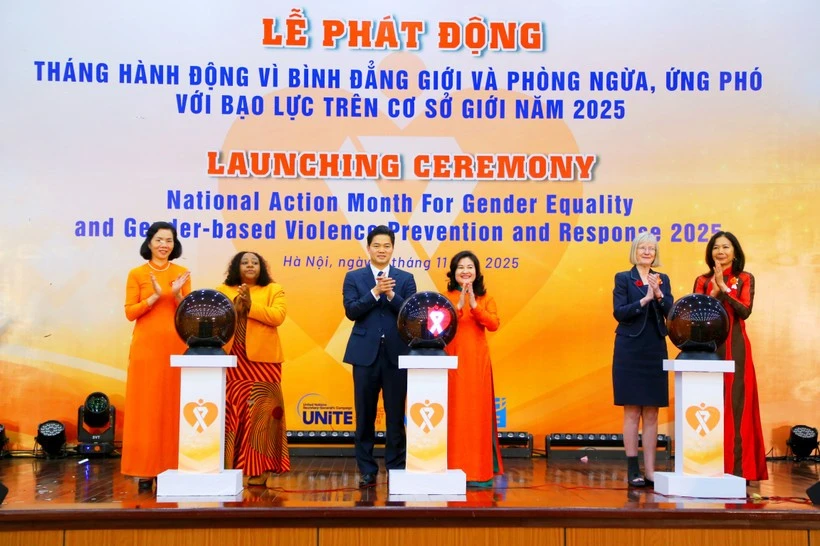
A ceremony was held in Ha Noi on November 11 to launch the National Action Month for Gender Equality and Gender-Based Violence Prevention and Response 2025, themed “Gender Equality and Safety for Women and Girls in the Digital Era.”

The “Not Alone” online safety festival officially opened at Dong Kinh Nghia Thuc Square in Hoan Kiem, Ha Noi, on the afternoon of November 1 with the attendance of around 500 participants — including representatives of ministries, departments, international organisations, technology enterprises, students, and tourists.
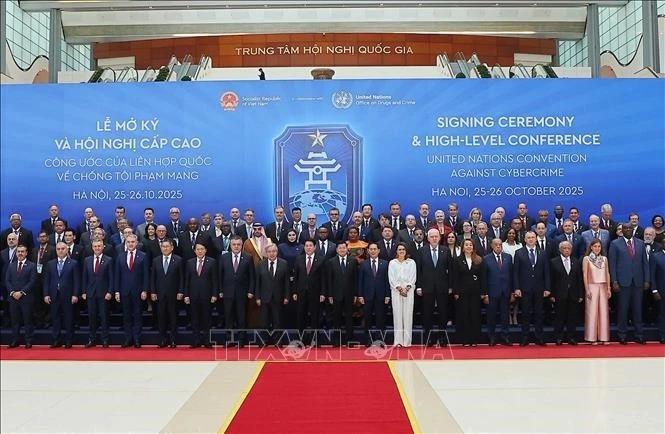
The Signing Ceremony of the United Nations Convention against Cybercrime (Ha Noi Convention) marks a milestone in the 47-year cooperation between Viet Nam and the UN, reflecting the nation’s ambition to help shape global digital governance rules, according to reports by Geopolitical Monitor (Canada) and Channel News Asia (Singapore).
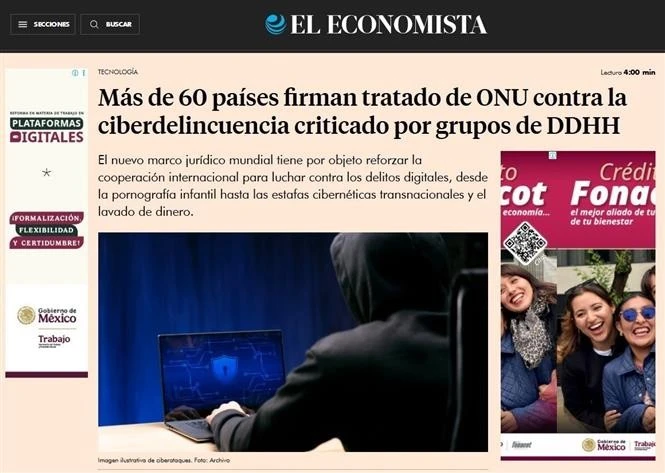
Latin American media have praised Viet Nam for successfully hosting the Signing Ceremony and High-level Conference of the United Nations Convention against Cybercrime (known as the Ha Noi Convention), calling it a historic milestone in international cooperation to ensure global cybersecurity.

The United Nations Convention against Cybercrime, also known as the Ha Noi Convention, will truly become a beacon guiding global cooperation on cybersecurity, leading the world toward the goal of “technology for humanity, digitalisation for peace,” Politburo member, Minister of Public Security Gen. Luong Tam Quang affirmed on October 26.

Viet Nam has a very important role to play in advancing global efforts against cybercrime, stated British Ambassador to Viet Nam Iain Frew on the sidelines of the signing ceremony of the UN Convention against Cybercrime (Ha Noi Convention), which took place in the capital city on October 25.