When directed towards the right priorities, public investment can serve as a lever for economic growth while creating opportunities for businesses to strengthen their capabilities.
Managing capital flows with a new mindset
At the end of July, T&T Group and the Viet Nam Development Bank (VDB) signed a financing agreement for projects in transport infrastructure, energy, industrial parks, and logistics, among other sectors. These fields play a leading role in driving growth and require substantial implementation capacity and long-term financial resources. The scale and nature of this investment portfolio provide the foundation for T&T Group to expand its cooperation with financial institutions, including VDB.
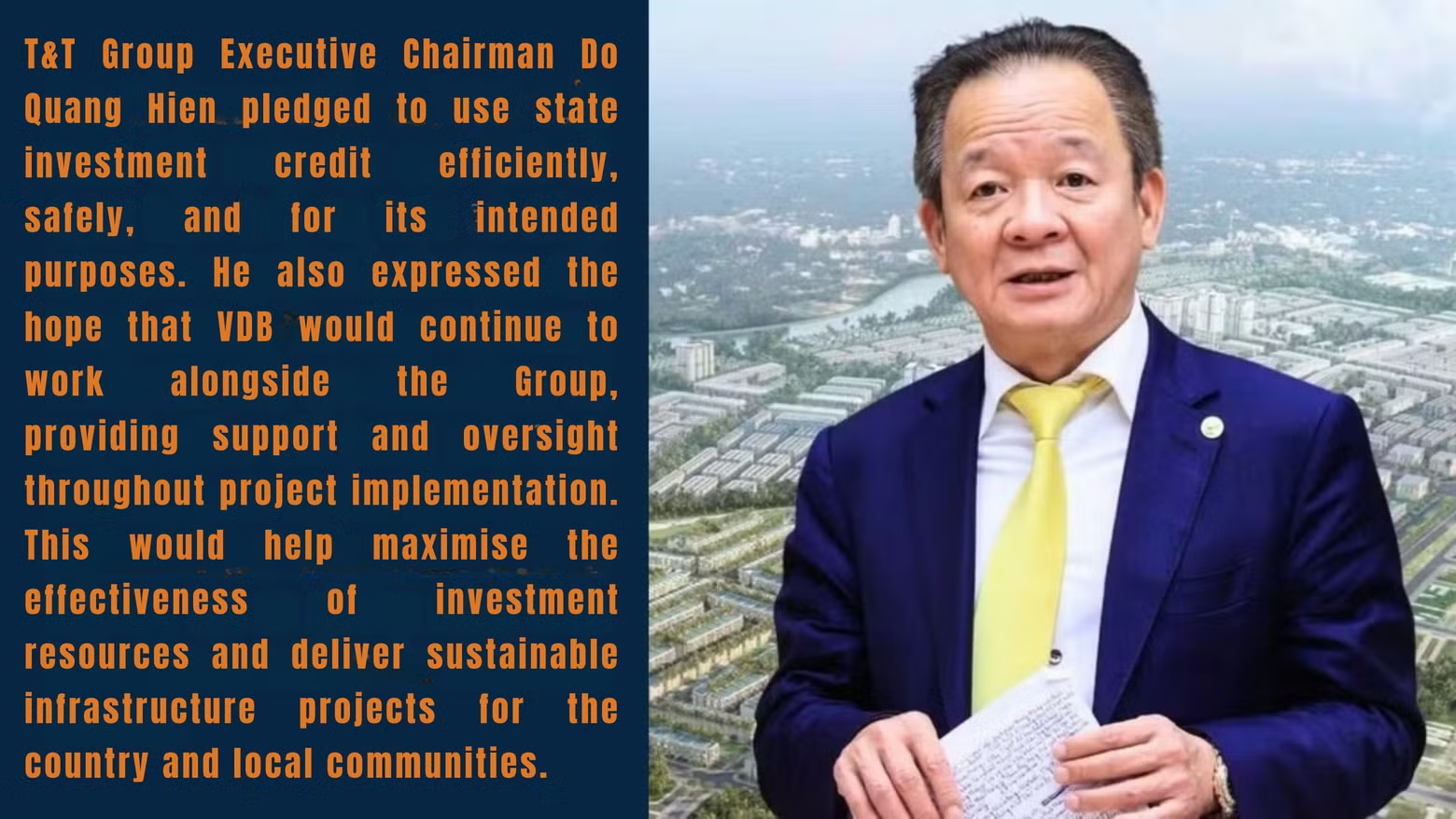
T&T Group Executive Chairman Do Quang Hien pledged to use state investment credit efficiently, safely, and for its intended purposes. He also expressed the hope that VDB would continue to work alongside the Group, providing support and oversight throughout project implementation. This would help maximise the effectiveness of investment resources and deliver sustainable infrastructure projects for the country and local communities.
Establishing a cooperation mechanism with VDB not only opens up an additional channel through which eligible projects can access state investment credit, but also reflects a broader trend towards diversifying the financial resources available to support T&T Group’s long-term investment portfolio. It further establishes a collaborative framework between private enterprises and state-owned development finance institutions to mobilise resources for projects in priority sectors. More broadly, it demonstrates that state investment capital is now being deployed with a new mindset: proactively guiding, unlocking, and multiplying resources across society.
Resolution No. 79-NQ/TW, issued by the Politburo on January 6, 2026, on the development of the state economy, clearly states: “The state economy must take the lead in creating the conditions for development, providing direction, opening the way, promoting industrialisation and modernisation, restructuring the economy, and establishing a new growth model.” Through financial institutions such as VDB, state resources guide capital flows into strategic sectors, generating spillover effects and attracting substantial investment from businesses and society. This model has proved effective in many developed countries, where public funds serve as “seed capital” to mobilise private investment.
To sustain double-digit economic growth over the coming years, the country must prioritise investment in transport infrastructure, energy, logistics, and other sectors characterised by long investment cycles and extended payback periods. State budget allocations and commercial credit are considered unlikely to meet the substantial capital requirements of these sectors. In this context, state investment credit channelled through VDB is directed towards priority areas, while businesses must fully satisfy conditions regarding project viability, financial capacity, equity capital, and debt repayment plans. These criteria are essential to identifying projects genuinely capable of generating added value for the economy.
An opportunity for businesses to grow and mature
According to Associate Professor Dr Ngo Tri Long, an economist affiliated with the Viet Nam Financial Consultants Association, the fundamental purpose of public investment is to provide “seed capital” that guides and mobilises resources across society. State budget funds are prioritised for essential infrastructure projects requiring substantial investment and long payback periods — areas that the private sector would find difficult to undertake independently. Every dong of public investment disbursed not only generates direct value for the project concerned but also creates spillover effects across multiple economic sectors, from construction and building materials manufacturing to services, trade, and employment.
In recent years, the Government has placed considerable emphasis on encouraging innovation and strengthening business capabilities. However, for this policy direction to translate into practical capacity, businesses need opportunities to gain hands-on experience by participating in major domestic infrastructure projects, enabling them to develop progressively. Enterprises themselves must deepen their partnerships, specialise in their respective fields, and grow into capable general contractors equipped to undertake the country's key infrastructure works and major national projects.
The fundamental purpose of public investment is to provide ‘seed capital’ that guides and mobilises resources across society.
Associate Professor Dr
Ngo Tri Long
Associate Professor Dr Dinh Trong Thinh, an economist, observes that businesses can build up their general contracting capabilities only through experience gained from successive projects. One of the conditions for developing strong general contractors is a change in how bundles are organised and managed. Consolidating individual contract packages into larger packages and assigning them to a single general contractor for management is an emerging approach that warrants further study, as it could help standardise technical implementation and accelerate project delivery. Businesses would be given greater autonomy in organising and executing the work, while the State would retain control over the projects.
The consistent policy direction of the Party and the State on investment is to maximise the use of social resources and diversify capital mobilisation channels, with the private sector identified as an important funding source alongside public investment. On average, every dong of state capital invested has mobilised nearly three dong from non-budgetary sources, demonstrating the state's seed-capital role in line with the intended orientation. Recently, Politburo Resolution No. 68-NQ/TW on private-sector development, issued on May 4, 2025, introduced a new perspective: the private sector is not merely a participant in the market, but also a force working alongside the State to organise and develop the economy.
The target of completing 5,000km of expressways by 2030 is of great significance, establishing a vital infrastructure foundation to support targeted average annual GDP growth of at least 10%. Given the limitations of state resources, mobilising investment from non-budgetary sources is critically important.
Minister of Construction Tran Hong Minh
According to Minister of Construction Tran Hong Minh, the target of completing 5,000km of expressways by 2030 is of great significance, establishing a vital infrastructure foundation to support targeted average annual GDP growth of at least 10%. Given the limitations of state resources, mobilising investment from non-budgetary sources is critically important.
The Ministry has drawn up a list of 29 priority projects for investment under the public-private partnership (PPP) model, with total estimated capital of approximately 923 trillion VND. These projects focus on expanding the existing North–South Expressway, completing ring roads around major cities, and developing connecting routes along the East–West Economic Corridor, in the Central Highlands, and across the Mekong Delta, among other areas.
The Ministry has pledged to maintain dialogue mechanisms and strengthen coordination among relevant agencies and organisations, promptly addressing bottlenecks to create favourable conditions for businesses to participate in and grow through these projects.