As Viet Nam sets its sights on becoming a developing country with a modern industrial base and upper-middle-income status by 2030, repositioning its FDI attraction strategy towards high quality, green growth and innovation-driven investment is no longer an option, but an inevitable requirement to ensure sustainable growth in the years ahead.
Record FDI disbursement in 2025
According to the General Statistics Office under the Ministry of Finance, as of 31 December 2025, total registered FDI in Viet Nam reached 38.42 billion USD, up slightly by 0.5 percent year on year. A bright spot was realised FDI, which was estimated at 27.62 billion USD for the year, a 9 percent increase compared with the same period last year and the highest level recorded during 2021–2025.
By sector, manufacturing and processing continued to serve as the main growth engine, attracting 9.80 billion USD in newly registered capital, equivalent to 56.5 percent of total new investment. Real estate ranked second with 3.67 billion USD, accounting for 21.2 percent, while the remaining sectors together attracted approximately 3.85 billion USD.
In terms of investment sources, among the 90 countries and territories with newly licensed projects in Viet Nam, Singapore remained the largest investor with 4.84 billion USD, accounting for 27.9 percent of total registered capital. China followed with 3.64 billion USD (21 per cent), ahead of Hong Kong (China) with 1.73 billion USD (10 percent), Japan with 1.62 billion USD (9.4 percent) and Sweden with 1 billion USD (5.8 percent). Taiwan (China) and the Republic of Korea came next, with registered capital of nearly 966 million USD and 896 million USD, respectively.
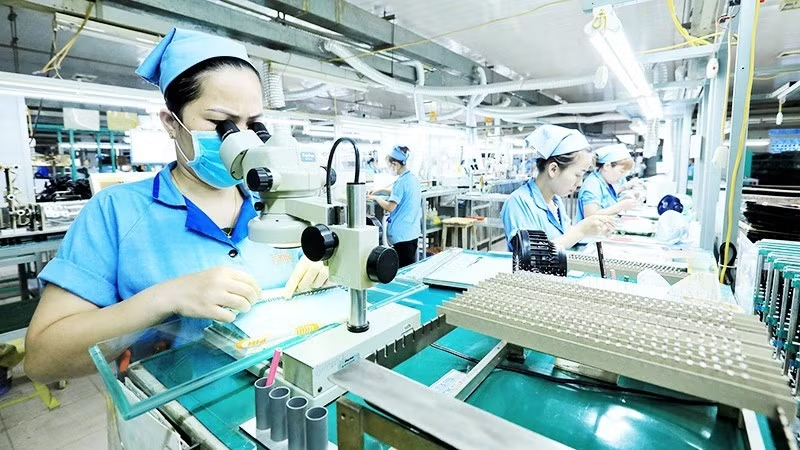
The General Statistics Office noted that the standout feature of Viet Nam’s FDI landscape in 2025 was the strong rise in realised capital. With total disbursement of 27.62 billion USD, manufacturing and processing played a pivotal role, reaching 22.88 billion USD and accounting for as much as 82.8 percent of total realised FDI nationwide.
Real estate business activities and electricity and gas production and distribution contributed 1.93 billion USD (7 percent) and 914.9 million USD (3.3 percent) respectively to overall disbursement. These results reaffirm foreign investors’ strong confidence in Viet Nam’s investment environment and the economy’s capacity to absorb capital.
The Viet Nam Association of Foreign Invested Enterprises (VAFIE) observed that FDI disbursement results during 2019–2025 indicate that Viet Nam has maintained stable attractiveness amid the global restructuring of supply chains. After slowing due to the COVID-19 pandemic in 2020–2021, realised FDI rebounded clearly from 2022 and has maintained a steady upward trend, reflecting the country’s ability to translate investment commitments into tangible resources for production, exports and employment.
Notably, the structure of FDI has increasingly shifted towards quality, with a rising share in high-tech industries, green manufacturing, renewable energy and the digital economy.
Against a backdrop of global economic uncertainty, stable disbursement momentum, coupled with institutional reforms and infrastructure upgrades, is laying the groundwork for further FDI breakthroughs. If reform progress is maintained and major projects are implemented effectively, Viet Nam is well placed to reach a new high in FDI disbursement in 2026.
How to move towards attracting a new generation of FDI?
After more than 35 years of opening up to foreign investment, the FDI sector has become an important pillar of Viet Nam’s economy. However, amid increasingly intense competition for international capital and a global shift towards high technology, green transition and sustainable development, an FDI attraction model based primarily on low costs, land availability and cheap labour is showing clear limitations.
According to Dr Phan Huu Thang, Chairman of the Viet Nam Industrial Zone Finance Association and former Director General of the Foreign Investment Agency (Ministry of Planning and Investment, now the Ministry of Finance), FDI has fulfilled its “historic mission” in the early phase of industrialisation by helping Viet Nam integrate more deeply into global value chains and form key manufacturing industries such as textiles and garments, electronics, footwear and mechanical assembly. However, a growth model based on processing and assembly with low technological content and limited value added is no longer suitable.
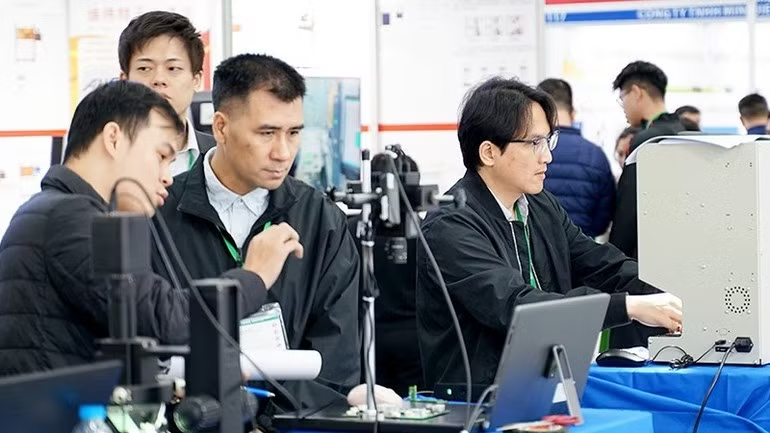
In practice, localisation rates in the FDI sector remain low, averaging only about 30 per cent, and even lower in high-tech industries such as electronics and semiconductors. While R&D activities by FDI enterprises have improved, they are largely concentrated at the application stage and have yet to generate strong spillovers to domestic firms. Meanwhile, global investment trends are rapidly shifting towards areas such as semiconductors, artificial intelligence, data centres, renewable energy, new materials and the circular economy—sectors that require a higher level of institutional quality, human resources and infrastructure.
From this reality, Dr Phan Huu Thang argued that Viet Nam needs to move into a new phase of FDI attraction, with quality, efficiency and spillover effects as the core criteria. Rather than competing through across-the-board tax incentives, Viet Nam should prioritise projects with core technologies, R&D centres, firm commitments to technology transfer and strong linkages with domestic enterprises. In particular, the development of green industrial parks, eco-industrial parks and a new generation of high-tech parks should become a central direction.
At the policy level, he stressed the need to promptly finalise the FDI Strategy for 2025–2035, with a long-term vision and clear criteria for next-generation FDI. In this framework, special incentives should focus on strategic sectors such as semiconductors, digital technologies, biotechnology, renewable energy and high-tech supporting industries. Ministries and agencies need to develop a comprehensive legal framework for green and smart industrial parks, while also establishing a unified, real-time-updated FDI database to support management, evaluation and policy-making.
From the perspective of institutions and the economy’s absorptive capacity, Pham Tien Dat of the Institute for Strategy and Financial Policy (Ministry of Finance) noted that the greatest challenge today lies not in a shortage of FDI, but in the ability to “digest” and transform these capital inflows into productivity gains, technological advancement and long-term competitiveness. Constraints are evident across multiple dimensions, from institutional quality and infrastructure to technological capability, workforce skills and the degree of linkage between FDI enterprises and domestic firms.
To improve FDI quality, he argued, Viet Nam must shift from a mindset of “attracting at all costs” to one focused on optimising effectiveness and spillover impacts. One promising approach is reforming investment licensing towards a “policy contract” model, under which commitments on technology, the environment, knowledge transfer, workforce training and value-chain linkages are quantified through specific criteria. Investment incentives should be closely tied to actual performance, particularly localisation rates, R&D expenditure and contributions to sustainable development goals.
In addition, developing a domestic innovation ecosystem is seen as a decisive condition for absorbing high-quality FDI. The State should increase investment in innovation centres and technology transfer hubs under public–private partnership (PPP) models, while promoting dual training programmes and demand-driven training tailored to FDI enterprises. More flexible co-funding mechanisms for R&D among the State, FDI enterprises and domestic firms are also needed to encourage research collaboration and the commercialisation of technologies.
In terms of infrastructure, experts believe that planning and developing industrial parks in the coming period cannot continue to follow traditional models. Instead, it is necessary to form industrial clusters linked to logistics centres, stable power supply systems, renewable energy and digital infrastructure. Mobilising resources for infrastructure through PPPs, green bonds and project bonds should be stepped up to ease budgetary pressure and improve service quality.
Finally, strengthening linkages between the FDI sector and domestic enterprises must be placed at the heart of policy. FDI firms should be encouraged to increase local procurement, support Vietnamese suppliers in upgrading quality standards and jointly participate in R&D projects. The establishment of a Supplier Upgrading Fund, together with the regular publication of indicators measuring the level of FDI linkages and spillover effects, would ensure that policies move beyond orientation and are monitored and evaluated on the basis of concrete outcomes.







![[Infographic] VN-Index rises 0.34% on October 6](https://en-cdn.nhandan.vn/images/j0QNt7m_5iy1OXpnUKiwG61aYhTv_B140GWhfriF26IM-hJLr-YyB-igcHJ7cLRKshCXmgI3hJXGVRYJMfGPzA/chung610-8460.jpg.avif)