According to an analysis published by fdiintelligence.com, the performance of FDI in Asia, as in other regions, depends on individual projects.
Broader factors like geopolitics, economic trends, the business climate, and cultural context play a big role in shaping how investment flows develop across the region. Of these, political and economic stability stand out as major drivers of FDI success.
The article notes that countries including Singapore, the Republic of Korea, and Viet Nam have strengthened investor confidence through consistent governance, transparent legal frameworks and business-friendly reforms.
In addition, high-quality infrastructure, such as special economic zones and efficient logistics networks, together with a skilled and cost-competitive workforce, has contributed significantly to their attractiveness as investment destinations.
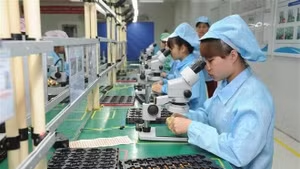
Viet Nam stands out as a representative example. The article cites US technology group Intel as a case in point. Since establishing its testing and assembly facility at the Saigon Hi-Tech Park in 2010, Intel has expanded operations through total investments of 1.5 billion USD. This expansion has been underpinned by Viet Nam’s rapidly developing semiconductor ecosystem, an experienced workforce and the country’s role as a lower-cost link in global electronics supply chains.
In October, Intel Viet Nam’s General Director Kenneth Tse discussed with government representatives the possibility of bringing additional production lines to Viet Nam in the near future.
The analysis further highlights that geopolitical positioning and participation in regional trade frameworks, notably the 15-member Regional Comprehensive Economic Partnership (RCEP), help reinforce investor confidence.
At a time when many Western governments are moving toward protectionist policies under the banner of security and strategic autonomy, Asia’s ability to maintain open trade and investment flows is seen as an important factor in sustaining FDI momentum.