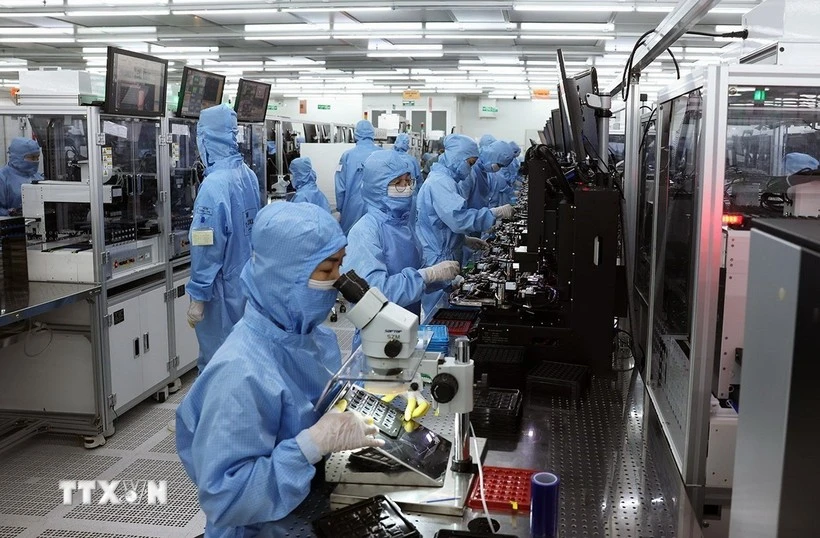
According to the National Statistics Office (NSO) under the Ministry of Finance, disbursed FDI reached an estimated 23.6 billion USD during the period, up 8.9% year-on-year - the highest 11-month disbursement in five years.
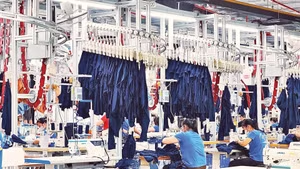
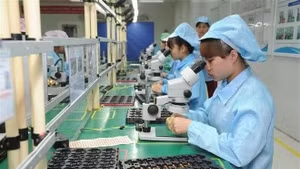
Manufacturing raked in 19.56 billion USD, accounting for 82.9% of the total. Real estate followed with 1.67 billion USD, while electricity, gas, steam, and air-conditioning production and distribution brought in 754.9 million USD.
According to the NSO data, total registered FDI, which covers newly registered capital, additional capital, and capital contributions or share purchases, hit 33.69 billion USD, up 7.4% from last year. Of the 3,695 newly licensed projects valued at 15.96 billion USD, manufacturing accounted for 9.17 billion USD, or 57.5%, followed by real estate with 3.14 billion USD.
Some 1,318 projects from previous years registered additional capital totalling 11.62 billion USD. NSO Director Nguyen Thi Huong said that, combining new and additional capital, manufacturing attracted 16.52 billion USD, or 59.9% of total newly registered and adjusted capital. Capital contributions and share purchases by foreign investors reached 6.11 billion USD across 3,225 transactions, of which manufacturing accounted for 2 billion USD. In total, the sector drew 18.52 billion USD in the 11 months, nearly 55% of all registered FDI.
Experts attribute Viet Nam’s appeal to its population of 100 million, abundant labour force, deep international economic integration and improving business environment. According to Hong Sun, Honorary Chairman of the Korea Chamber of Business in Viet Nam (KoCham), Viet Nam remains an ideal medium- and long-term investment destination for Korean companies. The Republic of Korea is the largest foreign investor in Viet Nam with nearly 95 billion USD in registered capital, including major groups such as Samsung and LG.
He noted that Viet Nam's stable political environment, effective FDI attraction strategy and continuous administrative reforms have strengthened investor confidence. The shift from a three-tier to a two-tier administrative structure has also helped accelerate policy response and streamline procedures.
Korean investors remain highly interested in manufacturing, while expanding into new fields such as semiconductors, artificial intelligence, energy and smart urban infrastructure.
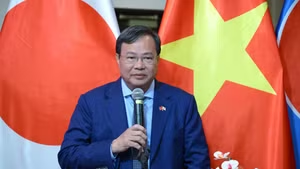
Japanese enterprises also value Viet Nam’s investment climate. Hamada Shogo, General Director of Daiwa Viet Nam, said company operations have expanded since entering the market in 1995, supported by Viet Nam’s open-door policy and active participation in free trade agreements. Administrative reforms, particularly in industrial zone investment procedures, have reduced processing time and improved competitiveness.
Ogawa Tsuyoshi, Director of Japanese-invested TKR Viet Nam, said the company expects revenue of 1.244 trillion VND (47.29 million USD) in 2025 and 1.847 trillion VND in 2027. To meet growth targets, TKR plans to build a third factory in Viet Nam and invest in equipment to assemble circuit boards in-house.
However, investors continue to face obstacles, including visa procedures for foreign experts and managers, complex VAT refund processes and customs clearance delays. Hong Sun recommended that Viet Nam further reduce legal barriers, enhance administrative transparency and efficiency, and strengthen infrastructure, especially in information technology and energy, to maintain its competitiveness.