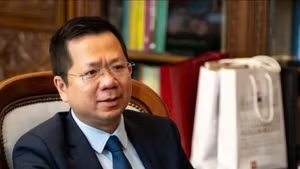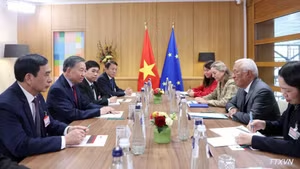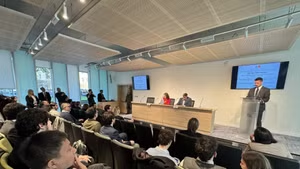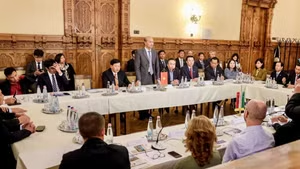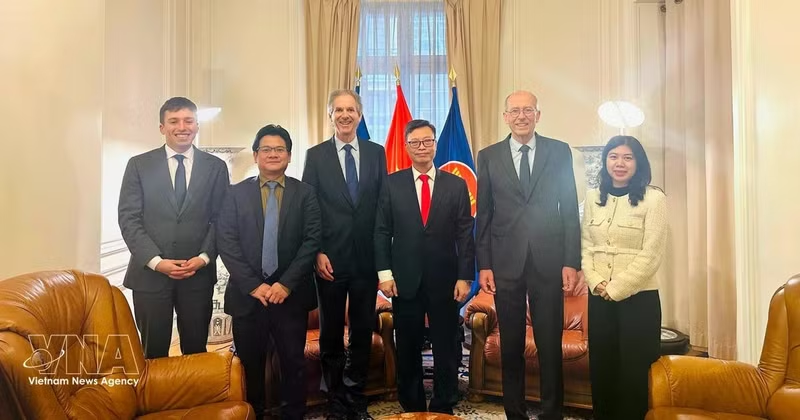
During a February 20 working session with Benoit Clocheret, Vice President of MEDEF International – the global outreach arm of the Mouvement des Entreprises de France (MEDEF) – and Executive Chairman of Artelia Group, along with representatives of major French corporations, Ambassador Hai underscored that these sectors form core pillars of Viet Nam’s sustainable development strategy and offer strong complementarities between the two economies.
He praised MEDEF International for its proactive engagement in recent years, particularly its successful organisation of the Viet Nam–France Business Forum in last June, noting that the event reinforced MEDEF’s role as a strategic connector between the two business communities and laid important groundwork for upgrading bilateral cooperation.
The ambassador also highlighted Artelia’s two decades of contributions in Viet Nam, notably in large-scale infrastructure projects such as metro systems in Hanoi and Ho Chi Minh City. The enduring and effective presence of French firms like Artelia, he said, reflects the depth and long-term potential of Viet Nam–France economic ties.
Clocheret, who also chairs the France–Viet Nam Business Council, said Artelia employs around 800 staff in Viet Nam and considers the country a strategic market, both commercially and in terms of human capital development. Vietnamese professionals are not only engaged in domestic projects but also support the group’s operations in Laos, the Philippines, Thailand and Indonesia, positioning Viet Nam as a regional “centre of excellence” within its network.
He added that Artelia is honoured to participate in the early stages of Viet Nam’s high-speed railway project and to provide consultancy and supervision services for a new airport project in Hanoi, describing these roles as a meaningful contribution to the country’s infrastructure modernisation drive.
Clocheret said MEDEF International is working to place Viet Nam more firmly on the strategic radar of French businesses, at a time when many firms are focusing on larger markets such as the US, China and India. With a population of over 100 million, sustained economic growth, a skilled workforce and strong reform momentum, Viet Nam stands out as a dynamic and promising destination in French companies’ global expansion strategies.
The two sides agreed to coordinate the organisation of the second Viet Nam–France Business Forum in France, tentatively slated for mid-June, with MEDEF proposing the participation of senior leaders, potentially including Viet Nam’s Minister of Finance, to maximise the event’s impact and business engagement.
Discussions also covered a broad range of potential cooperation areas, from transport infrastructure, including high-speed rail, metro systems and aviation, to renewable and nuclear energy, high-tech industries, semiconductors, healthcare, aerospace, defence and the maritime economy. Clocheret emphasised France’s strong capabilities in nuclear energy, with more than 60 reactors in operation and extensive expertise in technology and safety management, which could support Viet Nam’s long-term energy strategy.
The meeting also explored regional energy connectivity within ASEAN, where Viet Nam plays a pivotal role in linking hydropower resources from Laos with Singapore’s clean energy demand, creating fresh opportunities amid the global energy transition.
MEDEF International candidly raised concerns from French businesses regarding administrative procedures and the stability and predictability of Viet Nam’s legal framework, while acknowledging recent reforms to streamline governance structures and improve the investment climate as positive signals for investors.
Ambassador Hai reaffirmed the Vietnamese Government’s commitment to accelerating administrative reform, enhancing transparency and ensuring a stable, predictable legal environment to facilitate long-term investment, including by French enterprises.
On the EU–Viet Nam Investment Protection Agreement (EVIPA), he called on MEDEF International to continue advocating for France’s early ratification, sending a strong message of confidence and long-term partnership. Clocheret reiterated MEDEF’s bridging role and stressed the importance of encouraging greater Vietnamese investment in France, using successful cases to generate broader momentum for two-way cooperation.