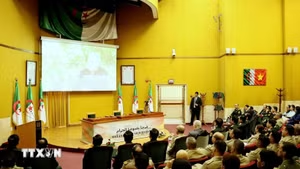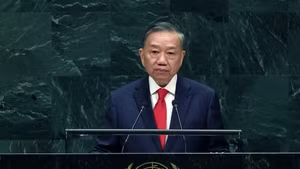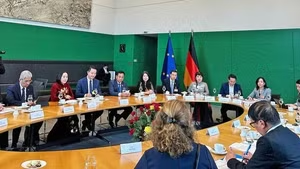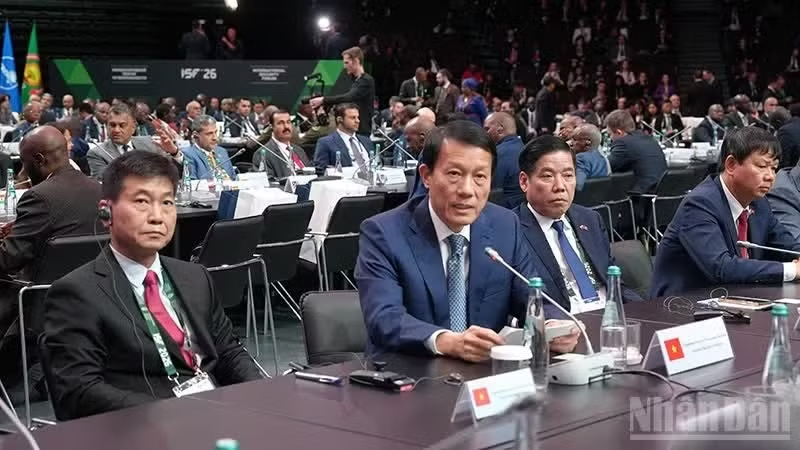
The Vietnamese delegation was led by Politburo member and Minister of Public Security General Luong Tam Quang, who attended and addressed the conference.
Quang highly valued the forum’s discussion topics, particularly the issue of challenges to global security in an emerging multipolar world, describing it as timely and highly relevant amid today’s increasingly unstable international environment.
Sharing Viet Nam’s perspective on the security challenges facing the international community, he reaffirmed that Viet Nam continues to pursue a foreign policy centred on independence, self-reliance, peace, cooperation and development, alongside the diversification and multilateralisation of external relations.
He stressed that Viet Nam seeks to be a friend, a reliable partner and a responsible member of the international community, while proactively and responsibly contributing to the resolution of regional and global issues.
Viet Nam does not choose sides or enter into alliances against any third party, the minister said. Instead, the country chooses justice, fairness, dialogue and cooperation for the common interests of humanity.
He underlined the importance of respecting independence, sovereignty and territorial integrity, non-interference in each other's internal affairs, and the peaceful settlement of disputes on the basis of international law and the United Nations Charter.
As a responsible member of the global community, Viet Nam proposed a number of key solutions to address current security challenges.
These include promoting compliance with international law and the UN Charter; respecting each country’s chosen political system; strengthening substantive dialogue and trust-building among nations; placing people at the centre of all security solutions, while promoting cooperation and sharing common achievements in sci-tech development in order to strengthen resilience and enhance human security in the face of emerging security challenges; and promoting substantive cooperation in addressing non-traditional security challenges.
Viet Nam urged the international community to continue strengthening solidarity and substantive cooperation in overcoming global security challenges for the benefit of all nations and future generations, Quang stated.
Earlier, on May 27, the high-level Vietnamese delegation also addressed the 6th Russia–ASEAN high-level consultation on security.
At the consultation, Quang affirmed Viet Nam’s consistent support for the central role of Association of Southeast Asian Nations (ASEAN) in shaping open, inclusive and transparent regional security mechanisms.
He noted that the bloc has consistently regarded Russia as one of its key partners with an important role in maintaining regional and global peace, stability and development, while Russia has likewise remained committed to strengthening relations with ASEAN.
To further enhance practical and effective cooperation, Quang proposed that both sides intensify high-level strategic exchanges and cooperation within ASEAN-led mechanisms, while also expanding collaboration in other security and law-enforcement frameworks.
He called for elevated cooperation in priority areas, particularly cybersecurity, including the effective implementation of the UN Convention against Cybercrime, also known as the Ha Noi Convention. The minister also urged stronger information-sharing and coordination in responding to emerging security threats.
In addition, Quang proposed enhancing cooperation in combating organised and transnational crime, establishing permanent ASEAN–Russia security information-sharing and early-warning mechanisms, especially in counter-terrorism, cybercrime, drug trafficking and human trafficking. He further called for broader collaboration in addressing non-traditional security threats, particularly in energy and health security.
At the consultation session, Secretary of the Security Council of the Russian Federation Sergey Shoigu said Moscow hoped ASEAN member states would coordinate practical actions to help shape both bilateral and multilateral security architecture across Eurasia.
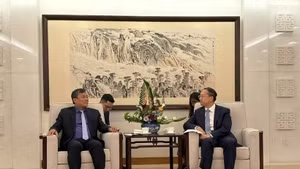
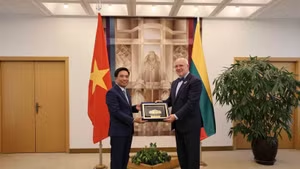
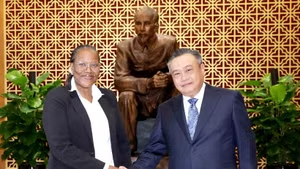
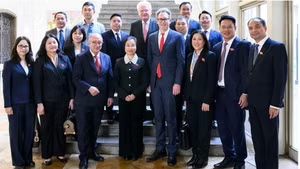
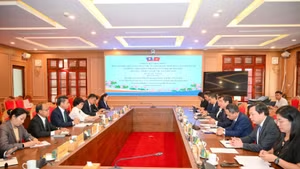
On the sidelines of the forum, Minister Quang held a series of bilateral meetings.
On the afternoon of May 27, he met with Altangereliin Byambajargal, Secretary of Mongolia’s National Security Council. Both sides agreed to strengthen cooperation in responding to non-traditional security threats, focusing on cybersecurity, transnational fraud and drug-related crime, while improving coordination in citizen protection efforts.
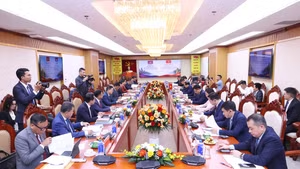
The same day, the Vietnamese minister held talks with Alexander Bastrykin, Chairman of Russia’s Investigative Committee. The two sides agreed to increase exchanges at all levels, coordinate and support one another at multilateral forums and international organisations, and effectively implement existing cooperation agreements.
They also agreed to enhance information-sharing on criminal matters and cooperate in investigating cases involving citizens of the two countries when requested.
In addition, both sides committed to strengthening training cooperation in areas including cybercrime investigations, counter-terrorism, anti-corruption, anti-money laundering and combating illegal migration.
Following the talks, Quang and Bastrykin signed a cooperation agreement between the Vietnamese Ministry of Public Security and the Russian Investigative Committee, marking another important step in strengthening bilateral relations and professional cooperation between the two bodies.