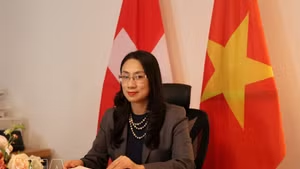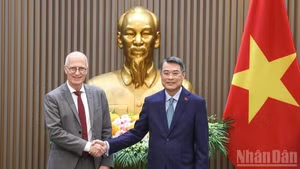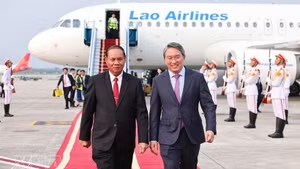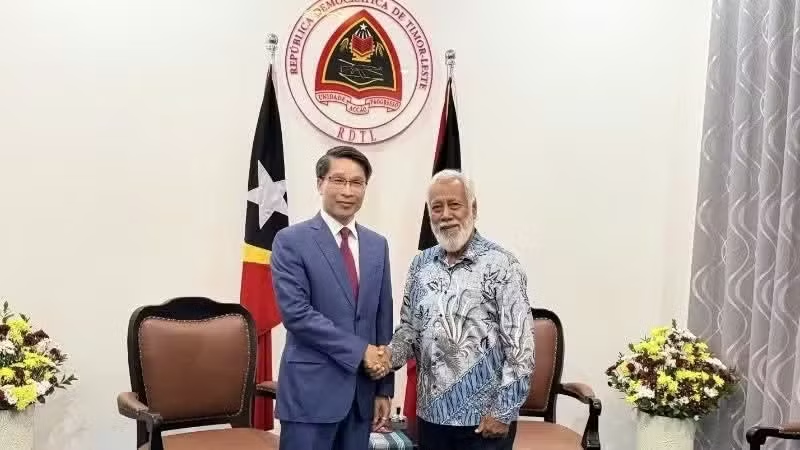
Dam said Timor-Leste’s high-ranking leaders have repeatedly travelled to Viet Nam and attended major events hosted by the country, reflecting the importance Timor-Leste places on the relationship and Viet Nam’s regional role and standing. In April, the Vietnamese Embassy in Timor-Leste began operations, a move that underscores strong political commitment from both sides to deepen presence, broaden cooperation and tighten connectivity.
For Viet Nam, hosting the Timor Leste’ PM on an official visit demonstrates a clear push to advance ties across multiple fronts. The trip also serves as a concrete step to realise the 14th National Party Congress’s Resolution, which designates diplomacy as a key, ongoing mission in service of national security and development interests. Lifting the close, substantive and effective partnership to a new level serves the interests of both nations and their people while contributing to a united, inclusive and resilient ASEAN.
The visit packs multiple elements, including a bilateral official trip, the ASEAN Future Forum, and activities focused on boosting connectivity and cooperation. Timor-Leste’s decision to send a high-ranking delegation comprising the PM, two Deputy PMs, key cabinet ministers and heads of agencies reflects the priority Timor-Leste places on Viet Nam and its desire to expand coordination across multiple channels and diverse sectors. This, in turn, will set the stage for deeper, broader and more substantive ties in the years ahead.
Both sides are set to sign a number of important cooperation agreements, creating a stronger legal framework and more favourable conditions to scale up cooperation and people-to-people exchanges, thereby laying a long-term foundation for the relationship, he said.
The bilateral ties, built on strong political trust, are now positioned to pivot from goodwill and political affinity toward a more concrete, focused and results-driven cooperation agenda with clear roadmaps, according to Dam.
First is agriculture and food security. Timor-Leste has ample demand for securing food supply, lifting agricultural productivity and developing rural areas. Viet Nam brings deep practical experience in rice production, fisheries, industrial crops, agro-processing and market development. The two sides can broaden coordination from rice trade to seeds, preservation and processing, workforce training and agricultural policymaking.
Second is telecoms, digital transformation and digital economy, which Viet Nam already has a tangible presence via Telemor. Viettel has been operating in Timor-Leste under the Telemor brand since 2012, launching services in 2013 and emerging as one of the key telecom operators in the market. As Timor-Leste pushes administrative modernisation, expands public services and boosts social connectivity, digital cooperation stands out as a highly practical and promising avenue.
Third is trade and investment. While Timor-Leste’s market remains relatively small, it has considerable demand for consumer goods, food, construction materials, equipment, services, tourism and infrastructure. Vietnamese enterprises hold advantages in suitable products, competitive pricing and experience navigating emerging markets.
Fourth is education, training and capacity-building for ASEAN integration. Timor-Leste is entering a new phase that demands a workforce capable of deeper engagement in regional mechanisms. Viet Nam stands ready to share experience in training officials across diplomacy, trade, customs, agriculture, information technology and ASEAN coordination.
Overall, the two countries have favourable foundations and conditions to advance substantive cooperation across multiple sectors. Timor-Leste has strong development and global integration needs, while Viet Nam brings experience, capacity and a partnership spirit. With the right priorities and steady, step-by-step action, the bilateral ties are well-placed to deliver tangible, meaningful results.
On Vietnamese enterprises’ contributions to the host country’s socio-economic development, Dam noted that the most prominent footprint is in telecoms. Telemor is not only an overseas investment by a Vietnamese company, but a concrete example of economic cooperation closely aligned with Timor-Leste’s practical development needs.
Through telecom infrastructure investment, Telemor has expanded connection for the people, created jobs, trained a local workforce, contributed to the state budget and supported the country’s digital transformation. For a young nation building its development foundations and pursuing regional integration, digital connection plays an outsize role in education, healthcare, trade, public services and everyday life.
In the coming months, Telemor and other Vietnamese tech players could further contribute to Timor-Leste’s digital transformation priorities, including network infrastructure, fibre optics, data systems, e-government, online public services, digital payments, digital workforce training, and expanding access to digital services for the population.
It is noteworthy that Vietnamese firms operating in Timor-Leste are not merely seeking short-term opportunities, but also demonstrate serious, long-term investment that aligns corporate interests with the host country’s development goals. This approach has built trust and created important conditions to expand investment cooperation into other areas.
However, Vietnamese investment in Timor-Leste remains modest compared to the potential and the strong political relationship between the two countries. Therefore, this visit provides an opportunity for both sides to boost business connectivity, share market information, review existing bottlenecks, and open new avenues for cooperation, he added.