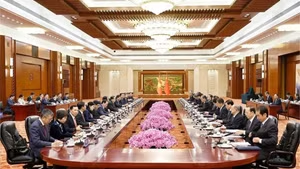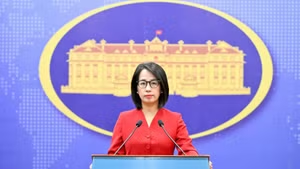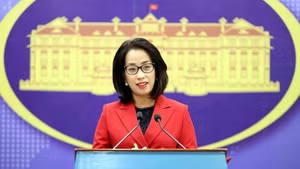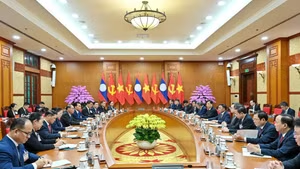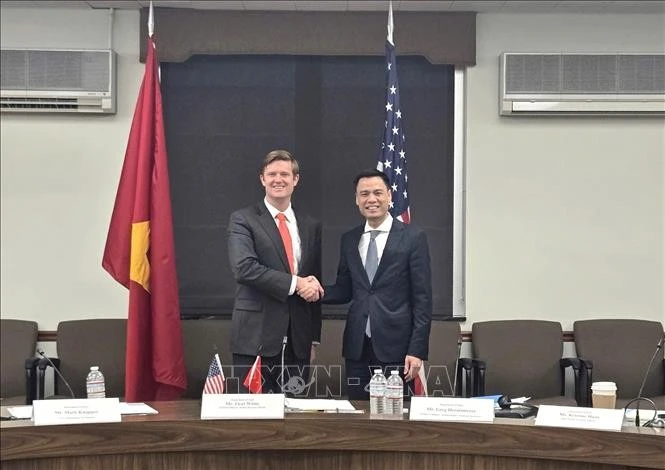
The annual mechanism aims to review and set orientations for political, security, and defence cooperation, enhance mutual understanding, build trust, and drive the stable and substantive development of Viet Nam - US relations.
Both sides reflected on the state of bilateral relations after 30 years of diplomatic ties and two years since elevating to a Comprehensive Strategic Partnership, noting sustained positive progress.
Viet Nam reaffirmed its view of the US as one of the leading strategic partners and welcomed increased US cooperation and contributions to regional peace, stability and development.
The US side described the Viet Nam-US ties over the past three decades as a model in international relations, evolving from former adversaries to comprehensive strategic partners. The host reiterated its desire to further boost mutually beneficial cooperation based on respect for Viet Nam’s independence, sovereignty, territorial integrity and political system, while expressing support for an independent, strong, prosperous, and resilient Viet Nam.
The two sides highlighted key recent achievements, including sustained all-level exchanges and contacts, especially at senior and ministerial levels; enhanced law enforcement collaboration, efforts against transnational crime, responses to non-traditional security challenges, and the effective rollout of projects to remedy war consequences and search for US servicemen missing in action (MIA).
The US side thanked Viet Nam for its active MIA cooperation and reaffirmed its commitment to expanding dioxin remediation and unexploded ordnance clearance projects, alongside stepping up new initiatives to support information collection and DNA identification technologies for missing Vietnamese soldiers.
The co-chairs commended current bilateral political, defence and security mechanisms as vital platforms for information sharing, difference management and advancing practical, sustainable cooperation on issues of shared concerns.
Building on the achieved outcomes, they agreed to further deepen cooperation under the Comprehensive Strategic Partnership framework and gradually expand cooperation into promising areas such as defence industry, capacity building for maritime law enforcement, specialised coordination in crime prevention, and high-technology controls.
On global and regional security issues, they underscored the importance of maintaining peace, stability, security, safety, and freedom of navigation and overflight; refraining from the use of force or threat to use force, and settling disputes by peaceful means in accordance with international law, including the 1982 United Nations Convention on the Law of the Sea (UNCLOS). Both sides reaffirmed the central role of the Association of Southeast Asian Nations (ASEAN) in the regional architecture.
Concluding the event, the two sides agreed to further maintain and uphold the dialogue’s effectiveness; step up the exchange of all-level delegations and consultations, especially at high levels; and effectively roll out the agreed cooperation areas, thereby contributing to advancing the Comprehensive Strategic Partnership for the practical benefit of both peoples, and for global and regional peace, stability, and development.
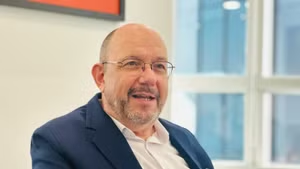
On the occasion, Giang met with President of the International Republican Institute Daniel Twining, representatives of the National Democratic Institute, and Co-Chairs of the Communist Party USA Joe Sims and Rossana Cambron to brief them on preparations for the 14th National Party Congress and discuss orientations for future party-to-party cooperation. The delegation also engaged several US organisations, businesses, and scholars to share views on bilateral, global and regional issues of common interest.