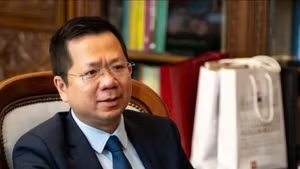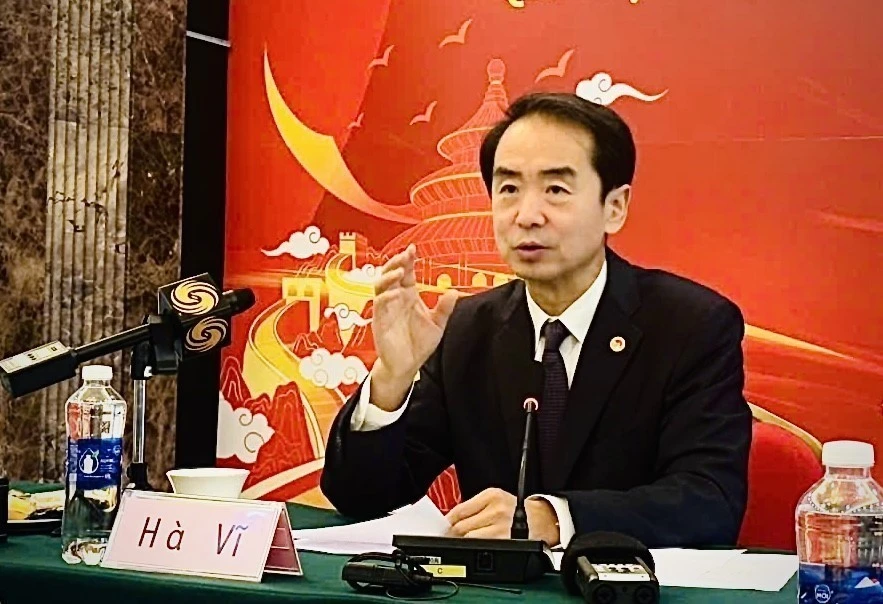
Speaking at the event, the Chinese diplomat said 2025 was a particularly significant year, marking strong progress in bilateral relations as the two sides actively implemented common perceptions reached by high-level leaders and jointly celebrated the 75th anniversary of diplomatic relations.
According to the ambassador, the most prominent highlight of the year was the historic exchange of visits by the top leaders of the two Parties and countries, especially the state visit to Viet Nam by General Secretary of the Communist Party of China (CPC) Central Committee and President of China Xi Jinping. The visit not only reaffirmed Viet Nam’s position as a top priority in China’s neighbourhood diplomacy, but also resulted in the signing of a record 45 cooperation documents.
These documents cover both traditional areas such as economy, trade, agriculture and culture, and emerging fields including artificial intelligence, infrastructure connectivity and social security. Ambassador He Wei noted that the display of these cooperation documents at the headquarters of the Communist Party of Viet Nam vividly reflected the rich and substantive outcomes achieved by the two sides.
In economic and trade relations, China has remained Viet Nam’s largest trading partner for more than 20 consecutive years. Bilateral trade turnover in the first 11 months of 2025 already surpassed the total for the whole of 2024, reaching the highest level in the history of bilateral trade. Cooperation in investment, supply chains and production chains has continued to be enhanced, bringing tangible benefits to businesses and people in both countries.
Agricultural cooperation, in particular, has delivered clear benefits to farmers and consumers, the ambassador said. Vietnamese fruit and vegetable exports to China recorded strong growth, with durian alone generating 3.4 billion USD this year. Exports to China accounted for more than 90% of Viet Nam’s total durian export volume. At the same time, strategic infrastructure projects, including three standard-gauge railway lines in northern Viet Nam and the waste-to-energy power plant project in Soc Son of Ha Noi, are being actively advanced, contributing to Viet Nam’s modernisation and green transition.
People-to-people exchanges have also flourished. The year 2025 has been designated as the "Viet Nam-China Year of Humanistic Exchange", featuring a wide range of vibrant activities such as the “Red Journey,” people’s forums and youth friendship meetings. The number of Chinese tourists visiting Viet Nam reached 4.8 million, accounting for around 25% of total international arrivals, while the number of Vietnamese students studying in China exceeded 20,000.
Notably, the successful QR code payment connection in early December 2025 has significantly facilitated trade and tourism, effectively addressing payment difficulties often faced by travellers between the two countries.
Looking ahead to 2026, the Chine ambassador described it as a pivotal year. China will begin implementing its 15th five-year plan, with the goal of basically realising socialist modernisation by 2035. Meanwhile, Viet Nam will convene the 14th National Party Congress, opening a new era – the era of the nation’s rise. Similarities in development strategies, particularly in innovation, the digital economy and new-quality productive forces, will serve as a strong foundation for enhanced strategic alignment and governance experience sharing.
The ambassador emphasised the need for the two sides to step up theoretical exchanges and experience sharing, summarising development practices and learning from each other to build a solid theoretical foundation for long-term sustainable development amid global uncertainties.
He also underscored the importance of improving the effectiveness of practical cooperation, focusing on industrial and supply chains, encouraging investment in high value-added sectors and better leveraging China’s vast market to expand Vietnamese exports.
Further deepening people-to-people exchanges will help build a solid social foundation, deliver tangible benefits to both sides, and continue to affirm the traditional Viet Nam–China friendship as a key driver of development for each country.
Amid complex global developments, Ambassador He Wei affirmed that China and Viet Nam will continue to strengthen coordination, jointly promote global initiatives on development, security, civilisation and governance, and make active contributions to peace, stability and development in the region and the world.
On the occasion of the New Year 2026, the diplomat extended his best wishes to the Vietnamese people, expressed confidence that Viet Nam will successfully organise the 14th National Party Congress, and affirmed that media agencies of the two countries will continue to serve as an important bridge, contributing to nurturing the traditional Viet Nam–China friendship “as comrades and brothers.”