At the invitation of Australian Governor-General Sam Mostyn and New Zealand Governor-General Cindy Kiro, General Secretary of the Central Committee of the Communist Party of Viet Nam and President of the Socialist Republic of Viet Nam To Lam, together with a high-level Vietnamese delegation, will pay State visits to Australia and New Zealand from August 9 to 14, 2026.
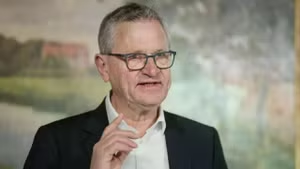
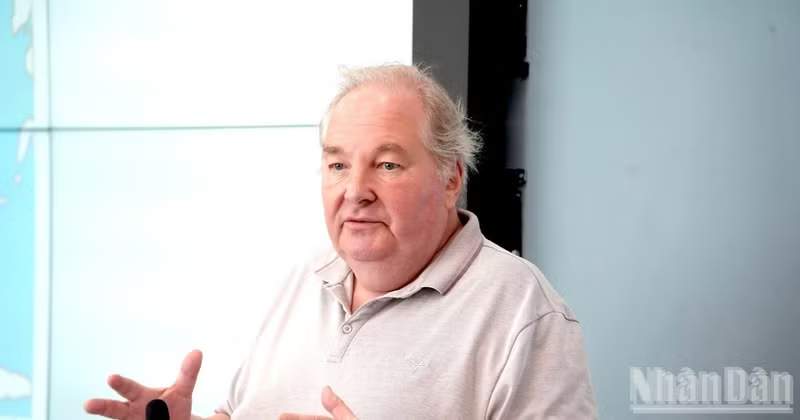
Speaking to a reporter from Nhan Dan Newspaper ahead of the visits, Doctor of Sciences Dmitry Mosyakov, Director of the Centre for Southeast Asia, Australia and Oceania at the Institute of Oriental Studies of the Russian Academy of Sciences, said the visits were highly significant, vividly reflecting Viet Nam’s continued and consistent pursuit of an independent and self-reliant foreign policy and the diversification and multilateralisation of its international relations.
According to Mosyakov, Viet Nam is increasingly affirming its role as an important member of the regional and international cooperation network. The visits to Australia and New Zealand will not only help consolidate bilateral relations with two important partners in Oceania, but also further enhance Viet Nam’s standing and role both in the region and internationally.
The Russian expert said that strong economic ties provide an important foundation for deepening Viet Nam’s relations with Australia and New Zealand. He cited the positive growth in trade between Viet Nam and Australia and New Zealand in recent years.
According to Mosyakov, this demonstrates that Viet Nam is gradually building an extensive network of foreign relations based on equality, balanced interests and mutual benefit.
Assessing the message conveyed by the visits, Doctor of Sciences Mosyakov described them as a positive signal, reaffirming Viet Nam’s consistent pursuit of a foreign policy for peace, cooperation and development, while expanding trade relations and working towards shared prosperity. He said Viet Nam is increasingly being recognised as an important partner in regional and international cooperation mechanisms.
Explaining why Australia and New Zealand are attaching increasing importance to relations with Viet Nam, Mosyakov said this is linked to adjustments in the two countries’ policies. Both are currently stepping up their strategies of engagement with Asia and paying greater attention to Southeast Asia.
According to the Russian expert, Australia and New Zealand are gradually integrating more deeply into Asia’s network of relations. In this process, Viet Nam is an important partner, reflecting the two countries’ desire to strengthen economic and trade cooperation and deepen their engagement with the region.
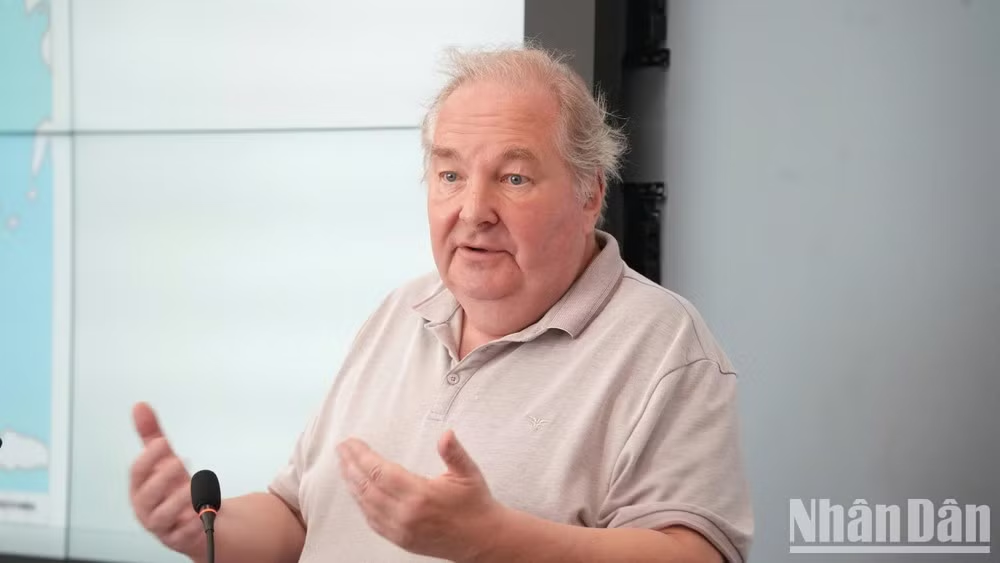
Mosyakov said Viet Nam has a number of significant advantages, foremost among them a stable political environment, highly predictable policies, an economy maintaining positive growth and a geographical position favourable to international trade. In addition, its long history and distinctive cultural identity have helped shape an image of Viet Nam as a dynamic, rapidly developing country and an attractive partner for many nations.
Regarding prospects for cooperation in the coming period, he said high technology, particularly artificial intelligence (AI), along with education, would become new drivers of relations between Viet Nam and Australia and New Zealand. These are areas with considerable potential for the parties to strengthen cooperation in research, innovation and human resource development.
Addressing the significance of Viet Nam’s efforts to strengthen relations with Australia and New Zealand for the regional cooperation architecture, Mosyakov said the process would contribute to deeper integration between the two Oceanian countries and Asia, including Southeast Asia. According to him, Viet Nam is playing an important role in connecting and advancing this cooperation process.
From the Russian perspective, Mosyakov affirmed that Moscow views positively Viet Nam’s continued efforts to expand and deepen relations with its partners in Oceania.