The value of a land creates a brand
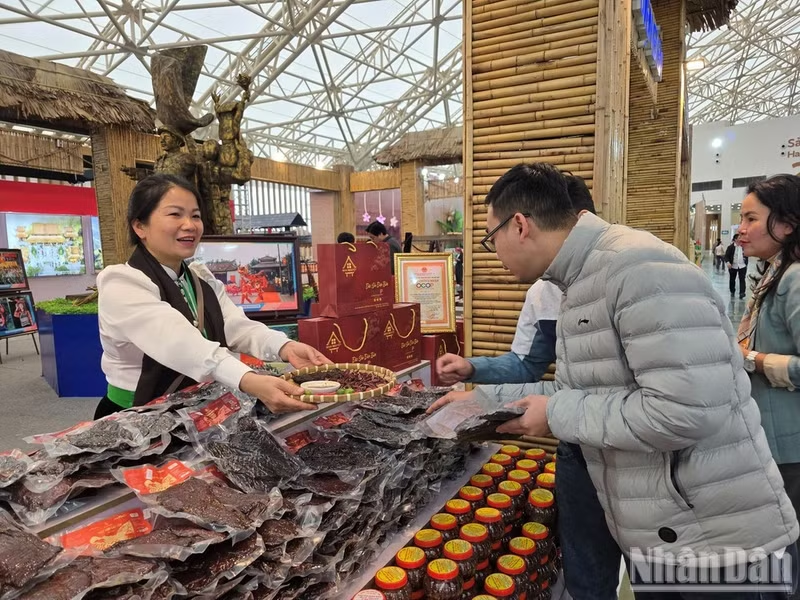
Many specialities from ethnic minority and mountainous areas are shaped by conditions not found everywhere: climate, soil, local raw materials, and the production experience and knowledge accumulated over generations. These factors create the quality, brand, and distinctive identity of products. When a product is protected by a geographical indication, that value is more clearly established in the market.
However, geographical indications carry a broader meaning. Speaking at a recent discussion on protection and exploitation of geographical indications for markets expansion of specialities in ethnic minority areas, organised by Industry and Trade Magazine, Dao Duc Huan, Head of the OCOP and Rural Tourism Management Division under the Central Coordination Office for National Target Programmes at the Ministry of Agriculture and Environment, said geographical indications are an intellectual property tool to establish protection rights, position product reputation, and become community assets.
After protection is granted, the challenge lies in organising operation and control so that the community shares responsibility and complies with rules to protect and maintain the common reputation. This approach places producers at the centre of the geographical indication story.

According to Dao Duc Huan, if a product’s reputation is a common asset, the benefits derived from that reputation should also spread to those who directly create the product. Geographical indications, therefore, should not be understood simply as a promotional tool or an identifying sign but also as a resource for reorganising production, connecting with markets, creating livelihoods, raising incomes, and making more sustainable contributions to the local economy.
Meo Vac mint honey is a clear example of the link between geographical indications, markets, and community livelihoods. The product was granted geographical indication protection in 2013. The protection has helped affirm its origin and reputation, making it more widely recognised by consumers and enhancing its value. With a selling price of around 500,000-800,000 VND per litre and growing demand, mint honey has created a sustainable livelihood for thousands of H’Mong and other ethnic households on the Dong Van Karst Plateau. It has not only helped many households escape poverty but also created opportunities to become better off from local products.
However, problems often emerge once a product has gained market recognition. Meo Vac mint honey has at times been sold for 600,000-900,000 VND per litre, with some establishments offering it for as much as 1.5 million VND per litre, around five to seven times the price of ordinary honey.
Yet quality remains uneven among producers, despite their use of the same geographical indication. This shows that the greater the commercial value, the greater the responsibility to protect the shared reputation. If one producer neglects quality or food safety, the consequences may extend beyond that individual and affect the entire community.
Therefore, managing and organising the use of geographical indications cannot be limited to granting usage rights. Communities must be involved and share responsibility for protecting the shared reputation, while strong enough production organisations are needed to control quality and bring products to market. This creates a requirement that goes beyond ordinary production. It is the foundation for sustaining livelihoods over the long term, rather than pursuing short-term gains at the expense of the value of the entire production area.
Lang Son custard apple is also a typical example. After being granted protection for the “Lang Son” geographical indication in 2024, the product gained additional advantages in promotion, marketing, and market connection. The geographical indication has become a tool for the locality to introduce the product at agricultural product weeks, fairs, consumption connection programmes, and on e-commerce platforms, thereby expanding its presence in many provinces, cities, and supermarket systems.
The economic value of the province’s custard apple crop in 2025 reached more than 1.5 trillion VND. Here, the value of the geographical indication is shown not only in terms of reputation but also in its ability to help products access broader markets.
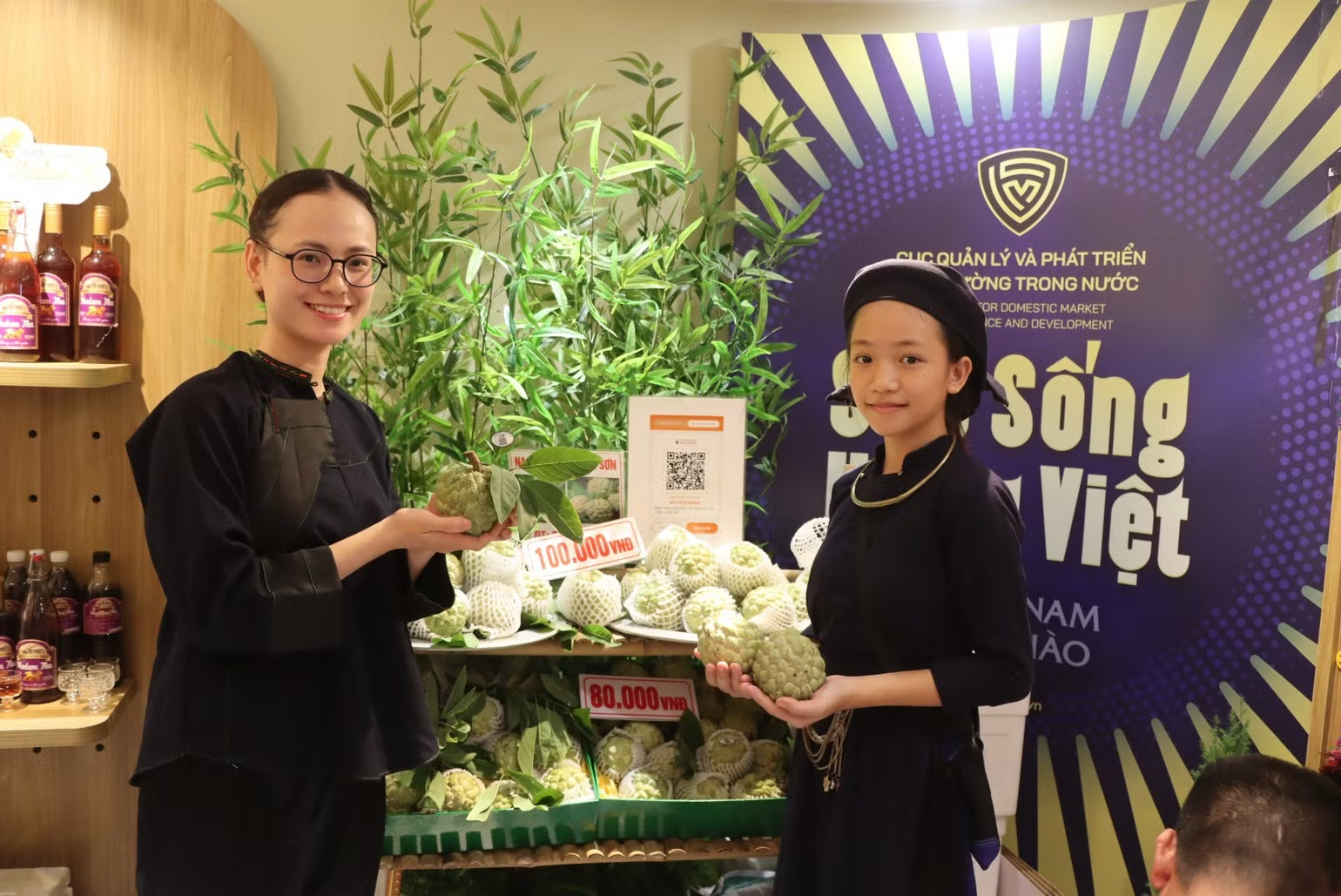
From production areas to distribution systems, from fairs to e-commerce, the more consumption channels are opened, the greater the opportunity to transform local products into economic value. And when economic value is linked with producers, geographical indications gain further motivation to be protected and developed.
Protecting reputation to protect livelihoods
One of the core issues in exploiting geographical indications is the linkage between enterprises and local people. Phan Ba Kien, Director of Baka Limited Liability Company, said connecting with farmers who directly create raw materials is a very important factor, even the most important, in exploiting the value of geographical indications. This linkage must first bring practical benefits to local people. When products can be sold at higher prices, enterprises are able to purchase raw materials at better prices from farmers.
At present, Baka supports local people in farming methods, environmental protection, soil protection, and control of chemical fertiliser and pesticide residues, while also providing training to improve awareness and farming techniques. Participation in larger value chains and the development of farm tourism also help strengthen connections and create motivation for local people to preserve and promote the values of their land and products. This approach suggests an important direction: for products bearing geographical indications to develop sustainably, producers cannot be separated from the value chain.
Farmers are not merely suppliers of raw materials. They are the subjects who directly create the quality and characteristics of products. If market benefits do not return to them, linkages can hardly generate long-term motivation to maintain quality and protect production areas. Conversely, when products are sold well and added value is shared, local people gain more motivation to invest in production, preserve raw material areas, and maintain the values that create product reputation. That is also why production organisation is regarded as a foundation.
Reality shows that a major bottleneck for production entities in ethnic minority and mountainous areas remains market access. A cooperative may produce well, but bringing products to the market also depends on its ability to meet requirements on prices, financial mechanisms, payment, quality, delivery deadlines, logistics, and many other factors. Thus, the livelihood problem cannot be solved simply by raising product prices. What is needed is a value chain with sufficient capacity to bring products to consumers, maintain quality, and create stable outlets.
Lang Son is addressing the issue in that direction. The locality aims to bring products with geographical indications and distinctive products deeper into distribution systems; and strengthen supply-demand connections, domestic and foreign trade promotion, e-commerce, and links with export enterprises, distributors, and importers.
At the same time, departments and sectors are expected to coordinate according to their respective functions, covering raw material areas, quality control, standards, traceability, intellectual property, trade promotion, distribution, and market expansion. Enterprises and cooperatives play a central role in organising production, processing, and consumption.
This approach is meaningful for areas where local products are closely associated with communities. The ultimate goal is not merely to have one more protected product, nor simply to create a recognised brand. The deeper goal is to turn the advantages of a land into economic opportunities for the very people who live, produce, and preserve the values of that land.
The results achieved with Meo Vac mint honey and Lang Son custard apple show that geographical indications can create additional value and expand market opportunities. However, this is not yet the common story for all protected products. Many products still suffer from limited recognition, irregular promotion, and ineffective storytelling about what makes them distinctive, while their connections with modern retail, e-commerce, and markets beyond their localities remain below potential.
This creates a dual requirement. On the one hand, markets must continue to be expanded, while product recognition and commercial value need to be enhanced. On the other hand, production must be organised and quality controlled strictly enough to prevent the shared reputation from being diminished. These two tasks cannot be separated. A broader market creates opportunities to increase value, but the higher the value, the greater the responsibility to protect reputation. A reputation built over generations can become a community asset, but it can also be damaged if geographical indications are used irresponsibly.
Therefore, the exploitation of geographical indications should be viewed as a process of shared development among local people, cooperatives, enterprises, localities, and management agencies. Each stakeholder has a role to play, but the destination must be a value chain strong enough to create stable outlets and distribute added value to those who directly make the products. When the value of a land is transformed into the value of products, and then returns to the community as income, livelihoods, and motivation for preservation, then the journey from protection to exploitation becomes truly meaningful.






![[Infographic] VN-Index rises 0.34% on October 6](https://en-cdn.nhandan.vn/images/j0QNt7m_5iy1OXpnUKiwG61aYhTv_B140GWhfriF26IM-hJLr-YyB-igcHJ7cLRKshCXmgI3hJXGVRYJMfGPzA/chung610-8460.jpg.avif)