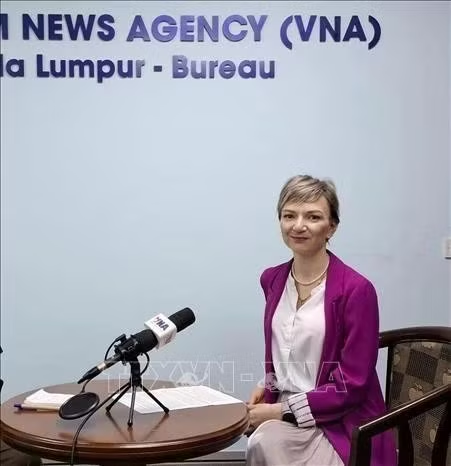
In an interview with Viet Nam News Agency correspondents in Kuala Lumpur on the occasion of the 14th National Congress of the Communist Party of Viet Nam, she held that amid a rapidly changing regional geopolitical landscape, Viet Nam is rising strongly to become a key player, playing an essential role in maintaining stability and fostering extensive cooperation within ASEAN.
According to her, since joining ASEAN in 1995, Viet Nam has undergone a remarkable transformation to become an indispensable link in the global supply chain by investing heavily in export-oriented industries and maintaining robust social stability.
The deep integration of Viet Nam into the global supply network has created outstanding competitive advantages. With reasonable production costs and good supply capabilities, Viet Nam is forecast to capitalise on opportunities more effectively than its neighbouring countries, including Malaysia, she stated.
This economic success not only brings prosperity but also serves as a crucial foundation to strengthen the public's trust in the State’s leadership, thereby maintaining internal cohesion and stability in the face of external challenges, she said, noting the focus on development for the benefit of the people has helped Viet Nam build a harmonious society, creating momentum for more confident foreign policy decisions.
Dr. Julia Roknifard commented that Viet Nam has solidified its international reputation through hosting major diplomatic events. These milestones highlight the country's policy of multilateralism and diversification, as well as its ability to maintain strategic partnerships that last for decades. Specifically, Viet Nam's consistent pursuit of the principle of non-interference and its neutral stance in regional conflicts have made it a reliable partner and a key player in achieving consensus within ASEAN.
In the future, she anticipated that Viet Nam's role will expand even further in building common security frameworks for ASEAN, ranging from disaster management to safeguarding critical sea lanes. With its strong foundation, Viet Nam can make important contributions to establishing regional command structures to tackle both traditional and non-traditional security threats.
In terms of bilateral relations with Malaysia, she noted the two countries have ample opportunities to form joint maritime security cooperation to protect their interests in the East Sea and the Strait of Malacca, based on strategic similarities and close people-to-people ties.
Dr. Julia Roknifard voiced her high expectations for Viet Nam to continue its development trajectory and serve as an "anchor" for regional stability. Additionally, Viet Nam is expected to actively promote infrastructure connectivity and financial projects within ASEAN, such as cross-border payments in local currencies and digital currency integration, to mitigate external policy shocks.
With thorough preparation in both economic potential and diplomatic standing, she asserted that Viet Nam is now positioned to seize great opportunities to assert its influence and lead ASEAN’s efforts in international integration in the new phase.

![[Infographic] Comprehensive strategic partnership between Viet Nam and Denmark](https://en-cdn.nhandan.vn/images/SCsTDAWshkugd_CR7euN3dJE8R5tBjXTeI_Ei3N1rqlMQ51GV2YGcjvxpQFD7-NjQniu1tgyhNBVDsDJmLSxVpkf6BzifI5ne9fyVawgZKkw1QSqvshBTU8QQcE1uc2tD2kFaBWIxM59QGKFzthJwQ/comprehensive-strategic-partnership-between-viet-nam-and-denmark-8462.png.avif)