An intense struggle of ideas
Q: From the perspective of someone directly involved and who contributed to the country’s Doi Moi reforms, could you share your reflections on the period of the 1980s?
A: The Doi Moi process, launched in 1986, brought about historic achievements. But looking back, it was by no means a smooth path. I had long been working at the State Planning Commission, the predecessor of the Ministry of Planning and Investment – an institution whose role was extremely important during the period of a highly centralised planned economy. At that time, the planning model was copied wholesale from the Soviet Union, from organisational structures to working methods, with everything governed by mandatory plan targets.
This planning work began to be adjusted in a more flexible manner from April 1982, when Vo Van Kiet assumed the post of Vice Chairman of the Council of Ministers while concurrently serving as Chairman of the State Planning Commission. Accordingly, greater autonomy in production and business was granted to grassroots units; alongside the mandatory plan system, Plan 2, Plan 3 and others were introduced.
Even so, the economy remained in severe difficulty, especially after the mistakes made in the price-wage-currency adjustment of 1985, which demanded even more far-reaching change.
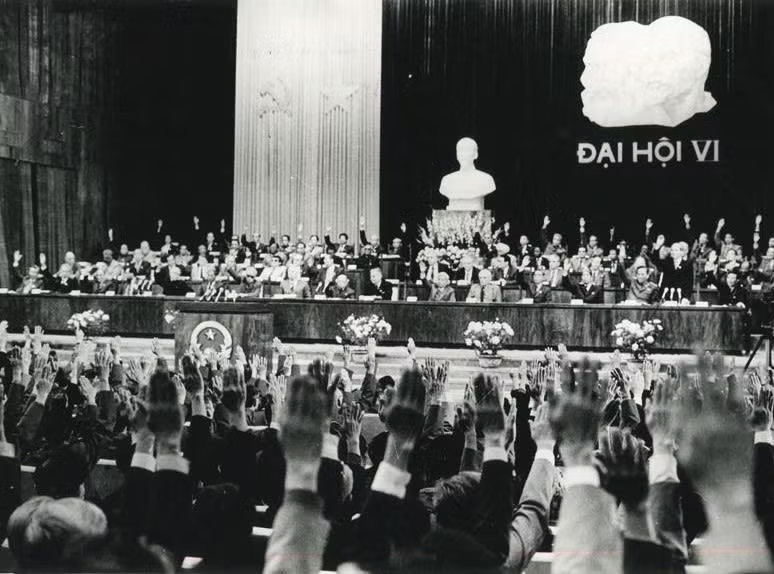
The 6th National Party Congress in 1986 opened the path of reform. It also took place at a time when the country’s socio-economic conditions were extremely strained, with inflation soaring above 700%, making change an urgent necessity.
In that context, the role of General Secretary Truong Chinh was particularly crucial. As General Secretary during the preparation for the congress, he directly led a fundamental review and revision of the draft political report. The political report he presented to the congress resolutely called for “looking straight at the truth, properly assessing the truth, and clearly stating the truth”, acknowledging the prolonged shortcomings of the centrally planned, bureaucratic, subsidy-based management mechanism and laying the foundations for a renewal of development thinking.
It was precisely this courage, openness to reality and determination to reform that created the historic turning point at the 6th Congress, with its landmark resolution to abolish the bureaucratic centralised subsidy mechanism and shift to a multi-sector commodity economy operating under market mechanisms with state management.
Elected to succeed Truong Chinh as General Secretary, Nguyen Van Linh continued to strongly promote the spirit of “looking straight at the truth, properly assessing the truth, and clearly stating the truth”. Previously, as Secretary of the Ho Chi Minh City Party Committee, he had effectively turned the city into a “laboratory” for new economic policies and understood deeply how the bureaucratic subsidy mechanism was stifling production.
After the Congress, he resolutely abolished the practice of “blocking trade and banning markets”, supported the promulgation of the Law on Foreign Investment (1987), and, notably, Resolution 10 in agriculture, which transformed Viet Nam from a food-deficit country into a rice exporter.
Under the leadership of General Secretary Nguyen Van Linh, from 1987 planning work began to undergo profound changes, shifting towards strategic orientation, gradually reducing mandatory targets and, importantly, phasing out the “ask–give” mechanism. From those early, cautious steps, the Doi Moi journey became increasingly decisive and forceful – an intense struggle of ideas in practice.
Q: The adoption of the Law on Foreign Investment in 1987, followed by the Law on Companies in 1990, is widely regarded as a path-breaking decisions. Could you share the context and the concerns surrounding these decisions, especially when the Eastern bloc and the Soviet Union had not yet collapsed and anxieties about “deviating from the path” were still strong?
A: Introducing the Law on Foreign Investment in 1987 was a bold decision. It was an entirely new field for the economy at that time. We were still under embargo, the domestic economy was in dire straits, and opinions were sharply divided. I remember very clearly that when foreigners came to Viet Nam seeking meetings with economic management bodies such as the State Planning Commission, many officials were hesitant to engage, fearing developments beyond their control. I often encouraged my colleagues, saying: “Just exchange views and work with them in the spirit of placing the common cause above all else.”
Q: I recall that at the 11th National Party Congress in 2011, during discussions on revising the 1991 Platform, there was a very frank debate that led to an important adjustment regarding the defining features of the economy. Could you elaborate on that?
A: In fact, this debate had begun as early as 2007. The majority of members of the drafting committee wanted to retain the old wording from the 1991 Platform: “An advanced economy based on modern productive forces and public ownership of the main means of production.” This view was endorsed by the Politburo and supported by more than 55% of delegates at the 14th Plenum of the 10th Central Committee.
However, at the plenary session of the 11th Congress, I proposed revising it to affirm the economic characteristic as: “An advanced economy based on modern productive forces and appropriate progressive production relations.”
My argument was that if the defining economic characteristic of socialism continued to be “public ownership of the main means of production”, it would make investors wary and constrain development. Who, then, would dare to invest in Viet Nam? This view received broad support from many delegates, and the 11th Congress subsequently voted to adopt this revised economic characteristic.
Q: In the turbulent years that followed, Viet Nam lost its aid support from the Soviet Union and Eastern Europe, forcing the country to adopt new and bolder decisions. The task of formulating an entirely new economic development strategy for 1991-2000 was assigned to the State Planning Commission. How did the process of opening up and international integration unfold?
A: The greatest challenge at that time was how to open the door to the global market. We had to rely primarily on our internal strengths while unlocking external resources. The State Planning Commission pursued two tracks in parallel. First, we sought to develop economic relations with Japan. We made several trips there and witnessed first-hand the remarkable transformation Japan achieved after the war, what we called the “Japanese lesson”. That experience reshaped my thinking about development and development pathways.
At the same time, the Commission actively engaged on the diplomatic front, contributing to efforts to normalise relations with the US.
Thanks to these efforts, the door gradually opened.
The 14th National Party Congress – a congress of democracy and intellect
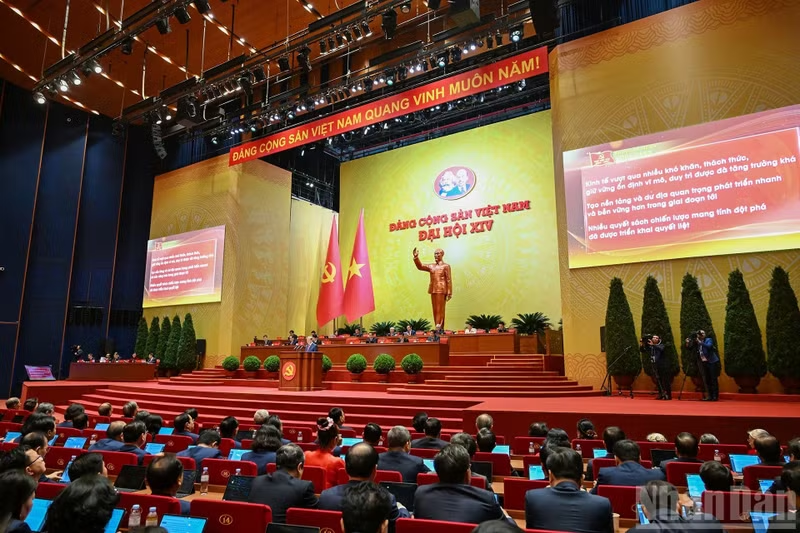
Q: Looking ahead to the 14th National Party Congress, as someone who has witnessed the entire Doi Moi process, do you have any expectations or messages for this particularly important event?
A: I hope that the 14th National Party Congress will be a congress of democracy and intellect. There is a great lesson that can never be repeated too often: the Party is strong because it dares to renew itself; a nation prospers because it dares to decide for the people.
Doi Moi is not a slogan but action. Sometimes, just one timely voice spoken for the benefit of the people and the nation is enough to shift the thinking of an entire era.
In the context of globalisation, the knowledge-based economy and the Fourth Industrial Revolution, the 14th Congress needs to chart a strategic vision for the path towards socialism with until 2030 and 2045.
The task of building an independent, self-reliant economy while proactively integrating into the international economy, and of developing a socialist-oriented market economy with clearly defined substance, must be decided upon in a firm and resolute manner if the country is to make breakthroughs and achieve its development goals.
I firmly believe that by looking back on 40 years of Doi Moi and drawing valuable lessons, our Party will make decisions that both inherit the finest achievements and boldly dismantle outdated barriers, ushering in a new era of more solid and comprehensive development.
Thank you very much.