For Indonesia, the republic was born in August; for Viet Nam, September brought its own historic declaration. This coincidence was no accident. It was the first shared milestone in a relationship that has steadfastly weathered changes of government and regional upheavals, eventually developing into one of the most substantive partnerships in Southeast Asia.
Over the decades, that shared beginning has evolved into one of the most trusted and dynamic bilateral relationships in Southeast Asia, formally established diplomatically in December 1955 under the leadership of President Sukarno and President Ho Chi Minh.
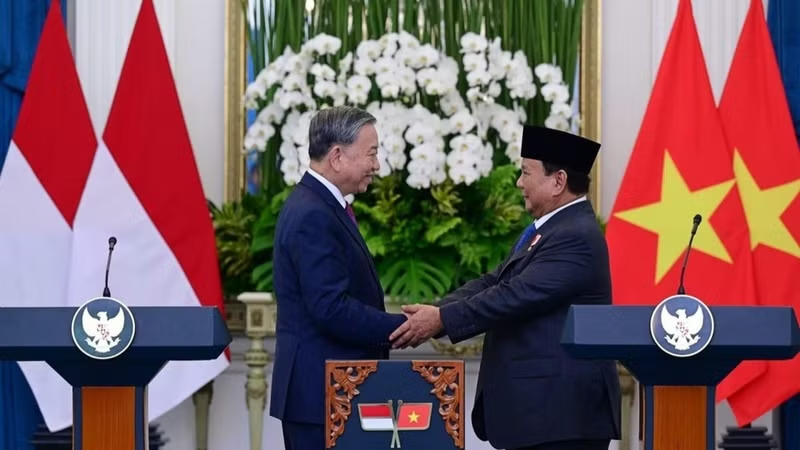
Today, as Indonesia celebrates its 81st anniversary of independence, the relationship between the two countries has grown far beyond historical nostalgia. What began in a spirit of solidarity has become a robust framework for cooperation. Last year, as the two countries marked the 70th anniversary of the establishment of diplomatic relations, their leaders elevated ties to a Comprehensive Strategic Partnership, marking a turning point in which the two countries became more than diplomatic partners; they became co-creators of a shared future, working towards their respective centenary visions of achieving high-income country status by 2045.
In July 2026, in Jakarta, the two countries adopted an Action Plan to implement their Comprehensive Strategic Partnership for the 2026-2030 period. Rather than merely expressing aspirations, as previous declarations had done, the document sets out specific priority areas for closer economic integration, including electric vehicles, renewable energy, the digital economy, smart agriculture and the halal industry. These are not fanciful ambitions, but practical areas of convergence between two economies working towards becoming high-income countries by the centenary of their respective founding in 2045.
Statistics are already pointing to positive developments. Trade and investment continue to grow, while supply-chain resilience has become a top priority for manufacturers in both countries. Indonesia and Viet Nam possess complementary strengths, creating opportunities for cooperation in areas such as battery manufacturing, components, assembly, downstream processing and market access.
The increasingly close bilateral relationship is reinforced by ASEAN economic integration. By reducing barriers, harmonising standards and strengthening connectivity, the ASEAN Economic Community delivers tangible benefits to businesses, including simpler rules of origin, faster customs procedures and access to an increasingly integrated 11-member regional market. The outcome is not merely greater bilateral trade, but more effective and resilient participation in global supply chains.
To further advance these opportunities, the Embassy of Indonesia will work with Viet Nam’s Ministry of Foreign Affairs and Quang Ninh Province to organise a business networking and investment opportunities forum, “Meet Indonesia”, later this year, with the aim of turning potential into concrete cooperation projects.
Yet the sustainability of this partnership rests on more than trade and investment. Cultural similarities also bind the peoples of the two countries. Images of stilt houses rising above flood-prone areas can still be found in both countries, whether across archipelagos or deltas. Bull-racing festivals remain occasions to test skill and courage in Madura as well as the Mekong Delta. Wayang shadow puppetry and Vietnamese water puppetry both reflect Southeast Asia’s longstanding tradition of using performance, light, shadow and storytelling to illuminate social truths.
These are more than fascinating similarities; they are vivid expressions of living cultures, reminding us that the sea between the two countries is in fact a bridge that brings us closer rather than a barrier that separates us. Student exchanges and tourism activities also contribute to strengthening friendship between the two peoples.
Alongside this cultural flow is the steady rhythm of port calls by the two countries’ navies. Ships of the Indonesian Navy and the Viet Nam People’s Navy regularly visit each other’s ports, with the most recent examples being the visit to Ho Chi Minh City in May 2026 and to Bali in February 2025 as part of the multilateral Komodo Naval Exercise.
These port visits are not intended to display military might, but to reaffirm a commitment to peace and stability. At a time when great-power competition is presenting growing challenges to regional institutions, they demonstrate the independent foreign policies of Indonesia and Viet Nam, as well as the two countries’ commitment to maintaining a peaceful, stable and prosperous region.
In 2026, as Indonesia and Viet Nam celebrate 81 years of independence, history has vindicated the vision and sacrifices of the generation of 1945. Independence was never the final destination, but the beginning of a broader national journey. Today, both countries are driven to carry that vision forward by building the resilience needed to transform themselves into high-income economies, creating inclusive supply chains, and nurturing harmonious, adaptable and prosperous societies alongside sustained economic growth.
The answer lies in maintaining the practical momentum that has brought Viet Nam-Indonesia relations this far: turning shared commitments into enduring friendship and transforming present cooperation into a stronger foundation for future generations, grounded in a shared history and directed towards a shared future.
The sea washes against both shores without favouring either side. It carries only those vessels sturdy enough to weather the waves. For eight decades, Indonesia and Viet Nam have kept their respective vessels seaworthy. The favourable winds of 1945 are still blowing. The compass of shared interests still points in the right direction. There is no reason why this voyage should not continue steadily, resolutely and side by side.