At recent National Assembly sessions, as well as based on the opinions of the people and voters nationwide, it has been affirmed that the revolution has fundamentally, thoroughly, and comprehensively changed the philosophy of power organisation at the local level, the local institutions and governance, the thinking on the organisation of the apparatus and public service personnel, the methods of operation, the role, position, and relationship between different levels of government, as well as the development goals.
Speaking at the forum of the 10th Session of the 15th National Assembly, Deputy Prime Minister Pham Thi Thanh Tra highly appreciated the efforts of the local political system, which, under conditions of rapid and urgent work, “running and queuing at the same time,” has worked together, synchronously and decisively to complete a very large volume of work from the central to local levels. Many localities have very creative, flexible, and timely approaches to resolving emerging issues.
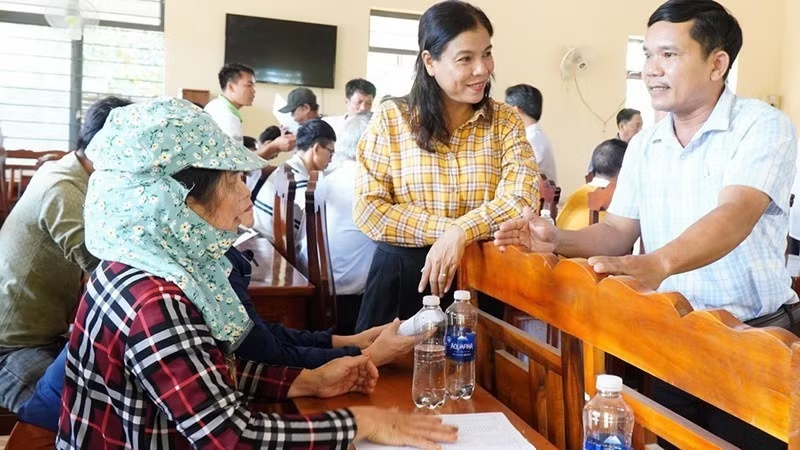
Commune-level governments have become the direct implementers of the Party and State’s policies and guidelines, bringing them to the people, and strengthening and enhancing the people’s trust through daily actions.
National Assembly representative K’Nhieu (Lam Dong delegation) stated: Despite the heavy workload and limited resources, the sense of responsibility never wavers. Even late at night, the office remains brightly lit, and officials and civil servants patiently process each case on time so that people don’t have to wait. The motivation for public service comes from receiving attentive guidance, getting results on time, and smiling in gratitude – a well-deserved reward for every civil servant at the grassroots level.
Practical experience has proven that the two-tier government model has become increasingly closer to the people. The remaining issue is organising better, more timely, and more convenient services to meet the legitimate needs of citizens and businesses. The key to this lies with the commune-level officials.
Commune-level governments are currently performing most of the tasks previously undertaken by district-level governments. Each workday for commune officials combines various tasks including paperwork, citizen interaction, fieldwork, and handling administrative procedures. The workload is enormous and diverse, requiring deep expertise, a high sense of responsibility, and considerable pressure.
In this context, commune-level officials have at times and in some places not been truly dedicated to their duties or have not kept up with the demands of their tasks, failing to cover all assigned areas, leading to anxiety, avoidance, and fear of responsibility... To address these issues, on December 11, 2025, the Party Central Committee issued Conclusion No.226-KL/TW on rectifying working methods and improving the effectiveness of the political system.
Nearly six months into the operation of a two-tier local government system, it remains a novel and unprecedented task. Compared to the 80-year history of familiarity with a three-tier local government system, the initial difficulties, obstacles, and shortcomings need to be addressed. Completely changing mindsets and governance methods, especially in terms of awareness, and adapting to different working styles and approaches, will require more time.
Recently, the Party has issued many groundbreaking resolutions for national development, and the National Assembly has also strongly demonstrated its determination to make institutions and laws a competitive advantage.
The proposed measures aim to unleash the full potential of productivity, open the way for the development of driving forces and resources, maximise internal strengths, leverage external forces, and use endogenous resources and human resources as the foundation, while using science and technology as the breakthrough to drive national development.
To keep pace with the massive movement and breakthroughs of the entire political system and the state public service, all cadres, civil servants, and public employees must revolutionise themselves in terms of ideology, psychology, thinking, awareness, working methods, public service spirit, and public service culture.
To facilitate this movement, the Ministry of Interior and relevant agencies also need to proactively research, advise, and issue comprehensive and practical solutions regarding organisational structure, staffing, and policies for those remaining after the restructuring.
Sharing perspectives from the grassroots, the closest to the people, where each official and civil servant is quietly working with the desire to bring satisfaction to the people, many National Assembly deputies stated: The current budget at the commune level is facing difficulties, slow transfers, and does not correspond to the requirements of the tasks, failing to ensure regular expenditures.
Commune-level civil servants work under immense pressure, with 2 to 3 times more work than usual, yet their benefits and policies remain unchanged, failing to encourage and motivate them to work with peace of mind and dedication.
Deputy Tran Quoc Tuan (Vinh Long Delegation) reflected: According to the summary report of voter recommendations submitted to the 10th Session, voters in many localities such as Quang Tri, Vinh Long, and Binh Thuan (now Lam Dong province) previously reported that after the administrative unit mergers, many commune officials have to travel further, while travel allowances and public service allowances have not been adjusted.
Voters in Nghe An, Lam Dong, and Dong Thap provinces have requested that the government implement policies to support and encourage officials in merged areas, as their lives are facing many difficulties, with increased travel, housing, and living expenses causing their real income to decrease by 10 to 12% compared to before.
Nearly six months into the operation of a two-tiered local government system, it remains a new and unprecedented task. Compared to the 80-year history of familiarity with a three-tiered local government system, the initial difficulties, obstacles, and shortcomings need to be addressed.
Many localities, such as the former Bac Kan (now Thai Nguyen province), Can Tho city, and some provinces in the Mekong Delta region, are experiencing a situation where grassroots officials are burdened with additional work due to downsizing, but their income has not improved, affecting their morale, motivation, and work efficiency.
Some delegates mentioned that the average Consumer Price Index (CPI) for the first nine months of 2025 increased by approximately 3.27% compared to the same period last year. The price increases of many essential goods are putting significant pressure on the living standards and real income of officials, civil servants, and public employees. The current base salary of 2.34 million VND/month is no longer adequate compared to the current cost of living…
Many delegates proposed a breakthrough policy on income and benefits because this is not just about increasing salaries to alleviate daily burdens, but also about the overall pulse of the system, which needs to be revitalised for higher goals.
The country is pursuing the goal of maintaining macroeconomic stability, improving the quality of growth, and achieving rapid and sustainable development in the coming period amidst a rapidly changing, complex, and fiercely competitive world with increasingly stringent demands and challenges. In particular, we need to successfully implement the Resolution of the 14th National Congress of the Party in the new term.
Therefore, policies and laws will be difficult to implement effectively if the team of officials and civil servants lack courage and responsibility, lack breakthroughs, and lack the determination to see things through to the end. Clear objectives, a long-term vision, and a stable and open legal framework are essential, but a half-hearted, overly rhetorical, and superficial implementation process will be very difficult.
Furthermore, the success of the new model depends heavily on the synchronisation between the capacity of the staff and the quality and effectiveness of legal framework implementation, the ability to apply modern technical infrastructure and technology based on a new management mindset.
This highlights the urgent need for greater objectivity and responsibility in the rational and scientific arrangement of the administrative apparatus, overcoming the imbalance of surplus and shortage, local parochialism, and corruption in personnel management; and in evaluating the qualifications, capabilities, responsibility, and ethics of public officials.
Many delegates suggested the immediate application of objective, impartial, and scientific standards, criteria, and metrics based on job positions for the selection, utilisation, and evaluation of personnel. This must be a challenging and verifiable process, with ups and downs, entry and exit; it is necessary to value and boldly appoint those who have proven their actual qualifications and capabilities.
Solving the aforementioned bottlenecks will contribute to enhancing the position and role of each official and public employee with new motivation, public service ethics, and enthusiastic dedication, making “every workday a day of creation.”
This will accelerate the transformation of administrative management methods towards creation and service, from passive administration to proactive local governance, creating a solid foundation, a crucial and urgent root in the global trend for modern national governance, for the goal of development and the happiness of the people.