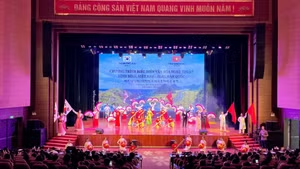
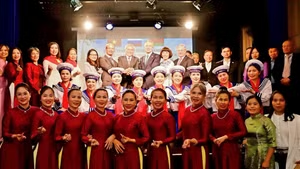
The exhibition showcases outstanding achievements in the history, archaeology, architecture and culture of Co Loa, helping shed light on the role of the site in the development of Red River civilisation while spreading awareness of the importance of appreciating and preserving heritage among the community.
The exhibition is organised around three themes, forming a narrative that begins with the cultural foundations of ancient Vietnamese inhabitants, proceeds through the achievements of the Au Lac capital, and concludes with Co Loa’s position and prospects within the World Heritage system.
The first theme, “The flow of Red river civilisation”, introduces typical archaeological cultural relics discovered at Co Loa, reflecting the history of settlement and the development of communities in this area from prehistoric times to the formation of the Au Lac state. Through a system of archaeological sites and artefacts from different cultural periods, visitors can learn about daily life, production activities, craftsmanship techniques and the creative achievements of ancient Vietnamese inhabitants. Archaeological materials help identify layers of cultural sediment, demonstrating that Co Loa is an important site for research into the formation and development of Red river civilisation.

The second theme, “Co Loa capital – Achievements of the Au Lac State”, focuses on highlighting the outstanding achievements of the Co Loa capital under King An Duong Vuong. It introduces the system of ramparts, moats, waterways and archaeological traces associated with metallurgical activities, weapons production and defence organisation.
With its distinctive scale and structure, the Co Loa rampart system demonstrates the level of spatial planning, construction techniques and the capacity of the Au Lac inhabitants to organise and mobilise resources. Beyond its defensive function, the structure of the capital also reflects the way political, military and social life was organised in an early state-building period. These achievements provide important evidence of advances in technology, social organisation and community management in Vietnamese history.
The third theme, “Co Loa in the flow of world heritage”, introduces the historical, archaeological, architectural and cultural landscape values that establish Co Loa’s distinctive position within Viet Nam’s and the international cultural heritage system. From the remains of an ancient capital to tangible evidence of the development of ancient Vietnamese inhabitants, Co Loa contains a wealth of materials of significance to research into the formation of the state and the development of early centres of power in Southeast Asia.
Placing Co Loa within the broader context of heritage sites and historical centres in the region helps identify the distinctive characteristics and values of the site. The theme also addresses the process of preparing the nomination dossier for World Heritage status, highlighting the need to ensure integrity and authenticity, and to enhance the effectiveness of heritage management and protection as the site moves towards UNESCO inscription.

Through these three themes, the exhibition offers a systematic approach to the history and values of the Co Loa Citadel, from archaeological cultural layers to the achievements in building the capital of the Au Lac state and heritage values of significance beyond the national boundaries. It thereby provides the public with further opportunities to learn about an important period in national history, gain a deeper understanding of Co Loa’s role in the flow of Red River civilisation and appreciate the importance of heritage preservation for present and future generations.
In his opening remarks, Nguyen Thanh Quang, Director of the Thang Long-Ha Noi Heritage Conservation Centre, said that the exhibition “Co Loa relic complex – A convergence of Red river civilisation” was a meaningful cultural activity that helped introduce, honour and disseminate the distinctive historical, cultural and archaeological values of Co Loa – a land associated with the early days of national state-building and a place where outstanding achievements of Red River civilisation converged and were crystallised.
Notably, the exhibition is being held against the backdrop of the Co Loa Ancient Citadel Complex being added to UNESCO’s Tentative List of World Heritage Sites in October 2026. This marks an important milestone, opening a new phase in the research, preservation and promotion of the values of the Co Loa Citadel.
Nguyen Thanh Quang said that the documents, images, archaeological research findings and visual displays at the exhibition would help the public gain a deeper understanding of Co Loa – not merely as an ancient capital but also as vivid evidence of the creativity, spirit of self-reliance and tradition of nation-building and defence of the Vietnamese people.
At the exhibition’s opening ceremony, Professor and Doctor Nguyen Van Kim, President of the Viet Nam Historical Science Association, Vice Chairman of the National Cultural Heritage Council and Vice Chairman of the Viet Nam National Commission for UNESCO, affirmed that the Co Loa Citadel was a place where cultural values and natural landscapes, natural conditions and architectural works, historical and cultural relics, religious and spiritual life, social activities of different resident groups and people's livelihoods were brought together in harmony. It is not only a source of pride for Ha Noi and Viet Nam but also a unique and distinctive cultural heritage of Asia and humanity.
“From this cultural and heritage space, great ideas and values that transcend time and have universal significance, such as harmony between people and nature, the aspiration for peace, creativity, tolerance and compassion, have become common and enduring values shared by many cultures,” Professor and Doctor Nguyen Van Kim emphasised.
According to Professor and Doctor Nguyen Van Kim, the exhibition, featuring nearly 200 documents and images, initially presents in a systematic manner the site's outstanding values. From preservation to promotion, Co Loa is gradually affirming the vitality of a heritage site of outstanding value. Achievements in research, archaeology, preservation and restoration have helped safeguard the site's unique historical, cultural and archaeological values. Meanwhile, heritage education, displays, exhibitions and cultural tourism are increasingly being promoted, creating opportunities for the community, particularly younger generations, to explore, understand and carry forward Co Loa’s values.
The Co Loa relic complex (Dong Anh commune, Ha Noi) is a special historical and cultural heritage site associated with the capital of the Au Lac state under King An Duong Vuong. Not only does it preserve important remnants of an early centre of power during the nation's state-building period, but Co Loa also reflects the formation, development and creative achievements of ancient Vietnamese communities through various periods. Its system of ramparts and moats, archaeological sites, religious architectural structures and intangible cultural values have shaped the distinctive character of a heritage space with profound historical and cultural significance.
In October 2026, the relic complex was added to UNESCO’s tentative list of world heritage sites. This is an initial result of the research and nomination dossier preparation process, undertaken in coordination with relevant agencies, organisations and experts, and also lays the groundwork for further research and the completion of the World Heritage nomination dossier in the coming years.