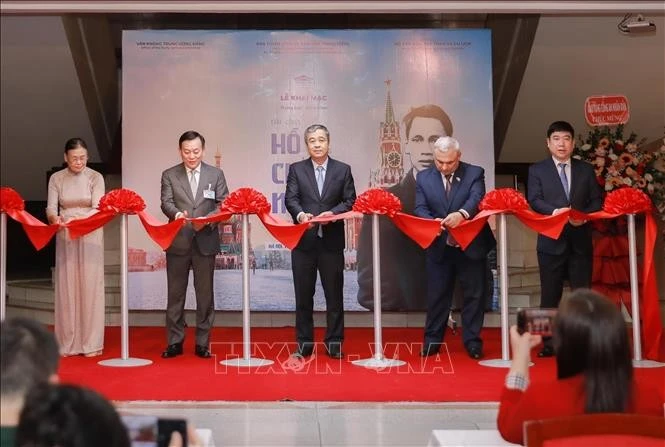
Under the directions of the Party Central Committee’s Commission for Information, Education and Mass Mobilisation, and the Ministry of Culture, Sports and Tourism, the Ho Chi Minh Museum co-hosts the exhibition in coordination with the Party Central Committee Office’s Commission for Political Theory and Archives Department. The event forms part of celebrations marking the 75th anniversary of diplomatic relations between Viet Nam and Russia (1950–2025) and the 108th anniversary of the Russian October Revolution.
Speaking at the opening ceremony, Director of the Ho Chi Minh Museum Vu Manh Ha emphasised that President Ho Chi Minh - a national liberation hero, an eminent cultural celebrity, and a close friend of the Russian people - laid the solid foundation for the long-standing Viet Nam–Soviet friendship, now the Viet Nam–Russia relationship.
The exhibition retraces the key milestones of Nguyen Ai Quoc (Ho Chi Minh)’s revolutionary journey in the Soviet Union, where he lived, studied, and carried out revolutionary activities in various periods between 1923 and 1938. Under the influence of Lenin’s theses on national and colonial issues, he embraced the path of the October Revolution and later founded the Communist Party of Viet Nam, leading the nation to independence and the establishment of the Democratic Republic of Viet Nam.
After 1945, President Ho Chi Minh made several official visits to the Soviet Union, where he witnessed first-hand the country’s socialism-building achievements and worked tirelessly to nurture bilateral ties.
Featuring nearly 300 carefully selected photos, documents, and artefacts, including rare items newly collected from Russia, the exhibition is divided into three sections on his early revolutionary years; his official visits to the Soviet Union as head of state; and 75 years of bilateral ties built on the foundation he established.
Notable items include a 1924 book on the Fifth Congress of the Communist International and archival photos capturing President Ho Chi Minh’s 1955 visit to the Soviet Union, accompanied by his handwritten notes in the Ural Geological Museum’s guestbook.
The exhibition is open to the public until the end of April 2026.