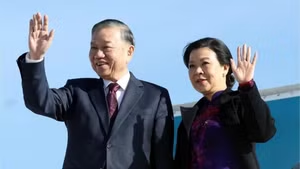
The activities took place within the framework of General Secretary of the Communist Party of Viet Nam Central Committee and President To Lam’s state visit to Russia.
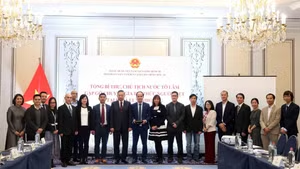
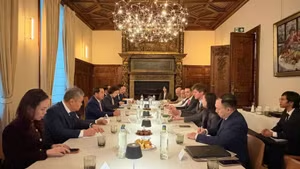
On September 9, Thang and the delegation held talks with Moscow authorities to review implementation of the 2025-2027 cooperation programme and discuss key priorities for the new period, including urban transport, science and technology, digital transformation, trade and investment, and cultural exchanges.
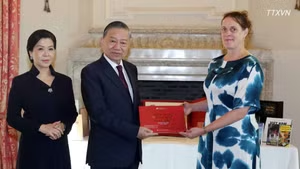
At the meeting, the city leader handed Moscow Deputy Mayor Alexander Gorbenko a decision approving the investment policy for the “Moscow House in Ha Noi” project, fulfilling a commitment under a 2008 cooperation agreement between the two capitals.
The move resolves longstanding obstacles to the project and demonstrates Hanoi’s determination to advance local-level cooperation between Viet Nam and Russia, while creating fresh momentum for deeper and more substantive ties between Ha Noi and Moscow.
The two sides also discussed cooperation in urban railway development. They agreed on the need for close coordination between relevant agencies to establish a strategic cooperation framework that would enable Ha Noi to benefit from Russia’s experience and advanced technologies in investing in, designing and operating urban railway systems.
Moscow authorities said they would soon provide Ha Noi with official information on the framework and key areas of cooperation in transport infrastructure.
Ha Noi’s efforts to complete legal procedures for projects demonstrate its consistent commitment to a transparent and favourable investment environment and its readiness to work with foreign investors, the delegation said.
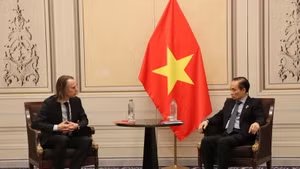
Also on September 9, the Ha Noi delegation met Tatarstan Deputy Prime Minister Oleg Korobchenko as part of efforts to diversify local-level external relations.
Tatarstan is one of Russia’s dynamic economic, industrial, high-tech and innovation centres. Building on existing connections and cooperation, the two sides agreed to establish a comprehensive cooperation framework covering the economy, science and technology, education and training, culture and tourism.
A highlight was the signing of a memorandum of understanding (MoU) between the Ha Noi People’s Committee and the Tatarstan authorities, laying the groundwork for practical programmes and projects.
The MoU is among the documents signed during To Lam’s visit and represents a notable local-level agreement to advance cooperation with Russia. It also helps concretise the senior leaders’ orientations for local cooperation and implement commitments reached at the 25th session of the Viet Nam-Russia Intergovernmental Committee.
Earlier, on September 8, the Ha Noi delegation worked with Saint Petersburg’s Committee for External Relations at the northern Russian city’s representative office in Moscow.
Deputy Chairman of the Ha Noi People’s Committee Nguyen Xuan Luu conveyed an invitation to Saint Petersburg Governor Alexander Beglov to visit Ha Noi this year and affirmed that the capital would provide full support for the trip.
Hanoi also proposed combining the visit with a cultural programme featuring Saint Petersburg artists and exploring specific business and investment projects in the two cities. The sides discussed cultural cooperation programmes, with a view to launching concrete projects later this year and in 2027.
The Hanoi delegation also met leading Russian companies, including Transmashholding, a major railway vehicle manufacturer, and Metrogiprotrans and Metropromproekt, which have extensive experience in consulting, designing and developing metro and underground transport systems.
The companies expressed their interest in practical cooperation and business-to-business connections with Ha Noi firms.
Discussions focused on areas of Ha Noi’s concern, including metro vehicles, underground construction design, urban railway operations, digital transformation, green technologies and urban governance.
The outcomes are expected to help Ha Noi gain modern urban management experience and mobilise international resources for strategic development projects, while contributing to stronger traditional friendship and the Viet Nam-Russia Comprehensive Strategic Partnership.
![[In Pictures] General Secretary and President To Lam and his spouse visit and present books to Royal Library of Belgium](https://en-cdn.nhandan.vn/images/3NY4Z6Du1Md1PrS_s0ZZOrwc5xDfq4rRua69depr-TBkwatGjBcD9lagzrI2BmGDo4nKYA9qjKDjuB3-yYloL_1KbNBr00klMZQFyHQxQ6Jq6GzFfAiY0m5agKw6jNtArN4QnVntX8RQeUmD7pdCq7nwvn3e235v3kufpokBN_s/1-tong-bi-thu-chu-tich-nuoc-va-phu-nhan-tham-tang-sach-cho-thu-vien-hoang-gia-bi.jpg.avif)