The province has identified “source separation of waste” as a fundamental and decisive solution for the effective treatment of household waste. It has therefore issued numerous directives and specific action programmes on separating and treating waste at source.
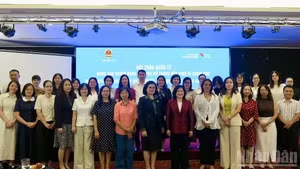
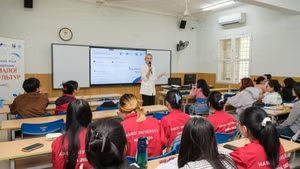
The project “Women in Hung Yen Separating and Treating Household Waste at Home, 2023–2026”, together with communication campaigns, training sessions, leaflet distribution and the establishment of pilot models, has initially helped raise public awareness of environmental protection.
Approximately 358,160 households across Hung Yen are now separating and treating household waste at home, significantly reducing the amount of waste that needs to be collected and transported to village and residential collection points.
Bui Ngoc Mai, from Doan Dao Commune, Hung Yen Province, said that after receiving support and training in treating household waste at home, she began separating waste before taking it outside. Since adopting source separation, she has found that the amount of household waste taken to the collection point has fallen by 60–70%.
To further enhance the effectiveness of household waste treatment, Hung Yen Province is encouraging and facilitating private-sector investment in waste treatment. Initial results have been positive, with four of the province’s 15 waste-treatment facilities already operational and three others under development.
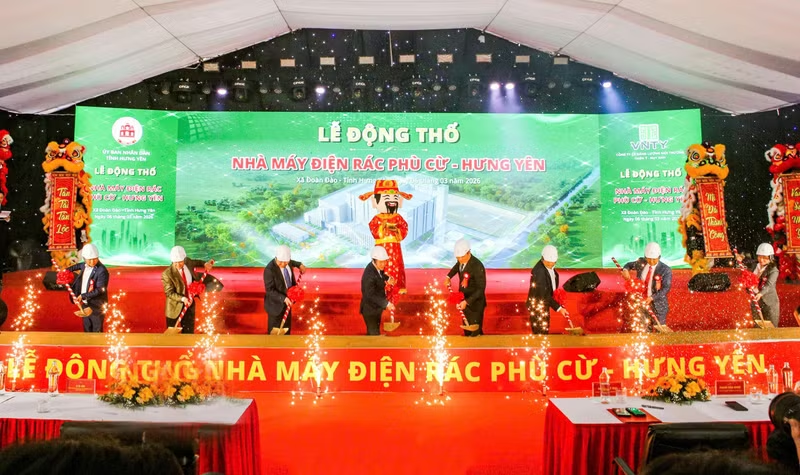
A key project among them is the Phu Cu waste-to-energy plant, which has a treatment capacity of up to 1,600 tonnes per day and night. The plant is capable of handling a large proportion of the waste currently generated, while also helping to address the long-standing problem of accumulated waste.
It also incorporates power generation with a capacity of 40MW, turning waste into a source of clean energy in line with the trend towards a circular economy and sustainable development. The use of modern incineration technology meeting European standards ensures strict control of emissions and minimises environmental impacts. This represents a major step forward compared with the traditional treatment technologies widely used at present.
However, for the plant to operate at maximum efficiency, it is essential to ensure a stable and suitable supply of incoming waste. This has created an urgent need to step up waste separation at source in order to improve the quality of the fuel used in the power-generation process.
According to a report by the functional authorities, approximately 2,000 tonnes of household waste are generated in Hung Yen each day, including around 1,684 tonnes in rural areas and 316 tonnes in urban areas.
To deal with solid waste effectively and comprehensively, Tran Dang Anh, Deputy Director of the Hung Yen Provincial Department of Agriculture and Environment, said the province was implementing a coordinated range of measures.
These include issuing specific regulations on waste separation at source and increasing penalties for violations. The province is also investing in synchronised technical infrastructure, from collection and transport systems to treatment facilities, which will be planned and developed in a modern, coordinated manner suitable for source separation.
Other measures include promoting socialisation and attracting investment; establishing favourable mechanisms for businesses to participate in the environmental sector, particularly in high-tech and environmentally friendly projects such as waste-to-energy plants and recycling facilities; and raising public awareness and encouraging behavioural change. Communication campaigns are deployed in a more substantive way and linked to practical benefits, while more effective pilot models are developed for wider replication.
In addition, the role of local authorities is strengthened by decentralising responsibilities, granting greater authority and improving their capacity to manage environmental protection effectively.