Keeping a promise to fallen comrades
Lieutenant General Hoang Khanh Hung falls silent whenever he speaks about a Heroic Vietnamese Mother who is nearly 100 years old. Every time a delegation visits her, she asks the same heartfelt question: "When will my son come home?" To this day, that question remains unanswered.
"As long as we live, we must repay our debt of gratitude"
Having fought on some of the fiercest battlefields, including A Bia, Coc Bai, Southern Laos, and the Quang Tri Ancient Citadel, and having witnessed the deaths of many comrades, including two sworn brothers from his hometown, Le Minh Duc and Nguyen Van Du, Lieutenant General Hoang Khanh Hung has always regarded the search for the remains of fallen soldiers as a way of fulfilling the promise made by surviving soldiers to those who never returned.
After retiring in 2010, he repeatedly returned to former battlefields in search of his comrades.
"I am alive today because so many of my comrades sacrificed their lives. As long as we live, we must repay our debt of gratitude," said Lieutenant General Hoang Khanh Hung.
He recalled a visit to former General Secretary Le Kha Phieu. During the meeting, the former Party leader was deeply moved as he remembered a promise made during the resistance war: while fighting, the soldiers promised one another that those who survived would bring home those who had fallen. Now that peace has come, we must do everything possible to honour our comrades. Those words became a command from the heart.
I am alive today because so many of my comrades sacrificed their lives. As long as we live, we must repay our debt of gratitude.
Lieutenant General Hoang Khanh Hung
Since joining the Viet Nam Association for Supporting Families of Martyrs in 2010 and serving as its chairman since 2020, Lieutenant General Hoang Khanh Hung, together with the association's staff and members, has turned that promise into practical and meaningful action.
So far, the association has collected information, connected witnesses, and supported DNA testing, helping to identify more than 1,100 fallen soldiers. It has also assisted families in exhuming, transporting, commemorating, and reburying more than 1,600 sets of remains, while mobilising over 180 billion VND through social contributions to support gratitude activities.
Notably, the association is a social organisation without permanent staffing or a regular salary fund. Most of its members work entirely out of a sense of gratitude and responsibility.
For Lieutenant General Hoang Khanh Hung, bringing a fallen soldier's remains home to a cemetery fulfils only half of the mission. The other half, and the one that weighs most heavily on him, is restoring each soldier's identity so that they can truly return to their family, homeland, and ancestors.
For many years, he has consistently been proposing the establishment of a national gene bank to support the identification of fallen soldiers. In his view, this would be a decision of historic significance.
Time waits for no one. The mothers, fathers, brothers, and sisters of fallen soldiers are growing older each day, and many are passing away. If their DNA samples are not collected now, countless opportunities to identify fallen soldiers will be lost forever.
Living maps
Keeping the promise made by the living to those who sacrificed their lives, thousands of veterans across the country continue their quiet journeys in search of fallen comrades. They have become "living maps", guiding the sacred journey towards bringing their comrades home.
Veteran Nguyen Quang Tue, formerly a soldier of Company 3, Battalion 1, Regiment 122, Division 313, fought at the Vi Xuyen Front in Ha Giang Province.
During a battle in 1984, he lost a leg and was left with an 83% disability. For many years, however, he has continued climbing mountains with his prosthetic leg, returning to strategic positions such as Hills 685, 772, and 773, tracing old trenches and rocky ravines to identify where his comrades fell.
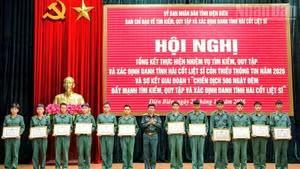
During the 500-day-and-night campaign to intensify the search for, recovery, and identification of fallen soldiers' remains, his guidance enabled recovery teams in Tuyen Quang Province to discover numerous sets of remains.
After retiring in 2005, Colonel Tran Thanh Hoa, former Reconnaissance Squad Leader of Regiment 24A on the Central Highlands Front, devoted most of his retirement to searching for fallen comrades. The memories of the battle at Special Zone 24 on Lunar New Year's Eve in 1968 remain vivid in his mind.
As the officer who led assault units into Kon Tum Town, he witnessed a battle in which more than 200 officers and soldiers from the regiment sacrificed their lives.
He later joined a joint Viet Nam-US research team, comparing battlefield maps, reconnaissance photographs, military records, and witness testimonies to reconstruct the course of the battle.
In June 2026, based on these documents, the authorities identified the location of a mass burial trench containing an estimated 70 to 90 fallen soldiers on Truong Chinh Street, in Dak Cam Ward and Kon Tum Ward, Quang Ngai Province. So far, Team K53 has recovered four sets of remains.
In the 57 years since the devastating bombing at Da Sap Cave in Ha Nha Commune, Da Nang City, on April 25, 1969, veterans Le Huy Tu and Nguyen Dinh Cap of Artillery Regiment 575 have never forgotten the comrades who remained there.
Beginning with their first return in 2004 and continuing in the years since, they have travelled repeatedly through the forests of Ha Nha, following every clue and meeting every witness in an effort to locate the cave buried by the bombing.
Every year on April 25, they return to burn incense at the cave entrance, standing before the collapsed rocks and calling out the names of their fallen comrades.
Their memories have helped the Da Nang Military Command accurately identify the area, leading to the discovery of numerous personal belongings. By July 22, eight sets of remains had been recovered.
A nationwide journey of gratitude
According to the Viet Nam Veterans Association, over the past five years its branches have collected more than 245,000 information forms, mobilised thousands of veterans to participate in search efforts, provided nearly 5,600 sources of valuable information, and assisted in recovering nearly 7,000 sets of fallen soldiers' remains.
During the 500-day-and-night campaign to intensify the search for, recovery, and identification of fallen soldiers' remains, veterans supplied many important clues that enabled the authorities to recover hundreds more sets of remains.
According to the Viet Nam Veterans Association, over the past five years its branches have collected more than 245,000 information forms, mobilised thousands of veterans to participate in search efforts, provided nearly 5,600 sources of valuable information, and assisted in recovering nearly 7,000 sets of fallen soldiers' remains.
More recently, veterans who took part in the 1968 General Offensive and Uprising provided diaries, operational maps, and other valuable documents, contributing to the discovery of mass graves at Le Thi Rieng Park in Ho Chi Minh City, where more than 100 sets of remains have so far been found.
Lieutenant General Hoang Khanh Hung often becomes emotional when speaking about the mothers and wives of fallen soldiers.
He recalled one occasion when a delegation returned a fallen soldier's remains to his hometown. Although the soldier's mother was seriously ill and struggled to walk, she insisted on being helped to the doorway. Trembling, she placed her hands on the ceramic urn and whispered through tears, "At last, you've come home to me." A few days later, she passed away peacefully.
In recent days, people across the country have also been deeply moved by the story of Nguyen Thi Le from Tay Ninh Province.
Before leaving to join the army, soldier Huynh Van Quen could only promise, "I'll fulfil my duty and then come back to marry you." That promise was never fulfilled as he was killed during the 1968 General Offensive and Uprising.
Although Quen died, Le never married. For nearly 60 years, she quietly cared for and worshipped him as though she had always been his wife.
In recognition of her silent devotion, on July 18 the Tay Ninh Provincial Department of Home Affairs officially recognised Nguyen Thi Le as the wife of martyr Huynh Van Quen and granted her the benefits provided to martyrs' relatives.
The sacrifices made by comrades, and by the mothers and wives of fallen soldiers, have never allowed Lieutenant General Hoang Khanh Hung to rest.
Even while receiving treatment at the 108 Military Central Hospital, he rarely remained in his hospital bed. On many occasions, he asked doctors to grant him temporary discharge so that he could return to the association's headquarters to deal with work.
On the morning of June 11, 2026, at the launch ceremony for the programme "Calling the names of the nation's stars", held in support of the 500-day-and-night campaign, adhesive tape and an intravenous needle were still attached to his hand. He attended the event to launch the programme before quietly returning to hospital to continue his treatment.
In the just over one month since its launch, the programme has received nearly 2.2 billion VND in donations from organisations and individuals through the charitable account numbered 2707 at Military Commercial Joint Stock Bank.
"The greatest value of the 500-day-and-night campaign is not reflected in the figures updated each day, but in restoring hope to millions of martyrs' families that the nation has never forgotten those who sacrificed their lives for the Fatherland," Lieutenant General Hoang Khanh Hung said emotionally.