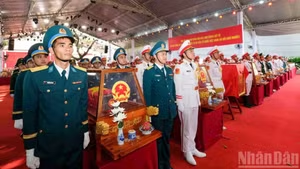
To this day, hundreds of thousands of fallen soldiers' remains across Viet Nam have yet to be identified. Every unnamed grave represents an enduring void in the hearts of their loved ones and the unrelenting hope of families who have spent decades searching for those they lost.
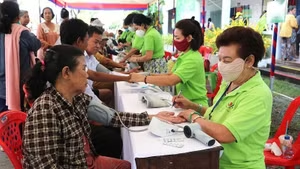
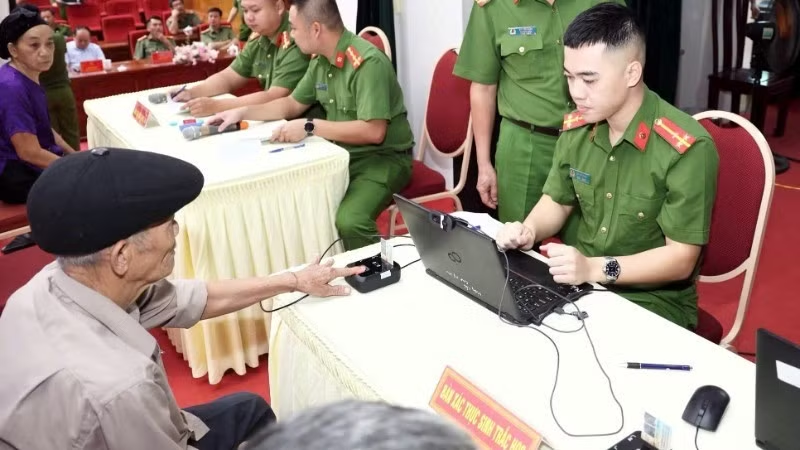
The Ministry of Public Security is vigorously carrying out a nationwide campaign to collect DNA samples from relatives of unidentified fallen soldiers. In Tuyen Quang Province, from July 22 to 27, the provincial public security forces are collecting DNA samples from more than 3,700 relatives of fallen soldiers at 18 fixed collection sites located at commune- and ward-level police headquarters, while three mobile teams are travelling to the homes of relatives.
A total of 1,267 public security officers and personnel have been mobilised for the campaign, together with other local forces. Beyond its scientific significance, the initiative reflects the responsibility, care, and gratitude of the Party and State towards those who laid down their lives for the nation.
Present at one of the DNA collection sites, 87-year-old Dao Van Nhan from the Do residential quarter in My Lam Ward said the DNA sampling is far more than just a procedure to support forensic identification. It also carries the hopes his family has held for more than half a century as they searched for news of his two younger brothers, who sacrificed their lives for the country's independence and freedom.
Nhan believes that, with advances in science and the determination of the authorities, the day will come when fallen heroes who gave their lives for the nation will once again be called by their rightful names and return to the embrace of their families.
His two younger brothers, martyr Dao Van Toan, who sacrificed his life in 1968, and martyr Dao Xuan Hoa, who sacrificed himself in 1972, both lost their lives on the southern battlefield. More than 50 years later, the family's search has yet to come to an end. They have travelled to countless martyrs' cemeteries and sought information from former comrades, but without success.
"At my age, I no longer wish for anything for myself. I only hope that before I pass away, I can find my brothers and bring them home to our homeland and ancestors. If I am no longer here, at least my children and grandchildren will know where they rest so they can pay tribute to them. That has been my family's greatest wish for more than 50 years," Nhan said emotionally.
Sharing a similar hope, Lu Thi Sung, an ethnic H'Mong woman from Vang On Hamlet in Hung Loi Commune, travelled nearly 60km through mountainous roads early in the morning to reach the DNA collection site at Minh Xuan Ward Public Security.
Her elder brother, martyr Lu Lao Chin, sacrificed his life in Ha Quang, Cao Bang Province, during the defence of the northern border in 1979.
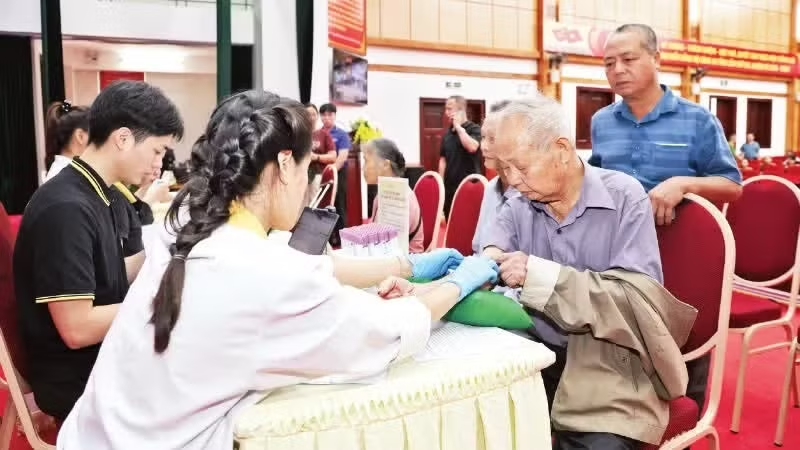
Holding her registration form and quietly extending her arm for a blood sample, Sung could not hide her emotions. To her, the drop of blood collected that day not only served DNA testing purposes but also embodied her family's faith in scientific progress and the Party and State's care for families of fallen soldiers.
"I only hope that DNA testing will one day help us find my brother and bring him home, so that future generations will have a place to burn incense for him on death anniversaries and during Tet," she said through tears.
As of June 10, commune- and ward-level public security across the province has updated information on 6,253 beneficiaries receiving allowances into the National Population Database. These include 2,278 fallen soldiers whose burial sites have been identified and 3,975 whose burial information remains unknown.
For those whose burial sites have yet to be identified, more than 5,600 maternal-line relatives eligible for DNA sampling have been recorded in the National Population Database, while more than 4,000 relatives have been registered for DNA sample collection.
Do Dinh Dat, Chairman of the People's Committee of An Tuong Ward, said the ward had identified the campaign as an especially important political task. It has mobilised residential groups, the Veterans' Association, and the Ho Chi Minh Communist Youth Union to review records, contact every family of fallen soldiers, and provide guidance on all necessary procedures to ensure no eligible case is overlooked.
According to leaders of Tuyen Quang Provincial Public Security, the greatest advantage in implementing the campaign has been the strong direction from the central to grassroots levels, the coordinated involvement of the entire political system and the broad support of relatives of fallen soldiers. Effective use of the National Population Database, combined with information technology applications, has enabled information verification and cross-checking to be carried out quickly and accurately.
However, the campaign also faces considerable challenges. A very large number of samples must be collected within a short period, while many relatives are elderly, in poor health, or live in remote areas, requiring additional manpower and time for mobile DNA collection teams.
The "500-Day Campaign" is a call from the heart and a profound reminder of the responsibility today's generation bears towards those who remain in the embrace of the motherland. Every fallen soldier is part of the lifeblood of the nation, an unfinished story of their homeland, their family and loved ones still waiting for news. Every action we take today is not only the fulfilment of a duty but also an expression of gratitude, an effort to ease the pain of war and to uphold the sacred bond with our fallen heroes.
Major General Nguyen Duc Thuan, Director of Tuyen Quang Provincial Public Security
Major General Nguyen Duc Thuan, Director of Tuyen Quang Provincial Public Security, said the "500-Day Campaign" is "a call from the heart" and a profound reminder of the responsibility today's generation bears towards those who remain in the embrace of the motherland.
"Every fallen soldier is part of the lifeblood of the nation, an unfinished story of their homeland, their family, and loved ones still waiting for news. Every action we take today is not only the fulfilment of a duty but also an expression of gratitude, an effort to ease the pain of war and to uphold the sacred bond with our fallen heroes," he said.
Determined to collect DNA samples from all eligible relatives of fallen soldiers across the province, Major General Nguyen Duc Thuan instructed public security units to continue upholding the spirit of "Serving the People", maximising the sense of responsibility of every collective and individual, overcoming difficulties, and carrying out the task proactively, creatively, and with dedication.
He also required all participating units to strictly follow the direction of the provincial public security leadership, maintain close coordination, promptly exchange information, flexibly handle emerging situations, and ensure that every step is conducted safely and scientifically, in accordance with procedures, for the right individuals and within the prescribed timeframe. The task, he stressed, demands the highest levels of responsibility, dedication, meticulousness, and care at every stage.
The journey to restore the names of fallen soldiers remains challenging. Yet, with the concerted efforts of the entire political system, the dedication of the People's Public Security force and advances in science and technology, there is growing hope that more unidentified fallen soldiers will one day regain their identities and return, under their rightful names, to the embrace of their families and homeland.