On this issue, Nhan Dan spoke with Associate Professor and Doctor Pham Van Thuan, Vice Rector of Viet Nam Maritime University.
Q: How are rapid advances in science and technology, digital transformation and the green transition affecting current requirements for maritime human resource training?
A: Science and technology are changing not only operational methods but also the knowledge, skills and professional competencies required of workers in the maritime sector. Previously, people in many positions mainly needed to master their professional expertise, operational procedures and equipment-handling skills. However, as digital technologies, automation and environmental requirements become increasingly integrated into production and business activities, these competencies need to be further expanded.
For example, in port operations, management involves not only coordinating vehicles, berths and cargo but also working with management systems, analysing data and selecting operational plans. In logistics, managers must take into account costs, time, operational efficiency and environmental impacts throughout the entire supply chain.
In maritime transport, engine technologies, new fuels and emission-control requirements also place higher demands on officers, engineers and seafarers. In response to these developments, Viet Nam Maritime University is renewing its curricula and teaching methods to align with technological changes in businesses and the professional requirements of the future.
One important change is the shift from knowledge transmission to developing problem-solving capabilities. Students are exposed to practical challenges such as organising transport routes, designing logistics networks, assessing costs, managing warehouses and selecting operational plans. Through this approach, they must not only apply their professional knowledge but also analyse information, compare options and select appropriate solutions.
In particular, amid the rapid development of artificial intelligence (AI), the issue is not simply whether students should be allowed to use AI in their studies. More importantly, they must be guided to use technology responsibly, ask appropriate questions, verify results and combine AI applications with their professional knowledge.
Therefore, educational reform is not just about adding technological content to curricula. It also requires changes in the organisation of learning to help students proactively acquire new knowledge and adapt to increasingly demanding professional requirements.

Q: The green transition is creating new requirements concerning engine technologies, fuels and emission control. How has the university renewed its training and scientific research activities to prepare for this transition?
A: For programmes in maritime sciences, the university is updating their content to cover green maritime transport, smart shipping and safety. In addition to knowledge of ship navigation, marine engine operations and maritime engineering, students are given greater exposure to digital technologies, control systems, energy management, the use of new fuels and emission reduction.
One of the facilities supporting training is an engine-room simulator donated by Japan's NS United Kaiun Kaisha. The system can simulate advanced engine technologies, including liquefied natural gas (LNG) engines and dual-fuel engines. It enables students to learn about the operating principles, technical characteristics and operational requirements of new generations of engines.
The university also has a Transas NTPRO 5000 bridge simulator with a 240-degree field of view, helping students become familiar with equipment and practise handling situations similar to those encountered aboard real ships.
Alongside improvements to practical training facilities, the university is promoting research into greenhouse gas emissions inventories, green port development, alternative fuels and marine environmental management.
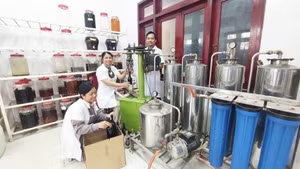
In the environmental field, the university has specialised analytical and monitoring equipment, including inductively coupled plasma mass spectrometry (ICP-MS), liquid chromatography-mass spectrometry (LC-MS), gas chromatography (GC) and infrared spectroscopy. Field equipment is also available for sampling and analysing seawater, soil, mud, sediment, air and other environmental parameters.
Notably, the university has equipment for monitoring emissions from marine engines, including carbon monoxide (CO), sulphur dioxide (SO₂), nitrogen oxides (NOₓ) and particulate matter. Combining laboratory analysis with field monitoring enables lecturers and students to gain practical experience of research methods and environmental assessments related to maritime activities.
In addition, topics such as the green marine economy, marine spatial planning, greenhouse gas emission reduction, green ports and marine environmental management are receiving greater emphasis in both teaching and research.

Q: One important requirement today is to link training with research and the application of science and technology. What models is the university implementing to enable students to participate in research, develop technologies and address practical challenges?
A: We believe that a maritime university in the new era cannot simply be a place that supplies workers. It must gradually become a knowledge, research and innovation centre within the marine economy ecosystem.
Accordingly, scientific research needs to focus more closely on issues that the sector and businesses are seeking to address, such as optimising port operations, reducing logistics costs, managing supply chains, cutting fleet emissions, using clean energy and automating warehouse and port operations.
The university is promoting research into artificial intelligence, big data, the Internet of Things and blockchain in transport, as well as automation, intelligent control and smart logistics, alongside solutions to reduce pollution and develop sustainable maritime activities.
To link research with training, we focus on building practical and simulation-based learning environments and creating opportunities for students to directly participate in developing technical models and products.
For example, the PL-TOS port operations simulator allows students to practise port operational procedures. At the Mekong-Japan Sub-region Logistics Training Centre, established with support from the Japan-ASEAN Integration Fund, students have access to SAP software, warehouse management systems (WMS), as well as a simulated warehouse, conveyor belts and lifting equipment.
Notably, some student research products have been incorporated into training activities, including an automated guided vehicle (AGV) robot designed to transport goods within warehouses. This demonstrates how research outcomes can be put to further use in teaching, allowing other students to access and learn about the technology.
In mechanical engineering and automation, the university has computer numerical control (CNC) machining systems, as well as engineering design and simulation software. Lecturers and students are also researching ways to combine CNC technology with 3D printing, with a view to performing both subtractive machining and additive manufacturing on the same system.
Through these activities, the university aims to establish a training environment that connects research with practical work, enabling students not only to operate equipment but also to participate in developing and improving technologies.
However, for scientific research to deliver effective results, closer links with businesses are needed. We hope businesses will do more than simply accept students for internships. They should also bring technical and management challenges into the classroom, send experts to participate in teaching, and work with the university on research and product development.

Q: Given technological changes and the requirements of sustainable development, what do you consider the core competencies of the maritime workforce over the next 10–20 years? What solutions are needed to achieve this goal?
A: From the perspective of Viet Nam Maritime University, we believe the major challenge in the coming years is to train a generation of workers equipped with three sets of competencies: maritime and logistics expertise, digital skills and green competencies.
A graduate in transport economics or logistics in the future cannot simply know how to organise transport. They must also be able to organise it more efficiently, intelligently and with lower emissions. A port manager must not only master the professional aspects of berth operations but also be capable of managing and operating ports based on data, technology and environmental criteria.
Similarly, logistics professionals must look beyond cost reduction to optimise costs, time, supply chain resilience and carbon footprints simultaneously.
In the past, we often asked whether graduates were qualified to perform their jobs. Amid rapid technological change, however, the more important question must be: “Do today's students have the capabilities to master the jobs and technologies of the maritime and logistics sectors over the next 10–20 years?”
To meet these requirements, the first priority is to continue renewing training curricula towards an interdisciplinary approach, integrating professional knowledge with digital technologies and environmental and sustainable development requirements.
The university is focusing on developing integrated undergraduate and master's degree programmes, enabling capable students to access advanced courses at an earlier stage and participate in research topics and projects alongside lecturers and businesses. This will help learners develop research and innovation capabilities at an early stage, as well as the ability to address complex technological and management challenges.
Another important solution is to promote scientific research linked to the practical requirements of the marine economy. The university plans to develop marine research and innovation centres focusing on artificial intelligence, big data, automation and green technologies, while improving the quality of research groups working on smart maritime technologies, logistics, offshore renewable energy and marine engineering.
At the same time, it is necessary to focus on commercialising research outcomes, promoting technology transfer and increasing business participation in research and innovation.
Another solution is to develop a smart learning environment, digital learning materials and online learning platforms, while making more effective use of existing practical training, simulation and research facilities.
Human resources remain the decisive factor in carrying out these tasks. The university will continue to improve its policies on attracting and providing incentives for leading lecturers and experts, while expanding the participation of Vietnamese scientists overseas and international experts in training, research and technology transfer.
We also hope to continue receiving attention and support from ministries, sectors and Hai Phong City in implementing the project to develop Viet Nam Maritime University into a national key university for training and research in support of the sustainable development of the marine economy by 2030, with a vision to 2045.
The university's goal is not only to provide sufficient workers for the sector but also to help develop a high-quality workforce capable of mastering technologies, driving digital transformation and the green transition, and enhancing the competitiveness of Viet Nam's marine economy.
Thank you very much!