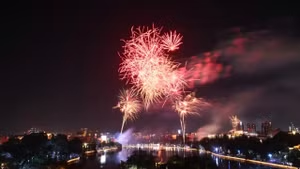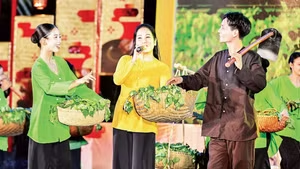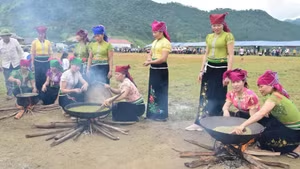
From meticulous scholarly editions, international translation projects, theatrical adaptations and folk performances to educational activities and contemporary arts, all have contributed to spreading the value of the masterpiece. Its aesthetic, humanistic spirit, and Vietnamese cultural essence continue to be rediscovered, extended, and creatively reinterpreted in increasingly dynamic and meaningful forms.
Bringing The Tale of Kieu into contemporary life
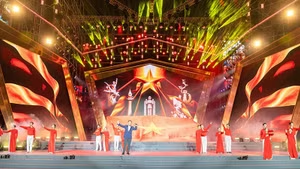
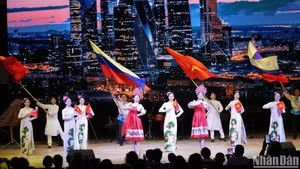
According to Ha Tinh Province’s plan, the celebration of the 260th birth anniversary of great poet Nguyen Du will take place at Thanh Sen Square (Thanh Sen Ward) with the art programme “Great Poet Nguyen Du – A Heart of Radiant Humanity”. A multi-layered stage will be elaborately constructed, combining modern performance technology.
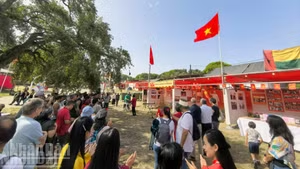
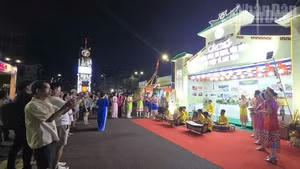
More than 200 artists from central and local units will participate in reenacting the emotional layers, fates, and humanistic spirit of The Tale of Kieu through the language of light and music. This represents an entirely new approach, bringing the masterpiece onto a contemporary stage and enhancing the interaction between tradition and technology. Alongside this are culturally rich activities such as traditional Kieu-themed folk performances and recitations, calligraphy inspired by The Tale of Kieu, as well as folk games associated with the characters and stories created by great poet Nguyen Du. Many localities, especially his homeland of Tien Dien, have planned folk festivals where people directly participate in performances, recitations, and “living with Kieu”.
In academia and publishing, several new works on The Tale of Kieu have been introduced, including research-based, annotated, and comparative editions for both general readers and specialists. These publications help enrich textual knowledge while offering visually engaging presentations suited to younger audiences. Conferences and scholarly seminars on Nguyen Du and The Tale of Kieu are being prepared, gathering linguists, textual scholars, and cultural researchers from inside and outside Viet Nam. Notably, several translation projects plan to introduce the masterpiece in multiple languages, alongside international talks on translation practice, aiming to further expand its global reach.
In arts and culture, over the past five years, many directors, artists, and contemporary designers have approached The Tale of Kieu through new forms, integrating diverse artistic disciplines, digital art, video art, modern music, illustrative graphics and interactive exhibitions to broaden the work’s dialogue with today’s visual and technological landscape.
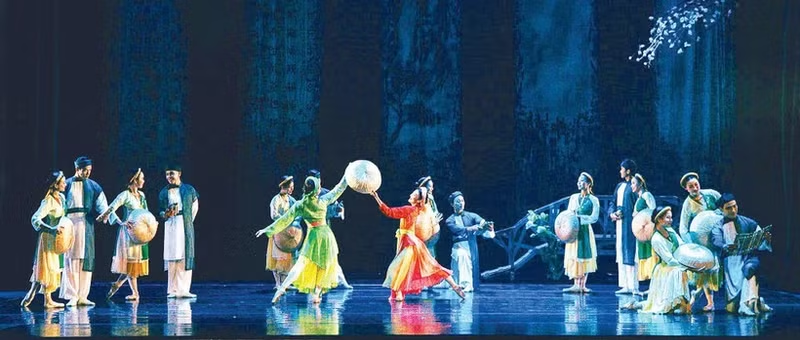
Numerous theatres and artists have sought to carve out new aesthetic pathways for Nguyen Du’s masterpiece. The clearest hallmark of this trend can be seen in “Ballet Kieu” by Ho Chi Minh City Ballet and Symphony Orchestra (HBSO). Premiering on June 20, 2020, under the direction and choreography of Nguyen Thi Tuyet Minh, the production surprised the artistic community by recounting Kieu’s fate through the refined movement language of ballet blended with folk dance elements. The integration of modern performance technology with national identity has enabled “Ballet Kieu” to set a new standard for adapting classical literature to the stage. Unsurprisingly, the ballet will be revived in 2025 with a fresh and energetic cast.
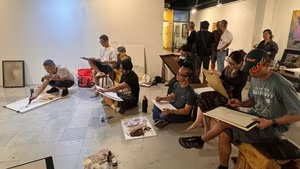
Contemporary fine arts are also revitalising the spirit of the work through visual and interactive spaces. In Da Nang, a community of young artists has created a “new breeze” in approaching The Tale of Kieu via a large-scale multimedia exhibition supported by the “Connections Through Culture 2025” programme of the British Council and major technology partners. Breaking away from traditional illustrated formats, the exhibition showcases diverse media: video art, digital art, illustration, graphic design, installation, light, and sound. The space is divided into emotional pathways evoking Kieu’s worldly and inner journeys, while engaging with modern questions: the fate of women, the right to choose, the meaning of sacrifice, and the spirit of freedom.
A need for deeper and more substantial investment
Although The Tale of Kieu has inspired strong creativity across artistic fields, many experts and artists agree that to enable this monumental heritage to truly enter contemporary life with its rightful stature, deeper, more systematic and professional investment is urgently needed. Associate Professor Dr Nguyen Dang Diep, Director of the Institute of Literature, emphasised: “The Tale of Kieu is a multilayered artistic structure.
Every sentence and image is tied to its narrative architecture and cultural allegories. If we separate it from Nguyen Du’s aesthetic context or interpret it arbitrarily for temporary tastes, creative work easily strays from the spirit of the original.” He argued that “renewal” should not mean altering or attempting to “modernise” the work superficially but instead opening space for new perspectives while preserving the humanistic essence, philosophical depth, and the beauty of Nguyen Du’s luc bat (six-eight syllable) verse language that Nguyen Du painstakingly created.
Sharing this viewpoint, art critic Nguyen Anh Tuan — a persistent advocate for integrating cultural heritage into contemporary fine arts — noted: “A masterpiece carries an ecosystem of symbols, capable of endless transformation. Contemporary artists should not feel constrained by the text but may engage with new materials so that each artistic form opens an additional dimension of reflection. Art must not simply become fashionable; instead, it should explore how poetic qualities behave when entering digital spaces, when fragmented, restructured, or activated by movement.”
Associate Professor Dr Pham Xuan Thach observed: “Expanding the space for The Tale of Kieu must align with the aesthetic language of the era. The key point is not how accurately one recreates the work but whether its core humanistic spirit is preserved. If we consider the masterpiece as already perfect and untouchable, it becomes difficult to enrich its value, meaning we have disconnected The Tale of Kieu from life. Artistic creativity only gains meaning when it avoids two extremes: overly dependence on the original or breaking it merely for sensationalism. The right path is dialogue, requiring artists to answer: Why does the work still matter today? Without answering this, even a faithful recreation remains a soulless copy.”
In reality, limitations persist in how the work is adapted. Certain films inspired by The Tale of Kieu have failed to persuade audiences. Attempts to reproduce Kieu’s world on screen often fall into mimicking scenes or borrowing visual motifs rather than forming a distinct cinematic language that both respects Vietnamese culture and resonates with contemporary aesthetics.
Similarly, in publishing and research, numerous editions, annotated works, and translations of The Tale of Kieu have appeared worldwide, yet not all uphold scholarly quality. Some foreign-language translations lack consistency in conveying meaning; others have been commercially produced without an authoritative review board. This inadvertently causes confusion, making it difficult for international audiences to grasp the true value of the masterpiece.
Even in theatre and performance arts, many projects stop at illustration rather than fully engaging with the work’s deep humanistic and philosophical layers. These limitations underscore a crucial lesson: refreshing a classic succeeds only when grounded in intellectual depth, humility, and respect for the original text and modern creative methodology. When efforts in research, adaptation, theatre, cinema, music, and fine arts receive appropriate investment, the work can transition from being merely “mentioned again” to truly “coming alive” in the consciousness of the times.