One year is not a long period in the development of a nation. Yet, for the most extensive reform of the organisational structure of the State apparatus since the Doi moi era, it provides an initial opportunity to evaluate a crucial question: How the new model has functioned in practice, what early outcomes it has achieved, and what challenges remain to be addressed?
Practice has delivered a positive answer
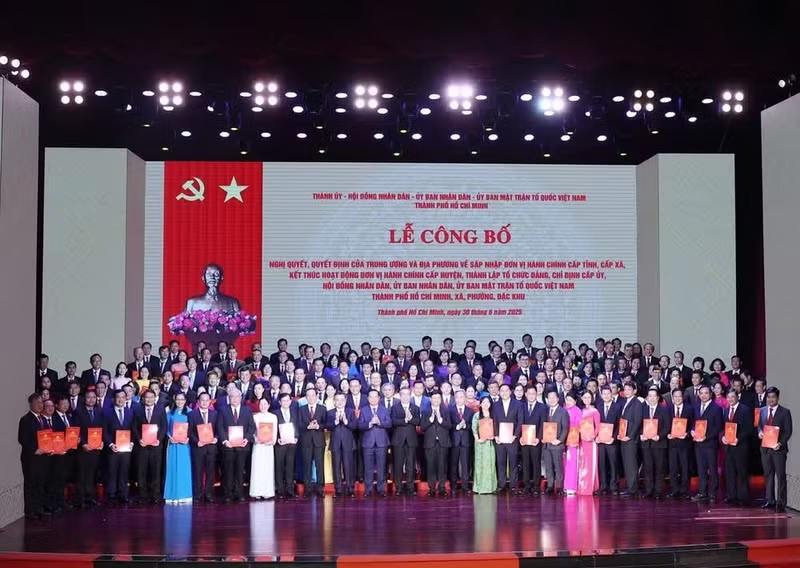
Within a remarkably short period, the entire political system undertook a series of unprecedented tasks simultaneously: reorganising administrative units nationwide; ending the operation of district-level administrations; restructuring Party, State, Viet Nam Fatherland Front, and mass organisation bodies; issuing hundreds of legal documents; arranging and reassigning officials; transferring thousands of responsibilities between different levels of government; while ensuring uninterrupted State administration and maintaining seamless public services for citizens and businesses. This constituted the first real test — and the most important benchmark — for the three-tier government model.
General Secretary and State President To Lam has repeatedly stressed that the organisational restructuring revolution is not merely about rearranging administrative bodies but about establishing a new governance model capable of meeting the country's development requirements in a new era.
General Secretary and State President To Lam has repeatedly stressed that the organisational restructuring revolution is not merely about rearranging administrative bodies but about establishing a new governance model capable of meeting the country's development requirements in a new era.
He has underscored that streamlining the State apparatus must follow the overarching principle that "the new apparatus must be better than the old one and become operational immediately; there must be no interruption to work, no gaps in time, no unattended areas or sectors, and no disruption to the normal activities of society or of the people." This principle has guided the implementation of the three-tier government model throughout the reform process.
Notably, after one year of operation, the achievements go beyond the stable functioning of the new administrative system. They are also reflected in tangible improvements in governance, the quality of public services, and the administrative system's capacity for management and coordination. These initial results further affirm the Party’s sound policy on restructuring the State apparatus, while laying an important foundation for building a modern, streamlined, effective, and efficient public administration.
Figures confirm the effectiveness of the organisational restructuring revolution
The effectiveness of the organisational restructuring revolution cannot be judged solely on qualitative assessments; it must be verified through concrete results. After one year of implementing the three-tier government model, a range of indicators have demonstrated encouraging progress.
From 63 provinces and centrally governed cities, the administrative system has been reorganised into 34 provincial-level units; 696 district-level administrative units have ceased operation; and the number of commune-level administrative units has been reduced from more than 10,000 to just over 3,300.
The first major achievement is the nationwide reorganisation of the administrative system. The number of provinces and centrally governed cities has been reduced from 63 to 34; all 696 district-level administrative units have ceased operation; and the number of commune-level administrative units has been consolidated from more than 10,000 to just over 3,300. At the same time, villages and residential groups have continued to be streamlined in line with population size and the governance requirements of the new period.
Beyond reducing organisational units, the administrative system has been redesigned to eliminate intermediate layers, shorten chains of command, and strengthen the autonomy of grassroots authorities.
Across the political system, numerous intermediary bodies have been restructured. Within the Party and local government systems, district-level organisations have been dissolved, while corresponding structures have been established in newly formed communes, wards, and special administrative zones. Within the Government, ministries and ministerial-level agencies have continued to be streamlined, with thousands of departments, bureaus, and sub-departments abolished or merged. Local authorities have likewise reorganised their specialised agencies to align with the new governance model.
Where the administrative structure once featured multiple layers, the distance between the central Government and the grassroots has now been significantly shortened. Administrative decisions can therefore reach the public more quickly, while the number of intermediary steps in implementation has been substantially reduced.
However, streamlining the organisational structure is only a necessary condition. The key to ensuring the new model functions effectively lies in redefining the functions, responsibilities, and powers of each level of government. Over the past year, hundreds of documents on decentralisation and delegation of authority have been issued, while nearly 10,000 responsibilities across the political system have been reviewed and reassigned.
This far exceeds a technical adjustment to public administration; it reflects a fundamental shift in governance thinking. The central Government now focuses on institution-building, policy formulation, and oversight and inspection, while local governments have been granted greater autonomy in implementation and held more clearly accountable for outcomes.

Another notable development is the continued progress in administrative reform. More than 5,000 administrative procedures have been published on the National Public Service Portal, while nearly 5,000 procedures are now available online and connected to data systems across ministries, sectors, and localities. At the same time, the Government has simplified or abolished thousands of administrative procedures and business conditions, shortening processing times and significantly reducing compliance costs for both citizens and businesses.
Alongside administrative reform, digital transformation has advanced at pace. More than 90% of administrative applications are now processed online, while nearly 95% of records have been digitised. Millions of applications have benefited from data reuse, eliminating the need for citizens to repeatedly provide the same information.
Ultimately, the success of any reform is measured by public satisfaction. After one year of operating under the new model, local authorities have processed more than 42 million administrative applications, with over 95% completed on or ahead of schedule. Citizen reception, complaint handling, and denunciation settlement have operated smoothly. Public satisfaction has exceeded 83%, while nearly 90% of respondents reported a marked decline in bureaucratic harassment and unnecessary obstacles in administrative procedures.
These figures demonstrate that the organisational restructuring revolution has achieved far more than altering the administrative structure. More importantly, it has begun to improve the quality of public services for citizens. That, ultimately, remains the highest objective of any administrative reform.
Core issue – Transforming governance mindset
While the figures on streamlining the State apparatus, decentralisation, delegation of authority, and administrative reform reflect the initial achievements of the organisational restructuring revolution, the deeper significance of the three-tier government model lies in a more fundamental transformation: a new approach to national governance.
History demonstrates that every successful reform goes beyond altering organisational structures; it seeks to transform the way government operates. A modern public administration is measured not by the number of institutions it comprises, but by its ability to deliver results, serve the people effectively, and create momentum for development.
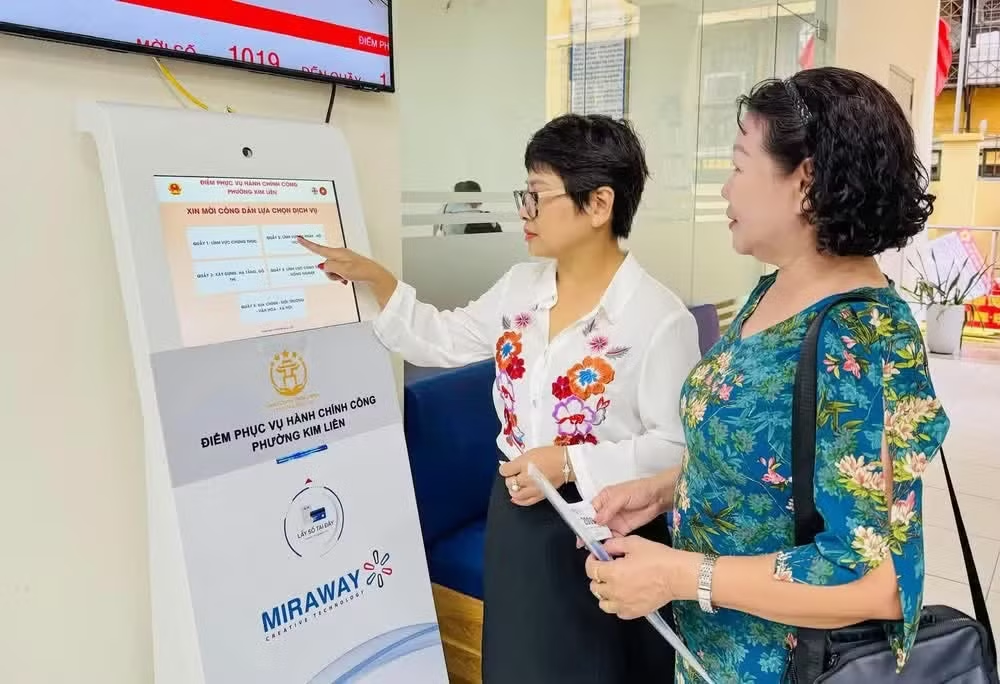
The current organisational restructuring revolution is not simply about removing one tier of administration. More importantly, it is about redefining the relationship between the central Government and local governments through a clearer allocation of functions, powers, and responsibilities. Under the new model, the central Government focuses more on strategic planning, institutional development, policy formulation, and strengthening inspection and oversight. Provincial authorities assume responsibility for coordinating development and allocating resources, while commune-level administrations become the frontline tier of government, directly managing local affairs, maintaining close contact with the people, and handling the majority of matters affecting citizens and businesses. This represents a transformation not only in organisational structure but also in the philosophy of governance.
This shift is most evident at the grassroots level. With district-level administrations abolished, commune-level authorities are no longer confined to routine administrative duties. They now directly undertake many responsibilities previously exercised by district governments, including land administration, construction, public investment, finance, justice, environmental management, social welfare, and digital transformation. Consequently, the role of commune leaders has grown significantly more important. They are expected not merely to manage administrative operations but also to lead local development, make decisions with confidence, accept responsibility for those decisions, and remain directly accountable to the people.
This is also a guiding principle that the Party has repeatedly emphasised: decentralisation and the delegation of authority must go hand in hand with clearly defined responsibilities, stronger mechanisms for controlling the exercise of power, and greater accountability on the part of those in leadership positions. Greater authority inevitably entails greater responsibility, while broader decentralisation requires more rigorous oversight.

Another defining feature of the three-tier government model is the transition from paper-based administration to data-driven governance. Alongside digital transformation, data is increasingly becoming the foundation of public administration. Electronic records are being reused; national and sectoral databases are gradually being interconnected; more public services are being delivered online; and many localities have begun operating through Intelligent Operations Centres (IOCs), AI-powered virtual assistants, and data analytics platforms to support public management.
This demonstrates that modern governance no longer relies primarily on experience or conventional administrative reports but increasingly relies on real-time data. Once data systems are fully integrated, leaders will be able to monitor the progress of tasks, identify bottlenecks promptly, accurately assess the performance of individual agencies and officials, and make evidence-based rather than intuition-driven decisions.
Naturally, every major reform requires time to mature. After one year of implementation, some localities continue to face challenges relating to staffing, governance capacity, digital infrastructure, and institutional coherence. Viewed in their entirety, however, these are transitional issues that do not alter the fundamental nature or positive trajectory of the organisational restructuring revolution.
Most importantly, the foundations of a new governance model have now been established: a public administration in which powers are more clearly defined, accountability is more precisely assigned, data has become a strategic resource for governance, and citizens and businesses are genuinely placed at the centre of public service delivery. That is the deepest and most enduring significance of the three-tier government model.
Practice continues to validate the value of the new model
No major reform is ever free from challenges during its initial phase of implementation. The history of administrative reform across many countries shows that the more far-reaching a policy decision is, the more time the transition requires for adaptation, refinement, and the full realisation of its benefits. Viet Nam's three-tier government model is no exception.

After one year in operation, alongside the positive results already achieved, practical implementation has also revealed several issues still requiring attention. It is important, however, to understand the true nature of these challenges. They do not indicate any flaw in the policy of restructuring the State apparatus; rather, they are the inevitable consequences of the transition from the former administrative model to a new governance framework.
Experience over the past year demonstrates that following the abolition of district-level administrations, the workload transferred to commune-level authorities has increased substantially. Many areas previously under the jurisdiction of district governments — including land administration, construction, public investment, finance, environmental management, justice, and digital transformation — have now been assigned directly to grassroots authorities. While this shift is consistent with the objectives of decentralisation and the delegation of authority, it has also placed considerable pressure on officials responsible for implementation.
In some localities, staffing structures are still being consolidated. Many officials are required to perform multiple roles simultaneously, while there remains a shortage of personnel with specialist expertise in planning, investment, finance, and digital technology. These constraints have inevitably affected the pace of administrative processing in certain areas.
It should be recognised, however, that these remain capacity challenges during the early stages of reform rather than shortcomings of the organisational model itself. As the administrative system continues to be strengthened, officials receive training tailored to their positions, and human resources are allocated more effectively, these pressures will gradually be alleviated.
Alongside the need to strengthen the workforce is the continuing task of improving the institutional framework. A revolution in organisational restructuring cannot rely solely on political determination; it must also be underpinned by a coherent and comprehensive legal system. Experience over the past year has shown that many regulations formulated when the district level still existed now require review and amendment to align with the new governance model. This is an extensive undertaking that demands simultaneous implementation, practical evaluation, and continuous refinement.
This is also consistent with the development of a modern rule-of-law State. Institutions are not static; they must evolve continuously in response to practical experience and the country's changing development needs.
The success of the three-tier government model depends not only on reducing organisational layers but also, to a significant extent, on the ability to integrate data across different levels of government, sectors, and localities.
Another pressing priority is to accelerate digital transformation. The success of the three-tier government model hinges not only on streamlining organisational structures but also on the effective integration of data across all levels of government and sectors. If data remains fragmented, administrative processes continue to operate on separate systems, and officials are still required to repeatedly enter the same information, the full benefits of decentralisation and delegated authority cannot be realised. For this reason, developing digital infrastructure is not merely a technological task but a fundamental requirement for modernising governance. Once data is fully interconnected, many administrative processes can be automated, processing times further reduced, and leaders provided with more effective tools to direct, monitor, and evaluate performance in an objective and transparent manner.
Encouragingly, despite having to manage an enormous volume of work throughout the transition, the administrative system has remained stable. The provision of administrative services has continued uninterrupted, the proportion of applications processed on time has remained consistently high, citizen reception and the handling of complaints and denunciations have continued to operate effectively, and public satisfaction has shown a steady upward trend.

It can therefore be affirmed that as the institutional framework continues to be refined, the civil service further strengthened, digital infrastructure developed in a coordinated manner, and decentralisation supported by the appropriate allocation of resources, the advantages of the three-tier government model will manifest more clearly. This will contribute to building a modern, professional, effective, and efficient public administration that serves the people ever more effectively.
History demonstrates that every major reform begins by changing the way government is organised, but it succeeds only when it transforms governance thinking and the culture of public service. It is in this respect that the three-tier government model heralds a much wider agenda for reform than the mere reorganisation of administrative units.
Ultimately, the success of the organisational restructuring revolution will not be measured by the number of organisational units eliminated or the number of legal documents issued. Rather, it will be judged by whether it succeeds in establishing a new model of governance equipped to satisfy the country's development needs. In that sense, the three-tier government model has gone far beyond a simple exercise in organisational restructuring to become a foundation for building a modern public administration that promotes development and serves the people.