After adding fees and taxes, the final price paid by the buyer reached 2,028,000 EUR.
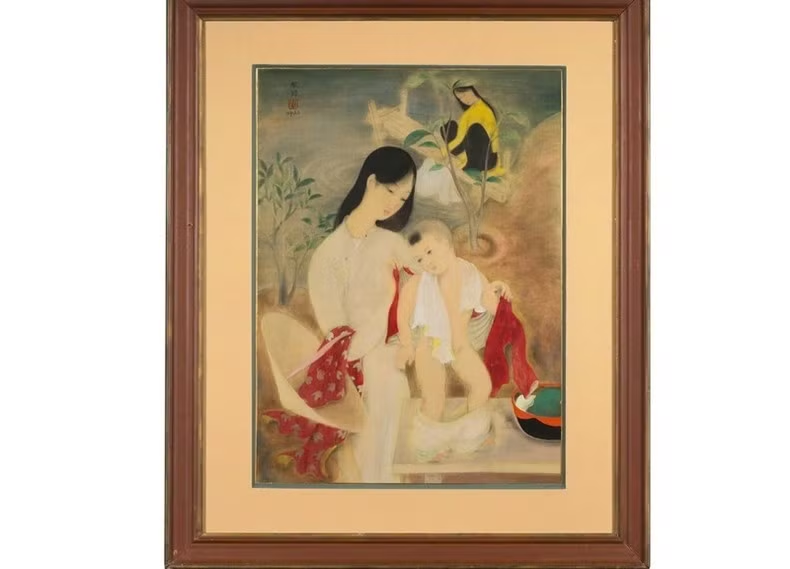
“Le bain” was created around 1938, during the early phase of Le Pho’s career when he was still living and working in Viet Nam.
The 61 x 45.5 cm work was executed on silk using ink, gouache, and watercolour. The painting features a poetic everyday scene: a mother bathing her young child, with a woman in a yellow dress washing clothes by the water’s edge in the background.
The layered composition creates depth, with a fluid and gentle perspective following Asian tradition, evoking a peaceful, intimate atmosphere full of homeland sentiment. This carefully calculated layout embodies the Asian style that Le Pho pursued throughout his career.
According to Le Quang, Chairman of Le Auction House and a direct participant at the Aguttes auction in Paris, the fact that the price for a silk painting has exceeded 2 million EUR demonstrates how Indochina art, specifically Vietnamese silk painting, is gradually securing its deserving place on the global map.
Le Pho continues to affirm his status as one of the most collected and highly appreciated Vietnamese painters in the international art market, further enriching the success story of early Indochina silk artworks in modern auctions.
Also at the auction, another work by Le Pho entitled ‘La Lettre’ (The Letter), was hammered down at 330,000 EUR, surpassing the initial estimate of 200,000 to 300,000 EUR.
After fees and taxes, the total payment for the piece reached 429,000 EUR, a compelling testament to the enduring appeal of Indochina art on the global market.
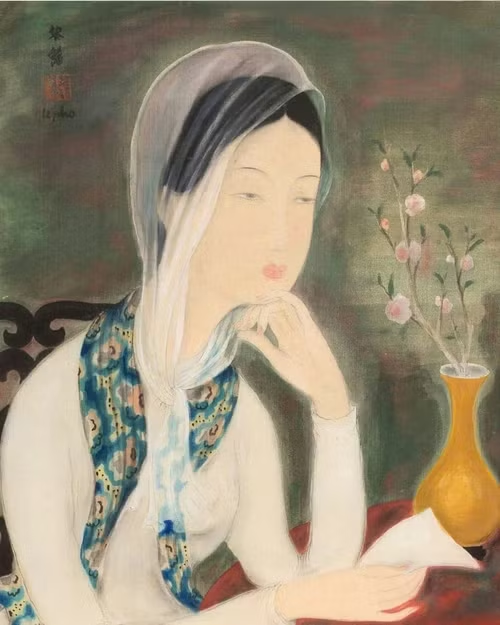 |
| ‘La Lettre’ (The Letter) painting was hammered down at 330,000 EUR |
Created around 1944, ‘La Lettre’ portrays a young woman thoughtfully reading a letter, with delicate features and a romantically tilted pose — a signature style of Le Pho during his time collaborating with Galerie Romanet.
The ink and colour on silk medium, combined with the original wooden frame from the mid-20th-century Romanet period, highlights the light and transcendent atmosphere that Le Pho had developed over decades of his career.
Alongside these, the lacquer painting ‘Paysage d’un village’ (Landscape of a Village), a six-panel folding screen by artist Le Quoc Loc (1918–1987), was successfully auctioned at 223,000 EUR. This clearly affirms the value of Indochina lacquer art — a unique medium of 20th-century Vietnamese fine arts.
‘Paysage d’un village’ is a folding screen consisting of six panels, each measuring 100 x 32.5 cm, totalling 100 x 195 cm — a large-scale work created using lacquer, a specialty of Le Quoc Loc.
Painted in 1942, the artwork depicts a peaceful rural scene along the Mekong River, featuring thatched roofs, trees, water docks, and village paths-all rendered simply yet evocatively within a coherent composition that balances restrained colours and emphasises spatial depth, characteristic of the peak period of Indochina lacquer art.
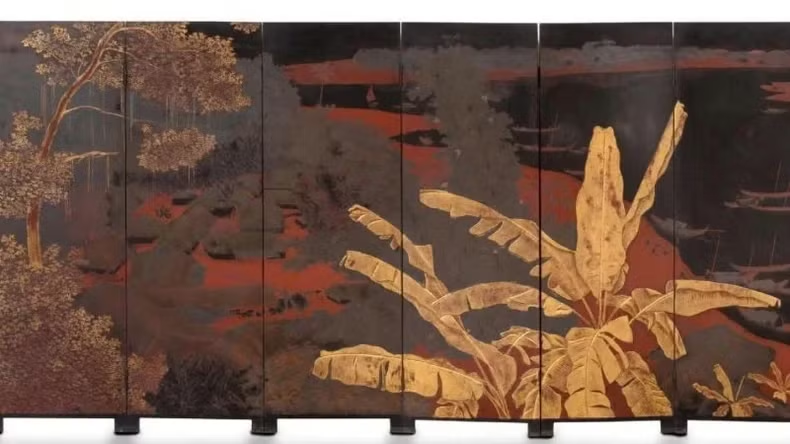 |
| ‘Paysage d’un village’ folding screen by artist Le Quoc Loc |
According to Le Quang, this is a meticulous work achieving harmony between traditional lacquer techniques and modern inspiration, combining high decorative value with a profound expression of the tranquil, humble yet powerful spirit of the Vietnamese countryside.
Beyond its artistic value, the artwork holds significant collectible worth, having once belonged to a private collection in Saigon (acquired before 1946), later moved to France and passed down through inheritance to the present day.
The organisers noted that the buyer will receive a certificate confirming the painting’s inclusion in Catalogue Raisonné of Le Pho, which is currently being compiled by expert Charlotte Aguttes-Reynier, representative of the Asian Artists Association in Paris.
The auction not only recorded impressive sale figures of Vietnamese artworks but also demonstrated the international appreciation of Vietnamese art.
Le Pho, born in 1907 in Ha Noi, is a major 20 century Vietnamese artist whose works are now sought by the greatest collectors in Asia.
Graduating in 1930 from the Indochina School of Fine Arts’ first class, he was selected for his talent as a painter by Victor Tardieu as assistant for the Colonial Exhibition of Paris in 1931. In 1937, he chose to settle permanently in Paris.
Le Pho’s strength lies in the assimilation and the association of his sources of inspiration, where Western heritage and traditional Vietnamese art, influenced by Chinese touches, are idealised and intermingled in works recognisable for their technical innovations.
His works are exhibited in Europe and the US, and the Museums of Modern Art in Paris and Viet Nam and the Ottawa Art Center are proud to have his work in their permanent collections.