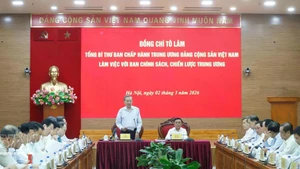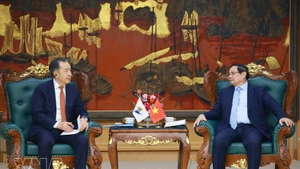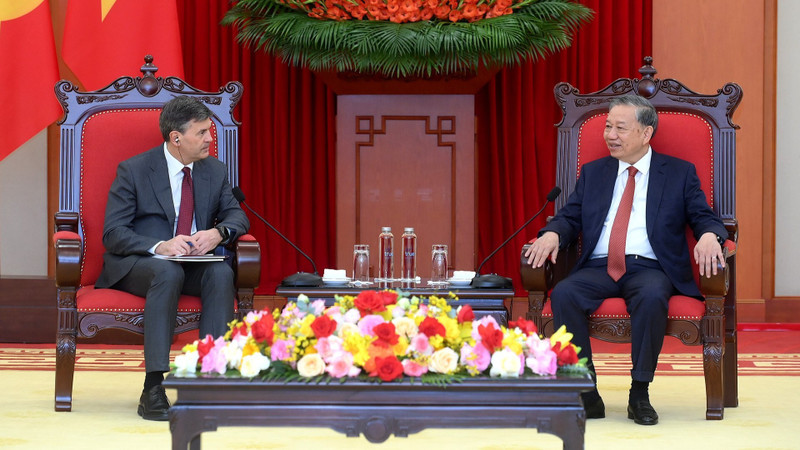
During a meeting with Rector of the Russian Presidential Academy of National Economy and Public Administration (RANEPA) Alexey Komissarov who is visiting Viet Nam on December 8, General Secretary Lam praised the Academy as Russia’s premier institution in public administration, policy planning, and preparing senior officials and civil servants.
He stressed that Viet Nam highly values its long-standing cooperation with Russia, highlighting that personnel training is a key pillar in strengthening human resources for national construction and defence. He expressed gratitude for decades of support from the Academy and Russian universities in training Vietnamese officials, many of whom have returned to serve effectively in national development, including those holding prominent positions in the country’s political system.
The Party chief also commended the cooperation programmes between the Ho Chi Minh National Academy of Politics (HCMA) and the Russian Presidential Academy, expressing confidence that the visit will further enhance collaboration between the two academies and relevant agencies of both countries, while opening new opportunities in training, professional development, scientific research, and multi-faceted cooperation.
Affirming that Viet Nam’s Party and State will continue to facilitate cooperation among training and research institutions in high technology, innovation, digital transformation, and other emerging fields, General Secretary Lam encouraged exchanges of lecturers, researchers, and students, as well as the organisation of scientific forums to share experiences in building a rule-of-law state, modern governance, and national development management.
Komissarov expressed his honour at welcoming General Secretary Lam and the HCMA delegation during the Party chief’s visit to the Russian Academy in May 2025, noting that this reflects the leader’s deep attention to the Academy and to education and training at large.
He announced the Academy’s decision to name the lecture hall where the Party General Secretary spoke after him. Komissarov also emphasised that awarding General Secretary Lam the title of Honorary Professor is not only a symbol of respect, but also a foundation for strengthening cooperation between the two countries and between the Academy and Vietnamese institutions, while motivating the Academy to continue innovating and improving training quality to meet current development needs.
Komissarov praised Viet Nam’s achievements in building a socialist rule-of-law state, administrative reform, socio-economic development, and international integration, noting that these successes inspire research and academic exchange programmes at the Academy.
He expressed hope that both academies will continue to expand cooperation in training public policy personnel and increase exchanges of experts and scholars to share international experience. He stressed that promoting educational cooperation today will help produce high-quality human resources contributing to the development of both nations.
Both sides agreed to expand collaboration between the Russian Presidential Academy, the HCMA, and other Vietnamese institutions to continue the tradition of effective cooperation, further consolidating and deepening the comprehensive strategic partnership between Viet Nam and Russia. Strengthened expert exchanges and interdisciplinary research programmes are expected to create opportunities for mutual support, enhance capacity, and promote stable, sustainable development of bilateral relations in the new era.