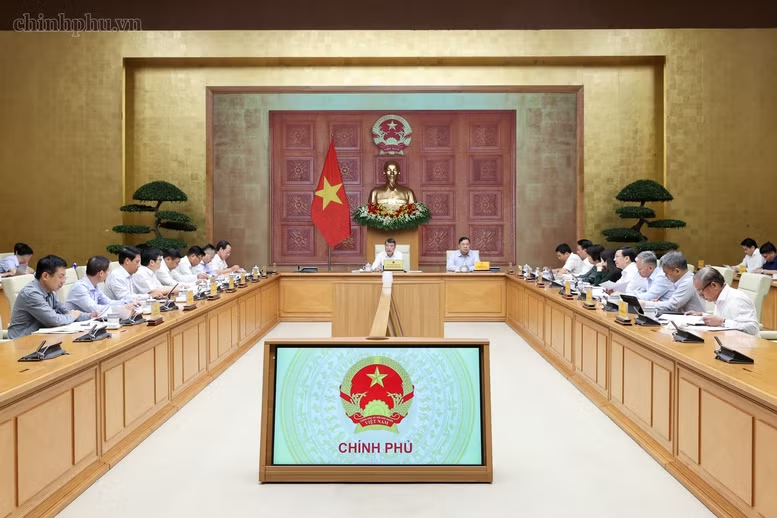
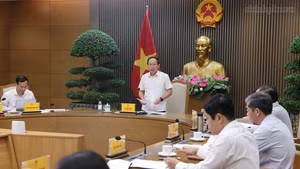
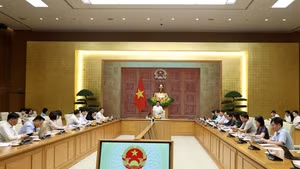
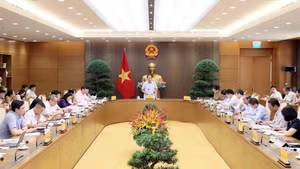
Speaking at the session, PM Hung said the laws are closely interrelated, have reciprocal impacts and remove bottlenecks, helping improve the legal framework, unlock resources, create new space and room for development, and contribute to achieving double-digit growth and sustainable development targets.
According to the PM, the drafting of the four laws must be placed within the broader requirement of promptly and fully institutionalising the Party’s major policies.
The proposed provisions must address the bottlenecks arising in practice, while creating conditions for development, freeing up resources and ensuring their effective use. The revisions should reform administrative procedures and reduce intermediate layers and the “ask-give” mechanism, he said.
Legal provisions must be clear and transparent to ensure a consistent understanding and implementation. Decentralisation and delegation of authority must be appropriate and clearly defined, with resources, data, management tools and responsibilities accompanying the delegated powers. Inspection, supervision and post-audit mechanisms must be put in place to control risks and prevent corruption, waste and group interests, without undermining the initiative and creativity of local authorities and businesses.
The PM requested full and proper compliance with the Law on Promulgation of Legal Documents, with broad and substantive consultation of affected parties, as well as input from associations, businesses, localities, experts, scientists, organisations and mass organisations. Policy explanations should accompany the consultation process so that people, businesses and other relevant groups can clearly understand the provisions and avoid differing interpretations.
PM Hung noted that the issuance of too many guiding documents should be limited, while the situation in which a single matter is subject to multiple procedures and regulations under different documents should be addressed to prevent overlaps and bottlenecks that increase compliance time and costs.
Giving his views on several specific issues related to the draft consolidated Law on State Budget, he stressed the need for clear regulations on the State budget, including central and local budgets, investment and recurrent expenditure, ensuring the leading role of the central budget and the proactive role of local budgets.
He called for clear delineation of the responsibilities of each level, stronger decentralisation and delegation of authority linked to inspection and supervision mechanisms, transparent public procedures, the elimination of unnecessary procedures, and greater use of technology. He also highlighted the need to pay attention to principles for evaluating investment efficiency, ensuring the effective use of public resources.
Regarding the draft Law on Development of Small- and Medium-sized Enterprises, the PM strongly agreed with the approach of fundamentally shifting the mindset from “support” to “development”, stressing that policies must be more feasible in practice, while ensuring consistency with the Law on Enterprises.
For the draft law amending a number of articles of the Law on Investment, he made clear that policies must ensure fair treatment and be applied consistently to both domestic and foreign-invested enterprises. They should attract high-quality and high-tech projects, promote technology transfer, and encourage domestic enterprises to engage in joint ventures.
The PM also noted the need for an objective assessment that accurately reflects the nature of the current participation rate of domestic enterprises in the export turnover of foreign-invested peers.
Regarding other issues, PM Hung asked the Ministry of Finance to continue thoroughly reviewing land-related financial issues in the amendments to tax laws, and study options for reforming and modernising tax calculation, collection and VAT refund procedures, which businesses have reported as facing numerous difficulties.

![[Infographic] Key points from General Secretary and President To Lam’s opening remarks at the 14th PCC’S 4th plenum](https://en-cdn.nhandan.vn/images/j0QNt7m_5iy1OXpnUKiwG61aYhTv_B140GWhfriF26JwZbNNJ8LWetfvXUhz4Az6/1-8220.jpg.avif)