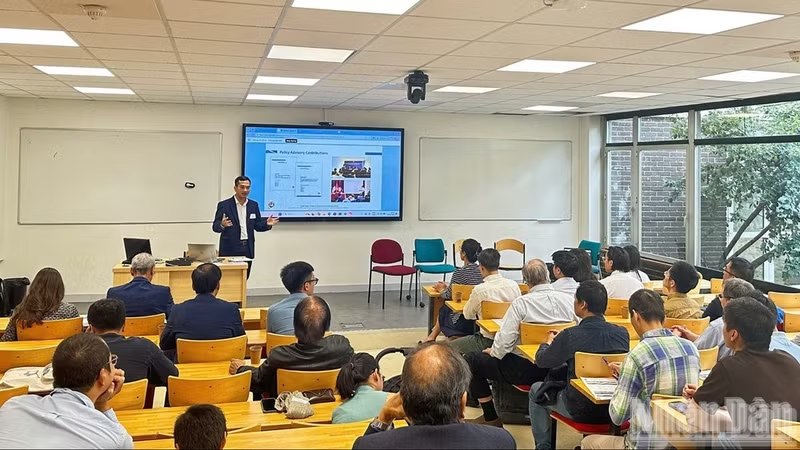
On August 29, at École Polytechnique in France, the Network of Vietnamese Nuclear Energy Experts Abroad (VietNuc) organised a workshop themed “Human resource development and prospects for international cooperation in nuclear power development in Viet Nam”.
The workshop was held both in person and online, covering the current status and needs of Viet Nam’s nuclear power programme, human resource development and trends in small modular reactors (SMRs), safety assurance experience, and directions for international cooperation in support of Viet Nam’s nuclear power programme.
Human resources as the foundation of the nuclear power programme
Presentations at the workshop offered a range of perspectives on the conditions that need to be prepared for Viet Nam to implement its nuclear power programme in a comprehensive, cautious and sustainable manner.
Presenting the current status and opportunities of Viet Nam’s nuclear power programme, Nguyen Hoang Linh, Director General of the Department of Radiation and Nuclear Safety under the Ministry of Science and Technology, said that nuclear power development not only requires decisions on technology selection and power plant construction, but also comprehensive preparations in terms of the legal framework, management capacity, nuclear safety and security, human resources and international cooperation.
Among these, human resources are one of the decisive conditions for the programme’s long-term implementation.
Sharing France’s and international experience, Xavier Perrette, Vice-President for International Relations at the French National Institute of Nuclear Science and Technology, under the French Alternative Energies and Atomic Energy Commission, stressed the need to build human capacity for the national nuclear programme.
Drawing on experience in implementing training programmes in Asia, the Middle East, Africa and Europe, Xavier Perrette said that human resource training needs to begin at an early stage, follow a long-term plan and be linked to each phase of the programme, from management, design and construction to operation, safety monitoring and radioactive waste management.
This approach shows that the human resource issue needs to be addressed in parallel with the preparation of the nuclear power programme, rather than only being considered once projects have entered the implementation phase.
Alongside human resources, experts also spent time discussing a number of technological trends and experiences currently attracting attention in the global nuclear power sector.
Dr Vu Thanh Mai, an expert at the International Atomic Energy Agency (IAEA), presented a paper on the global development and technological directions of small modular reactors (SMRs).
SMRs are expected to provide additional options for energy systems thanks to their smaller generating capacity, modular construction capability and flexibility in deployment. However, experts said that careful assessment is needed of the maturity of the technology, its commercialisation potential, costs, regulatory requirements, safety and the ability to master the technology before an appropriate choice is made.
From a technical and operational perspective, Dr Pham Tuan Hiep, Secretary-General of VietNuc and a materials mechanics expert at Électricité de France (EDF), shared a comprehensive approach to assessing stress corrosion cracking in the piping systems of nuclear power plants, based on EDF’s recent operational experience.
The presentation focused on the role of materials monitoring, structural integrity assessment and the development of risk mitigation solutions throughout the plant’s life cycle. These technical experiences are significant for maintaining a high level of safety and ensuring the stable, long-term operation of nuclear facilities.
Promoting the resources of overseas Vietnamese experts
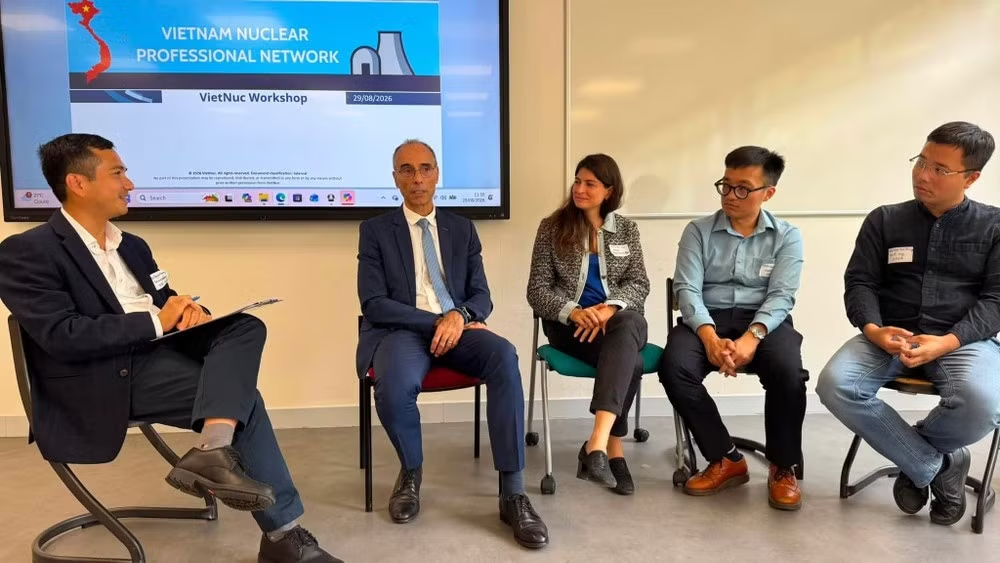
A notable feature of the workshop was the participation of Vietnamese experts working at leading organisations, corporations and research institutions in the nuclear sector in France and internationally.
According to Bui Nguyen Hoang, Chairman of VietNuc, the event first and foremost provided a forum for network members to meet and exchange views, while also expanding connections with professional communities in Viet Nam and abroad.
Through such activities, VietNuc seeks to share experience from nuclear power programmes around the world, thereby supporting Viet Nam in implementing its nuclear power programme successfully and safely; at the same time, it aims to build a bridge through which overseas Vietnamese experts and international friends can participate and contribute their knowledge and experience to Viet Nam.
According to Bui Nguyen Hoang, VietNuc currently focuses on five main areas, including organising thematic workshops; participating in policy consultancy; disseminating knowledge about nuclear power; supporting human resource training programmes in Viet Nam; and strengthening connections between network members and domestic agencies and international organisations.
One of the network’s recent activities has been to coordinate with Vietnamese agencies and Thoi Dai Publishing House to produce the book “A Question-and-Answer Handbook on Nuclear Power”, aimed at providing the public with scientifically grounded information presented in an easy-to-understand and accessible manner, thereby helping to address questions and concerns about nuclear power.
At the discussion session entitled “Viet Nam’s Nuclear Power Programme and Global Prospects”, delegates exchanged views on the conditions Viet Nam needs to prepare. Issues discussed included completing the institutional framework, training human resources, building a strong nuclear safety culture, selecting appropriate technologies, strengthening project management capacity, and enhancing linkages among regulatory agencies, research institutes, universities, enterprises and the international expert network.
VietNuc is working towards a role as a bridge connecting overseas Vietnamese experts with domestic agencies and organisations and the international nuclear community. The workshop at École Polytechnique showed that this intellectual resource can help connect Viet Nam’s needs with international experience, training systems and professional knowledge, thereby supporting preparations in institutions, human resources, technology and safety culture for Viet Nam’s nuclear power programme.
For a sector that requires highly qualified human resources, experience accumulated over many decades and particularly stringent safety requirements, effectively mobilising the resources of overseas Vietnamese experts could provide an important additional channel for Viet Nam to access international knowledge, experience and cooperation networks, contributing to more solid preparations for the development of nuclear power in the coming period.
Established in July 2025, VietNuc currently has more than 100 active members and connects around 200 experts worldwide. Its members are working in various fields, including nuclear regulation, engineering, construction, project management and research, in France, the United Kingdom, Austria, Belgium, Italy, Viet Nam and several other countries.
The network has identified three pillars for its activities: connecting Vietnamese nuclear experts around the world, contributing to the formation of a strong nuclear safety culture, and promoting innovation in the nuclear sector, particularly in Viet Nam.
In recent times, VietNuc has provided professional comments during the drafting of the Law on Atomic Energy and the draft decree detailing regulations applicable to nuclear power plants and research reactors; supported the development of training programmes at several universities; coordinated the organisation of professional workshops; and participated in disseminating scientific knowledge about nuclear energy.