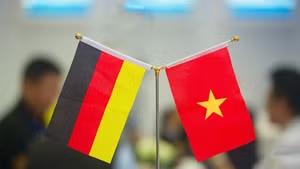
The visit from May 1 to 3 marks Viet Nam as the first country in the region to be visited by PM Takaichi following her re-election in February 2026, underscoring Japan’s high regard for the Comprehensive Strategic Partnership between the two countries as they enter a new phase of development.
Over five decades of trust and partnership
Viet Nam and Japan officially established diplomatic relations on September 21, 1973. Over more than five decades, bilateral friendship and cooperation have been steadily strengthened and expanded across all fields, becoming a bright spot in Viet Nam’s foreign policy of independence, self-reliance, self-strengthening, peace, friendship, cooperation and development, as well as diversification and multilateralisation of external relations.
The bilateral relationship has been continuously elevated – from a “reliable, long-term stable partnership” (2002) to a “strategic partnership for peace and prosperity in Asia” (2009), then an “extensive strategic partnership for peace and prosperity in Asia” (2014), and most recently a “comprehensive strategic partnership for peace and prosperity in Asia and the world” (November 2023). This latest upgrade reflects a high level of political trust and the maturity of bilateral ties, ushering in a new phase of more substantive and effective cooperation across all areas.
High-level exchanges have been maintained regularly with strong political trust. Notable recent visits and meetings included PM Pham Minh Chinh’s visits and participation in major summits in Japan in 2021 and 2023, and PM Le Minh Hung’s attendance at the online AZEC Summit in April 2026. High-level contacts also featured online talks between Party General Secretary and State President To Lam and President of the Liberal Democratic Party and PM Kishida Fumio in September 2024.
From Japan, visits by PMs Suga Yoshihide, Kishida Fumio and Ishiba Shigeru, along with senior parliamentary and imperial representatives, have reinforced ties. In April 2026, PM Takaichi Sanae, who is currently President of the Liberal Democratic Party, held a phone call with Party General Secretary and State President To Lam, becoming the first foreign leader to congratulate him over the phone after his election as President of Viet Nam.
")
In addition to high-level visits, the two sides have effectively maintained a wide range of dialogue mechanisms, including the Viet Nam – Japan Cooperation Committee co-chaired by the two foreign ministers, the Joint Committee on Trade, Energy and Industry, the Viet Nam – Japan Joint Initiative, and various defence and security dialogues. Both countries have also worked closely together at multilateral forums such as the United Nations, APEC, ASEM and ASEAN-related mechanisms, contributing actively to regional and global peace, stability and development.
Leading partners for each other
Economic and trade cooperation forms a key pillar of bilateral ties, underpinned by bilateral and multilateral free trade agreements, foreign direct investment (FDI) and official development assistance (ODA) from Japan to Viet Nam.
Japan is now Viet Nam’s largest ODA supplier, biggest labour cooperation partner, third-largest investor, and fourth-largest partner in trade and tourism. Bilateral trade has grown steadily and in a balanced manner, reaching approximately 52 billion USD in 2025, up 11% year-on-year. In January 2026 alone, the figure hit 4.87 billion USD, marking a 27.7% increase compared to the same period in 2025.
Viet Nam’s main exports to Japan include aquatic products, garments, footwear, machinery and equipment, wood and plastic products, while imports from the Northeast Asian country mainly include machinery, electronic devices and components, steel, automobile parts and chemicals.
In terms of FDI, as of January 2026, Japan had 5,722 valid investment projects in Viet Nam with a total registered capital of 78.9 billion USD, ranking third among 153 countries and territories investing in Viet Nam. Japanese investments are concentrated in manufacturing and processing, electricity production and distribution, and real estate.
Meanwhile, Viet Nam had 132 investment projects in Japan worth 47.2 million USD, accounting for 0.2% of Viet Nam's total overseas investment capital, ranking 33rd out of 85 countries and territories where Viet Nam invests in. Vietnamese projects mainly operate in processing and manufacturing; electricity, gas, water, air conditioner production and distribution; and real estate.
Japan is also Viet Nam’s largest provider of ODA, with total loans amounting to about 2.55 trillion JPY(over 23 billion USD) by the end of fiscal year 2025, making up more than 26% of Viet Nam’s total signed foreign loans. These funds have supported infrastructure development, economic growth, environmental protection and administrative capacity building.
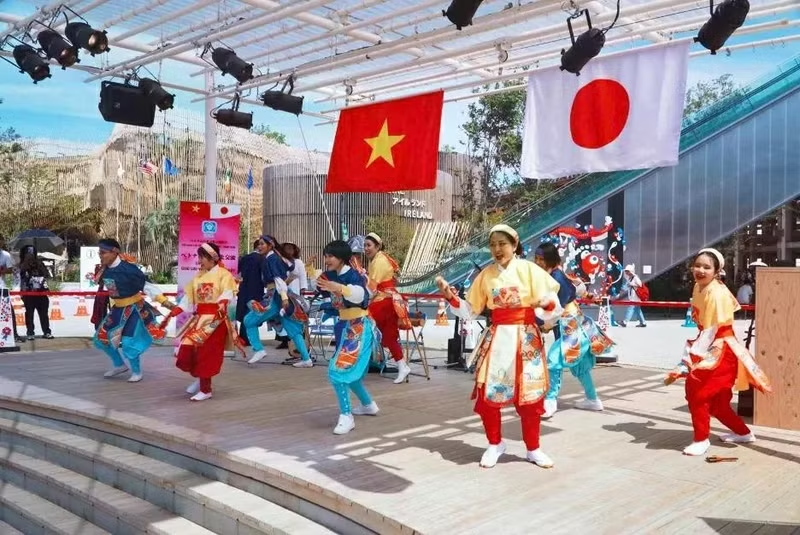
Beyond the economy, the two countries have expanded cooperation in education, culture, health care, tourism, and labour. Viet Nam is the largest source of foreign workers for Japan, with around 310,000 Vietnamese workers.
The number of Vietnamese students in Japan now exceeds 51,000, while people-to-people exchanges continue to grow, with annual tourist flows reaching over 810,000 visits from Japan and some 680,000 from Viet Nam.
Local-level cooperation has also flourished, with over 110 partnership agreements signed between localities of the two countries. Meanwhile, the Vietnamese community in Japan has surpassed 680,000 people, forming the second largest foreign community there and creating a solid social foundation for bilateral relations.
Promoting new areas of potential cooperation
Against a backdrop of complex regional and global developments, PM Takaichi’s visit carries particular significance, reaffirming the two countries’ shared commitment to peace, stability and development, especially as both sides are implementing major strategic policies for the years ahead.
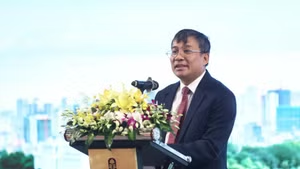
According to Vietnamese Ambassador to Japan Pham Quang Hieu, the visit will provide an opportunity to further consolidate political trust, enhance high-level strategy discussions and create new momentum for deeper, more substantive and effective cooperation.

Key areas expected to be discussed include economic cooperation, science and technology, innovation, energy and food security, semiconductor production, artificial intelligence, green transition, high-quality human resources development, tourism, locality-to-locality links and people-to-people exchanges, as well as closer coordination in regional and international issues of mutual concern.
Japanese Ambassador to Viet Nam Ito Naoki noted that a highlight of the visit will be PM Takaichi’s policy speech on the Free and Open Indo-Pacific (FOIP) strategy at the Viet Nam National University, Hanoi, marking the first such address by a Japanese PM in Viet Nam since 2020. The choice of venue reflects Japan’s recognition of ASEAN’s centrality and Viet Nam’s important role in the region.
Regarding bilateral collaboration prospects, Hieu emphasised that partnerships in science and technology, digital and green transformation, innovation, artificial intelligence, energy security and supply chain resilience is emerging as major growth areas. With Japan’s strengths in advanced technology and governance, and Viet Nam’s dynamic economy and young, increasingly skilled workforce, the complementarities between the two sides provide a strong foundation for expanding cooperation.
Both countries are expected to intensify collaboration in technology transfer, human resources development, joint research, green projects, energy transition, digital infrastructure and sustainable finance, opening up new prospects and further elevating the Comprehensive Strategic Partnership in the years to come, added the diplomat.