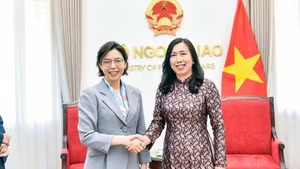
Prime Minister Pham Minh Chinh’s official visit to Russia has delivered “comprehensive and substantive results,” helping reposition and elevate the Viet Nam–Russia Comprehensive Strategic Partnership, Deputy Minister of Foreign Affairs Le Thi Thu Hang has said.
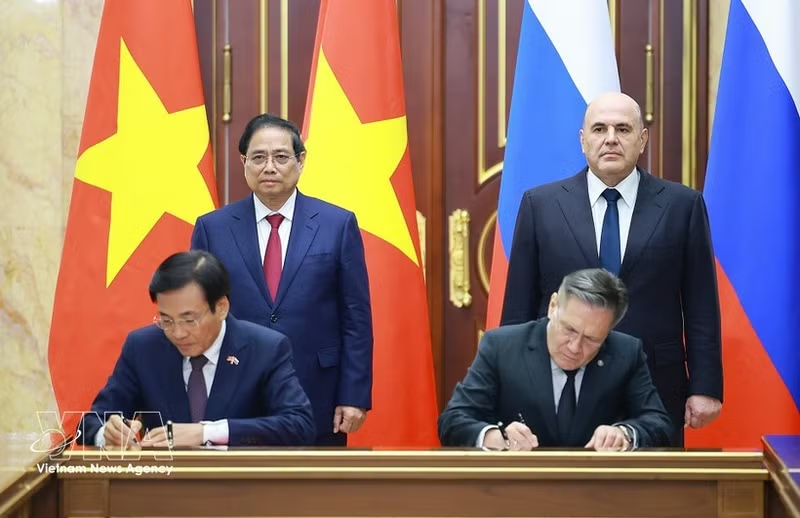
In an interview following the March 22–25 trip, made at the invitation of Russian Prime Minister Mikhail Mishustin, Hang described the visit as a significant diplomatic milestone, coming shortly after Viet Nam’s 14th National Party Congress and general election.
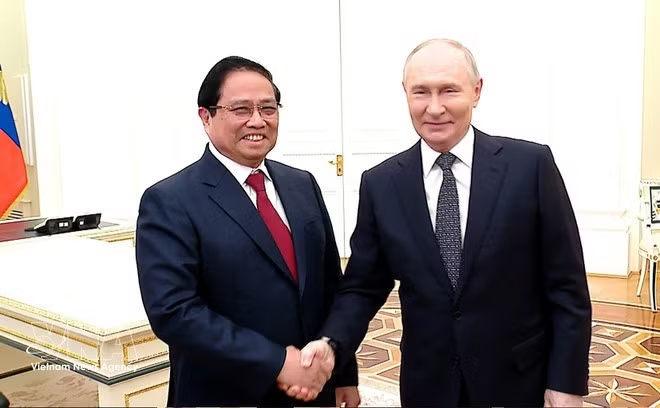
Lasting just only 72 hours, the visit featured nearly 30 engagements, reflecting its intensity and breadth. The Vietnamese leader held talks and meetings with top Russian leaders, including President Vladimir Putin, Prime Minister Mishustin, Federation Council Chairwoman Valentina Matvienko, State Duma Chairman Vyacheslav Volodin, and Security Council Secretary Sergey Shoigu.
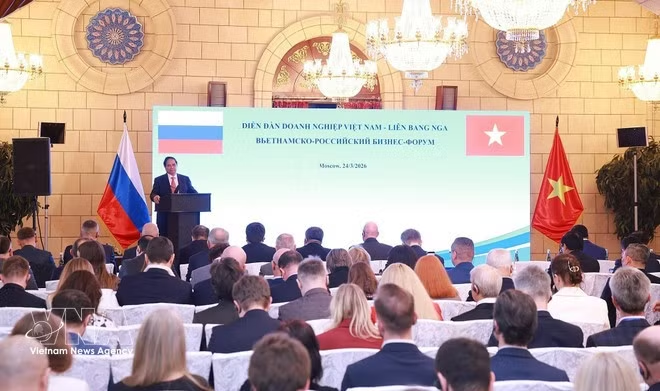
He also visited leading economic, scientific and educational institutions, attended a Viet Nam–Russia business forum, and met major Russian enterprises, while engaging with traditional friends and the Vietnamese community in Russia.
According to Hang, both sides reached strong consensus on deepening political trust and mutual understanding, building on their long-standing traditional friendship. Russian leaders, political parties and businesses all reaffirmed their support for strengthening the Comprehensive Strategic Partnership for the benefit of the two countries' people and for regional and global peace, cooperation, stability and development.
A key highlight of the visit was the signing of multiple agreements in areas aligned with Viet Nam’s development priorities, including energy, transport, science and technology. Notably, the agreement to build the Ninh Thuan 1 nuclear power plant was described as a “historic milestone” and a new symbol of bilateral cooperation, akin to earlier landmark projects such as the Hoa Binh hydropower plant and Thang Long Bridge.
The two sides also agreed to expand cooperation in oil and gas exploration, transport connectivity and urban infrastructure, including metro development - an area where Russia boasts strong expertise.
In education and science, both countries identified opportunities to enhance cooperation in basic research and high-quality human resource training, particularly in digital technologies, biomedical science and advanced fields. Hang noted that Russia remains a trusted partner as Viet Nam seeks to place science, technology and innovation at the centre of its development strategy.
Cultural and people-to-people exchanges were also highlighted as key pillars. Leaders of both countries expressed support for increasing cultural activities, tourism exchanges and youth engagement, while recognising the bridging role of the Vietnamese community in Russia.
Looking ahead, Hang outlined several priorities to translate high-level commitments into concrete outcomes.
First, both sides should effectively utilise existing cooperation mechanisms, including intergovernmental committees and inter-parliamentary cooperation frameworks, while ministries and localities accelerate the implementation of signed agreements with clear roadmaps and priorities.
Second, the two countries need to promptly carry out cooperation projects in strategic sectors such as energy security, transport, logistics and science and technology. This includes expediting the Ninh Thuan 1 nuclear power project, expanding oil and gas operations through joint ventures such as Vietsovpetro and Rusvietpetro, and enhancing rail, air and maritime transport connectivity.
Third, greater emphasis should be placed on people-centred cooperation. This involves boosting education and training links, promoting language teaching, and organising regular cultural, sports and artistic exchanges to strengthen mutual understanding, particularly among younger generations.
Fourth, locality-to-locality cooperation should be expanded. With 20 pairs of local partnerships already established, there remains considerable potential to broaden cooperation at the sub-national level.
Finally, continued attention should be paid to the Vietnamese community in Russia, which is seen as a vital bridge in bilateral relations. Creating favourable conditions for them to live, work and study will contribute to strengthening ties between the two nations.
Hang expressed confidence that with strong political will and coordinated efforts, Viet Nam–Russia relations will continue to grow robustly, contributing to the socio-economic development of both countries in the new period.