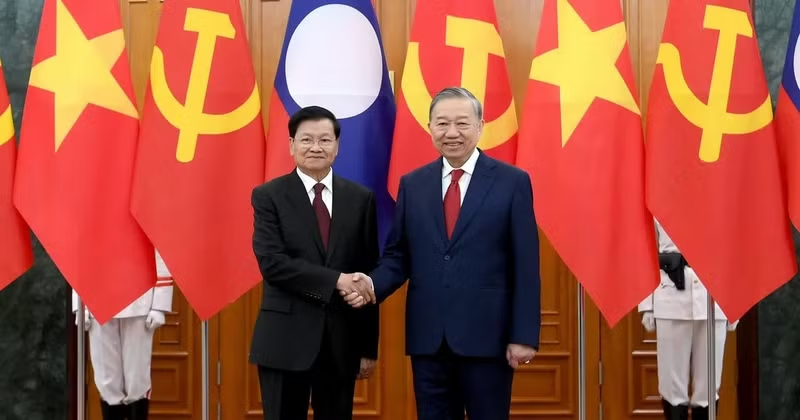
Viet Nam and Laos are neighbouring countries whose relations of great friendship, special solidarity, and comprehensive cooperation have been painstakingly nurtured by generations of leaders and peoples of the two countries. In recent years, alongside strengthening cooperation in politics, defence, and security, the two sides have worked to elevate and create breakthroughs in economic cooperation, bringing about strong changes, with the effective implementation of key projects connecting the two economies, especially in transport, including expressways and railways, energy, trade, investment, training, high-quality human resource development, and the building of sustainable supply chains.
Economic, trade, and investment cooperation is increasingly affirming its role as an important pillar and a solid core foundation for turning the “strategic connectivity” between the two countries into substantive cooperation.
Viet Nam-Laos bilateral economic cooperation is recording highly impressive growth figures. Viet Nam currently has 289 investment projects in Laos with total registered capital of 6.7 billion USD. Notably, in the first six months of 2026, total Vietnamese investment in Laos reached nearly 600 million USD, more than 4.2 times higher than in the same period of 2025, focusing on key sectors such as hydropower, mining, high-tech agriculture, and telecommunications (Unitel). Many projects have operated effectively, making positive contributions to Laos’s state budget and social welfare.
Viet Nam has advantages in its seaport system, logistics network, and international connectivity, while Laos occupies a strategic position in the Greater Mekong Subregion, serving as an important bridge between ASEAN and inland Asia. As a landlocked country, Laos places particular importance on transport connectivity with neighbouring countries for trade and economic development. With its seaport system and transport network extending towards the East Sea/South China Sea, Viet Nam has the potential to become an important gateway for Lao goods to reach international markets.
Developing transport routes connecting Viet Nam and Laos is regarded as one of the priorities of bilateral economic cooperation. If the roads linking Laos through border gates with Viet Nam’s economic centres and seaports are developed in a coordinated manner, they will help shorten transport times, reduce logistics costs, and enhance the competitiveness of goods. The Lao Government is working to implement its strategy of transforming Laos from a landlocked country into a regional connectivity hub linking the Greater Mekong Subregion and ASEAN, opening new development space for industry, agriculture, and cross-border trade.
To realise this vision, Laos is implementing its “Trade and Transport Facilitation Action Plan for 2025–2030” and hopes that Viet Nam will share its experience and promote the development of interconnected warehousing infrastructure to address transport-cost bottlenecks and open a maritime gateway through the Vung Ang Port complex in Ha Tinh Province.
A seamless transport system will provide a foundation for businesses to take greater initiative in organising supply chains and expanding markets. These transport routes will not only connect the two countries but also have broader significance by contributing to the formation of economic corridors linking Laos with Viet Nam and, through Viet Nam, to the sea, while expanding connectivity with other countries in the region.
Against the backdrop of profound shifts in the regional economy, strengthening economic integration between Viet Nam and Laos, while also capitalising on their geographical advantages, border infrastructure, and bilateral and multilateral trade agreements, is a strategic imperative. This will not only aid in expanding markets but also help establish interconnected production and logistics chains and create new development space, bringing tangible benefits to the peoples of both countries.