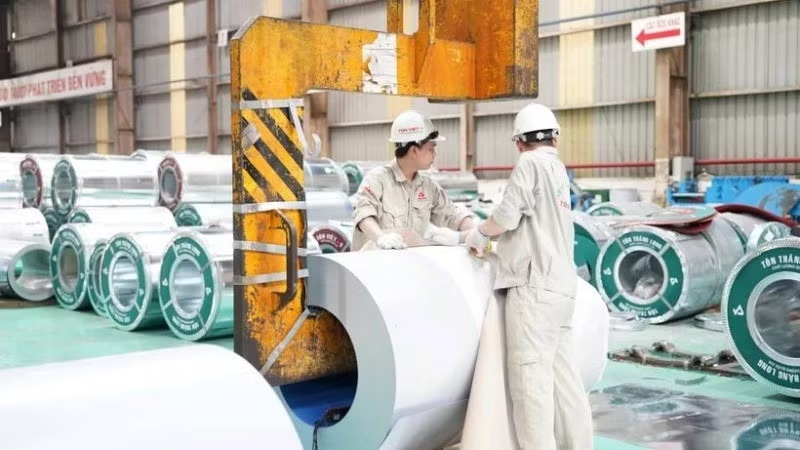
The cases involved products ranging from major export earners such as solar panels (around 4.2 billion USD) and shrimp (800 million USD) to lower-value items such as moulded fibre trays (50 million USD) and paper plates (9 million USD).
To date, there have been 298 trade-remedy investigations from 25 markets and territories into Viet Nam’s exports, including 21 new initiations in 2025 alone. Steel products in particular faced nine newly initiated cases, while many countries also introduced a series of regulations to curb steel imports — for example, the US raised tariffs; Canada applied import quotas and out-of-quota duties; and India added requirements on input material standards.
Even so, thanks to close coordination between state authorities and associations and businesses, responses to trade-remedy cases in recent years have delivered many positive results, helping ensure Viet Nam’s exports are treated fairly and safeguarding the legitimate rights and interests of exporters.
For instance, Canada concluded that semi-trailers imported from Viet Nam were not circumventing trade-remedy duties; and the US issued its final determination for the 20th administrative review of anti-dumping duties on pangasius and basa fish, under which eligible Vietnamese exporters received a 0% duty rate.
The Trade Remedies Authority under the Ministry of Industry and Trade is currently closely monitoring export movements of more than 420 product lines to 10 markets that frequently conduct trade-remedy investigations, especially 27 high-risk product groups, so as to provide regular updates and help ministries, sectors, localities and businesses avoid being caught off guard in their response efforts. However, as Viet Nam’s export capacity continues to expand, Vietnamese goods may face an increasing number of investigations and trade-remedy measures imposed by foreign countries.
Businesses should also prepare financial resources and dedicated personnel for trade-remedy work, as the costs of participating in such cases are often substantial and demand significant effort and deep professional expertise. Firms also need to proactively increase transparency in their accounting systems and strengthen traceability to respond more effectively to investigations into circumvention of trade-remedy duties and the increasingly prevalent forms of origin fraud.
Therefore, relevant agencies should continue to closely track developments in protectionist trends and global trade conflicts; study and report changes in foreign trade-remedy regulations, especially those likely to have significant impacts on Viet Nam, in order to provide timely information to regulators and the business community for proactive responses.
At the same time, it is necessary to strengthen trade-remedy capacity for domestic manufacturing industries and integrate trade-remedy content into sectoral development programmes, strategies and policies to ensure reasonable protection for domestic production, particularly in the context of implementing new-generation FTAs.
For businesses, enhancing trade-remedy capacity has become an urgent requirement if they wish to participate in global supply chains. Companies therefore need strategies to diversify both markets and sources of supply, avoiding excessive concentration on any single market that frequently initiates trade-remedy investigations.
Businesses should also prepare financial resources and dedicated personnel for trade-remedy work, as the costs of participating in such cases are often substantial and demand significant effort and deep professional expertise. Firms also need to proactively increase transparency in their accounting systems and strengthen traceability to respond more effectively to investigations into circumvention of trade-remedy duties and the increasingly prevalent forms of origin fraud.







![[Infographic] VN-Index rises 0.34% on October 6](https://en-cdn.nhandan.vn/images/j0QNt7m_5iy1OXpnUKiwG61aYhTv_B140GWhfriF26IM-hJLr-YyB-igcHJ7cLRKshCXmgI3hJXGVRYJMfGPzA/chung610-8460.jpg.avif)