Tears of Joy
Recalling the liberation of Saigon in April 1975, war veteran Pham Duy Do, former company commander of Commando Regiment 116, still remembers the special mission assigned to him by Senior General Tran Van Tra shortly before the final victory: infiltrating central Saigon and assess the area surrounding the Independence Palace in order to draw a detailed map.
“For half a month, two teammates and I disguised ourselves as the US troops to carry out the mission. We completed the map in October 1974. At the time, our commander said it might be needed someday, but we didn’t expect it would be used so soon,” recalled First Lieutenant Pham Duy Do with pride.
Thanks to his in-depth knowledge of the palace's layout, he became one of the first to enter and raise the flag of the Provisional Revolutionary Government of the Republic of South Vietnam on the second floor of the Independence Palace on the morning of April 30, 1975.
“After the joy and pride, I suddenly thought of those who had fallen,” he said. “I could not hold back my tears.” - First Lieutenant Pham Duy Do said.
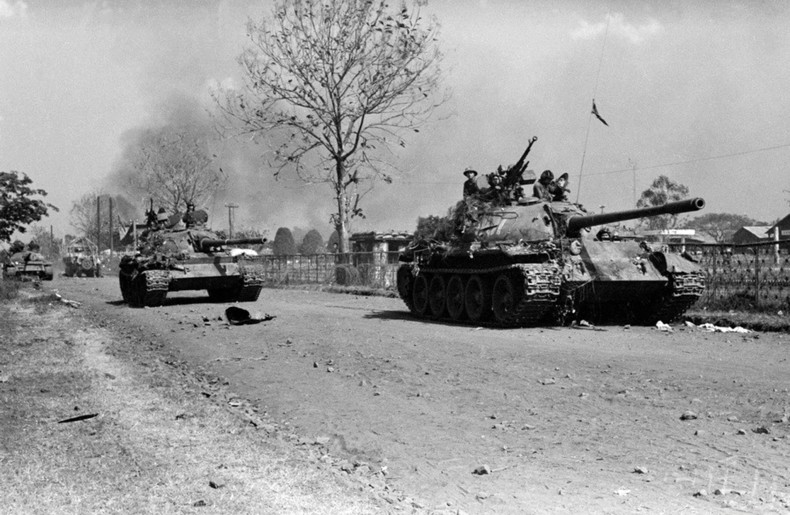 |
| Infantry, tank, and mechanized units advancing to liberate Buon Ma Thuot (March 1975). (Archive photo) |
The day of victory saw emotional reunions after years of separation.
Ngo Viet Tho, 62, is the son of People’s Armed Forces Hero Ngo Thanh Van (also known as Ba Den), who led the 11th Battalion of 17 elite commandos during the attack on the US Embassy in the 1968 Tet Offensive. He was the only survivor from the unit.
Tho said he remembered traveling with relatives to Cu Chi, Bien Hoa, and later Phu Quoc Island to confirm his father's whereabouts. Van had been imprisoned after the attack.
When the family learned that he would be released in 1973, they were overjoyed but didn’t know when he would return.
Following the success of the Ho Chi Minh Campaign, Tho and his elder brother waited at Bach Dang Wharf, hoping to spot their father among the victorious liberation forces entering Saigon.
“At last, we saw him and embraced, in a flood of joy” he said.
News of the victory spread rapidly among Vietnamese communities overseas.
Luu Thanh Dung, former Vice President and Secretary General of the Vietnamese Association in France, recalled the moment vividly.
“I was driving from Paris to visit university friends on May 1, a public holiday in France. Suddenly, a radio broadcast announced that the Americans had evacuated and the Saigon government had collapsed. I was so overwhelmed that I turned my car around and returned to Paris to inform my friends in the movement. We all gathered at Bastille Square,” he said.
“At that time, large crowds were already marching to commemorate International Workers’ Day. We joined them to express our joy. It was an unforgettable moment.”.
In Thailand, Vietnamese expatriates also welcomed the news. Cao Tat Minh, former Chairman of the Vietnamese Association in Khon Kaen Province, shared:
“When the news reached us, we were overcome with emotion. Despite difficult living conditions, we had made contributions to support the liberation cause — both financially and through community mobilisation,” he said.
“Looking back, we are proud to have played a small part in the struggle. And over the past five decades, we have witnessed Vietnam’s tremendous development under the Communist Party’s leadership.”.
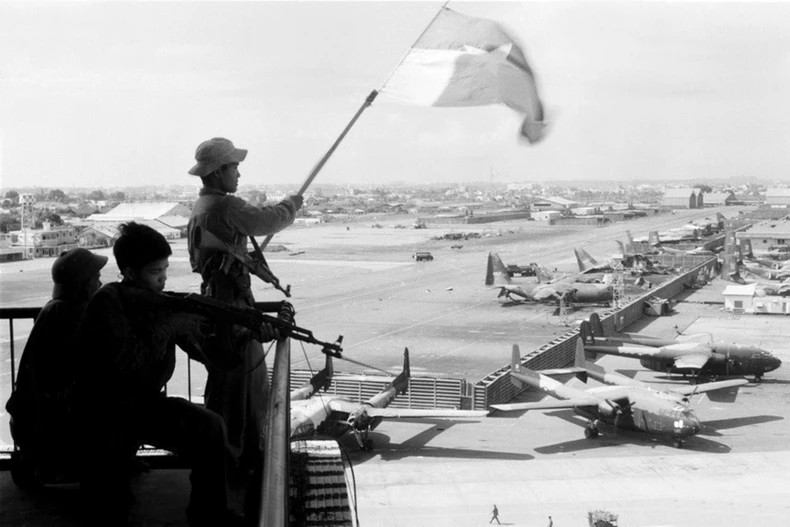 |
| In the early morning of April 30, 1975, Liberation forces entered Saigon from various directions. They quickly captured the enemy’s Air Force Command and Paratrooper Division, securing control of Tan Son Nhat Airport. In the photo: The Liberation Flag flying over Tan Son Nhat Airport on April 30, 1975. (Archive Photo) |
Gérard Daviot, former President of the France-Vietnam Friendship Association, has long supported Vietnam. Reflecting on the events of 1975, he said:
“The war may have ended 50 years ago, but it remains vivid in my memory and in the minds of many French people who supported Vietnam’s cause. In May 1975, I joined Vietnamese friends in France to celebrate the victory,” he said.
“As the 50th anniversary approaches, I am honoured to be in Vietnam to share this historic moment and express our continued solidarity with the Vietnamese people.”
International Recognition of Historic Milestone
Professor Pan Jine, senior researcher at the Academy of Marxism of the Chinese Academy of Social Sciences, a long-time scholar of Vietnamese studies, emphasised the broader significance of the Spring Victory in 1975.
“The great Spring Victory concluded the 21-year resistance war against American intervention and marked a brilliant milestone in Vietnam’s long struggle for national independence” she said in an interview with Nhan Dan Newspaper.
“It had deep international implications at the time and remains historically significant today.”.
She added that Vietnam's development over the past five decades shows the success of its socialist orientation. “Vietnam has achieved remarkable progress through its policy of 'Doi moi' (renewal), demonstrating that the country’s chosen path is well suited to its conditions,” she said.
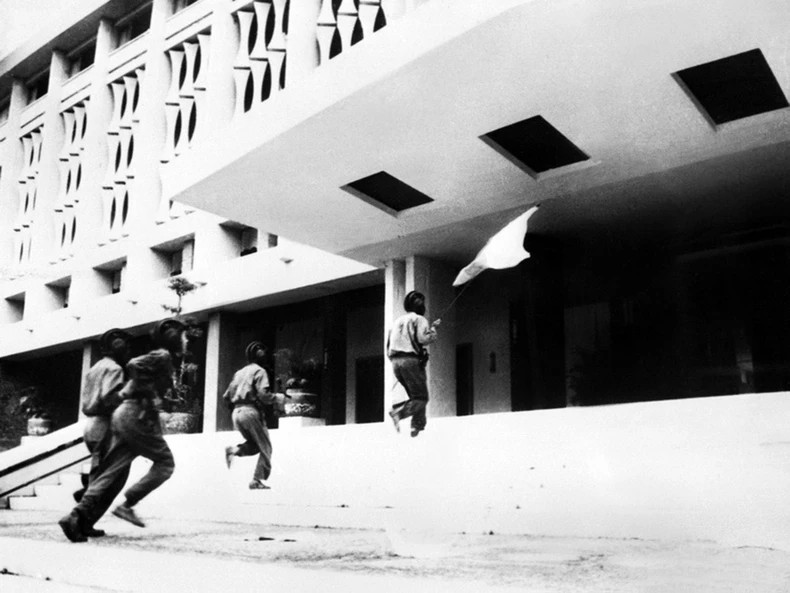 |
| At 11:30 am on April 30, 1975, soldier Bui Quang Than (holding the flag, front) and three other soldiers of Army Corps 2 — the Hương Giang Corps — raised the Liberation Flag atop the Presidential Palace in Saigon. |
Born in 2001, Tran Trong Nghia, a graduate of RMIT Vietnam’s School of Design, Applications and Creativity, is among the younger generation actively preserving Vietnam’s revolutionary legacy. Now in his early twenties, he serves as Director of the Saigon-Gia Dinh Special Forces Museum.
Nghia is the grandson of People's Armed Forces Hero Tran Van Lai (also known as Mai Hong Que), a key figure in the construction of underground weapon caches used during the 1968 Tet Offensive, including the attack on the former Independence Palace.
From a young age, Nghia was inspired by stories his father told of his grandfather’s resistance activities — stories he once thought too extraordinary to be real. Over time, they instilled in him a deep interest in national history. Today, he is leading efforts to modernise the museum using digital technologies that allow visitors to experience history in more interactive ways.
“What makes me happiest is seeing more young people come to the museum. If we apply technology in the right way, we can make history more engaging. Once young people understand history, they’ll grow to truly appreciate it,” he said.
Peace has opened up unprecedented opportunities, laying the crucial foundation for economic growth and national development. Dr. Tran Dinh Cuong, Chairman of Ernst and Young Vietnam, reflected on the dramatic shift in perception since the early 1990s.
“Back then, when I spoke with international partners or friends overseas, mentioning Vietnam often drew surprise, curiosity, and even pity,” he said.
“To them, Vietnam was a symbol of war and poverty. But today, it has become one of the world’s most dynamic and open economies. It’s a truly remarkable transformation.”
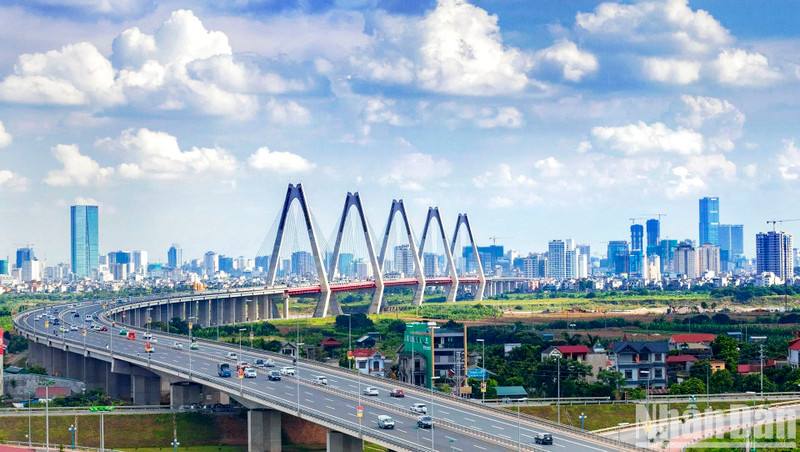
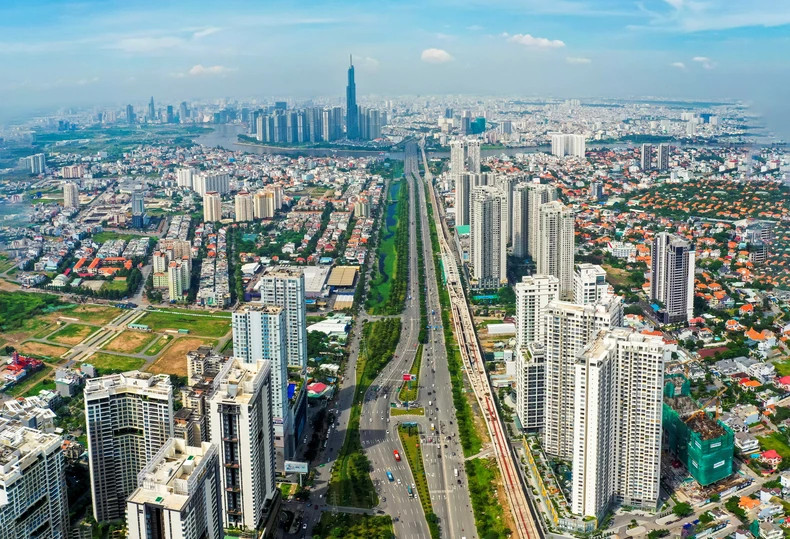 |
| An overview of modern-day Ho Chi Minh City. (Photo by Dang Anh) |
Ambassador Phạm Quang Vinh, former Deputy Minister of Foreign Affairs and former Ambassador of Vietnam to the US, noted that: Over the past 50 years, Vietnam–US relations have had to overcome the legacy of a war that caused immense suffering for the Vietnamese people and also left deep wounds in American society. Moving beyond the aftermath of war has been no easy task.
A central tenet of Vietnam’s foreign policy is to set aside the past and look toward the future. The country has made serious efforts to address lingering issues from the war, including humanitarian initiatives such as the search for the remains of American soldiers in Vietnam. Over the years, not only have many Americans who supported Vietnam during the war but also numerous US veterans—some of whom later became American policymakers—overcame doubts about the war’s painful legacy and helped build bridges of friendship between the two nations.
Since the normalization of diplomatic relations in 1995, Vietnam–US relations have seen steady and comprehensive growth. High-level exchanges have taken place regularly, reinforcing mutual understanding and cooperation. All US presidents since Bill Clinton have visited Vietnam — including George W. Bush, Barack Obama, Donald Trump, and Joe Biden — underscoring the strategic importance of the partnership.
In 2013, the two nations elevated their ties to a Comprehensive Partnership. A decade later, in 2023, relations were further upgraded to a Comprehensive Strategic Partnership. Today, the US consistently affirms its support for an independent, resilient, and prosperous Vietnam.
According to Dr. Tran Dinh Cuong, in an era marked by global uncertainty, Vietnam stands at a critical juncture—pursuing reforms on an unprecedented scale. The current challenge is to maximize the value of peace to realize the country’s aspiration of becoming a high-income nation by 2045. This requires new drivers of growth: improving labor productivity and boosting investment. Vietnam’s strategy of streamlining the administrative apparatus, emphasising science and technology, and enhancing the capacity of the private sector is therefore highly appropriate.
Fifty years after reunification, peace has enabled Vietnam to overcome poverty and step confidently onto the global stage with a renewed sense of identity and role. The value of peace in the next phase of development must lie in helping Vietnam ascend to a new level—that of a fully developed nation.