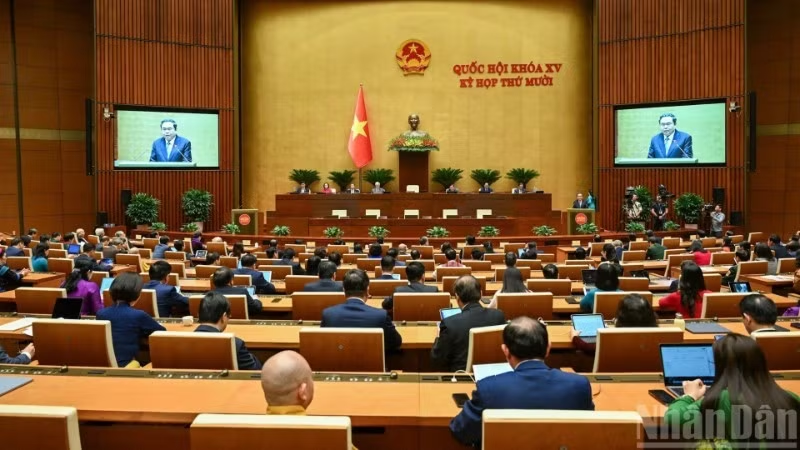
With an enormous workload, the National Assembly reviewed, discussed, and adopted 51 laws and 39 resolutions, including 8 legally binding resolutions. This is the largest legislative volume to date, accounting for nearly 30% of the total laws and resolutions for the entire term.
The passed legal documents meet practical requirements in a timely manner, helping to create a solid legal framework for the country's new development phase, contributing to removing bottlenecks, unleashing resources, and enhancing the people's mastery.
That result vividly demonstrates the utmost determination and extraordinary efforts of the National Assembly and each deputy, reflecting the National Assembly's and government's responsibility in accompanying the people and the nation.
In addition to legislation, the working session also reviewed and decided on many strategic issues of great importance, including a comprehensive assessment of the 2021–2026 tenure of state agencies, personnel matters, and thorough discussions of draft documents for the 14th National Party Congress.
Looking back on the 5-year journey of the 15th National Assembly, we take pride in the achievements overcome amid countless difficulties and challenges. During the term, the 15th National Assembly held 19 sessions — 9 extraordinary sessions and 10 regular sessions.
The 15th National Assembly has demonstrated a pioneering spirit, with strong and decisive innovation, while daring to think and daring to act in removing institutional and legal system bottlenecks
Overcoming complex regional and global developments as well as internal challenges; under the wise leadership of the Party, the National Assembly has strived to adapt flexibly, act decisively, achieving comprehensive results in constitution-making, legislation, supreme supervision, deciding important issues, and parliamentary diplomacy.
These efforts have contributed to stabilising the macro-economy, controlling inflation, budget deficits, and public debt; maintaining a high trade surplus; developing culture and society; improving social welfare and people's livelihoods; strengthening national defence and security; expanding international integration; and achieving breakthroughs in fighting corruption and negativity.
In particular, the 15th National Assembly has demonstrated a pioneering spirit, with strong and decisive innovation, while daring to think and daring to act in removing institutional and legal system bottlenecks: amending and supplementing the Constitution; streamlining the state apparatus and merging administrative units; expanding university autonomy; and accelerating digital transformation in parliamentary activities.
Recently, the National Assembly successfully organised the law-making forum and a thematic supervision forum, where people, businesses, and experts could speak frankly and truthfully, contributing directly to the legislative process based on practical needs and development requirements.
The National Assembly has proactively innovated its law-making mindset, promptly institutionalising the Party's policies, affirming its role of leading by one step in institutions, as well as applying digital technology and artificial intelligence.
The important laws promulgated at the 10th session focus on perfecting the socialist rule-of-law state, creating a solid foundation for the country to enter a new era, towards sustainable, equitable, and humane development.
In the time ahead, the country's development requirements demand an effective and efficient shift, bringing laws and resolutions into practical life. That journey requires decisive and synchronous action. As the first year of the new term, 2026 must become a breakthrough year for implementation. Every legal provision must be brought into life with urgency and high effectiveness, no less than the drafting process.
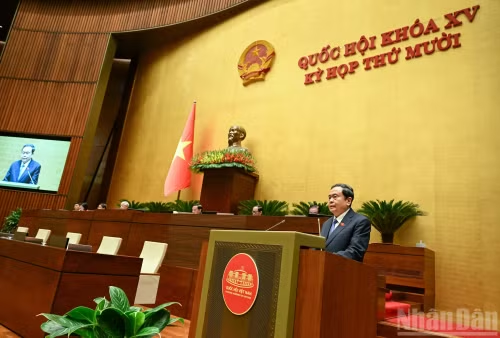
The National Assembly has outlined a plan for organisation, implementation, and deployment of thematic supervision in Q2/2026 on credit package disbursement, renewable energy ratios, and digital transformation enterprises — evaluated as the first resolution linking specific supervision targets, demonstrating determination to green the economy through legality and practice.
Supervision, auditing, and publicity are the three pillars ensuring effective implementation. The National Assembly Standing Committee will soon establish three supervision delegations on implementation across various fields; and supervision results will be publicised on the National Assembly's information portal, sent to the Election Council to support personnel evaluation.
2026 is also a pivotal year preparing for elections of deputies to the 16th National Assembly and People's Councils at all levels for the 2026–2031 tenure. Right after the session, the entire political system will continue to strive for achievements to welcome the 14th Party Congress and the 11th National Patriotic Emulation Congress, as well as prepare for the election and the 80th anniversary of the first general election day.
The National Election Council, the National Assembly Standing Committee, the government, the Fatherland Front, and relevant agencies will maintain close coordination, review the legal framework, ensuring democracy, transparency, discipline, so that the election will succeed splendidly.
The National Assembly calls on the government, ministries, sectors, and localities to urgently and synchronously implement the laws and resolutions, successfully achieve socio-economic growth, national defence, security, and foreign affairs targets for 2026-2030; care for people's livelihoods, especially disaster-affected areas. The new phase's tasks require the entire Party, people, and army to promote patriotism, development aspirations, and great national unity, as well as innovate thinking and effectively implement strategic decisions.
Looking back on the journey, the 15th National Assembly leaves a legacy not only of a vast legal system but also of ceaseless responsibility and innovation. Law-makers' responsibility must see the people in every clause; the responsibility of all levels, sectors, localities, and implementers must turn documents into concrete actions.
The 10th session concludes with determination to create new breakthrough developments, opening a decade of sustainable, equitable development, for a prosperous, civilised, and happy Viet Nam.