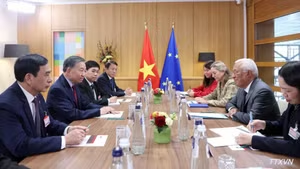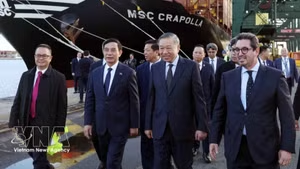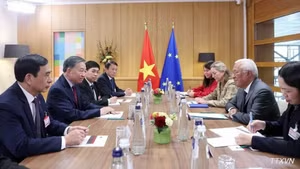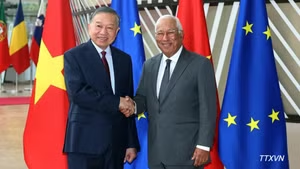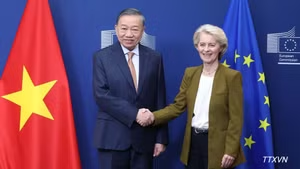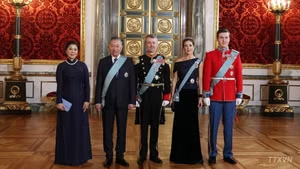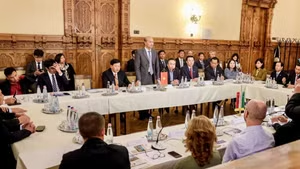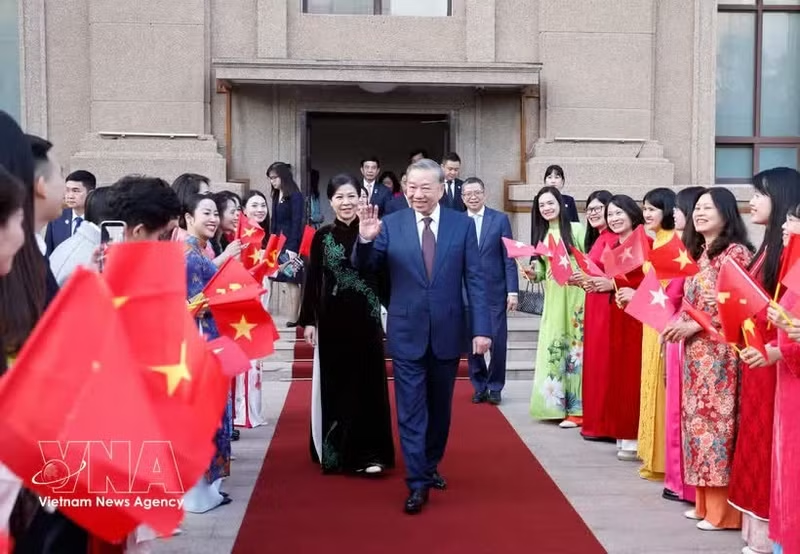
With his role as both Party General Secretary and State President, analysts believe To Lam is well positioned to effectively leverage international cooperation frameworks in service of national development goals.
The trip takes place as Viet Nam seeks a bigger role in geopolitics, a significant shift outlined at the 14th National Congress of the Communist Party of Viet Nam in January this year. Viet Nam has increasingly positioned itself as an active player on the international stage. In 2024, the country launched the ASEAN Future Forum as an annual platform attracting global leaders, including Malaysian Prime Minister Anwar Ibrahim, Timor-Leste President Jose Ramos-Horta, and New Zealand Prime Minister Christopher Luxon.
In March, Ha Noi hosted the first Viet Nam-China ministerial-level “3+3” strategic dialogue, covering public security, defence, and diplomacy. Viet Nam is also preparing to host the Asia-Pacific Economic Cooperation (APEC) Economic Leaders' Week 2027 and is set to assume the ASEAN Chairmanship in the coming period. These developments underscore the country’s expanding diplomatic footprint.
Observers noted that Viet Nam’s geopolitical role is undergoing a transformation, with two objectives: sustaining economic growth and strengthening national defence and security.
Le Hong Hiep, senior fellow and coordinator of the Viet Nam Studies Programme at the ISEAS-Yusof Ishak Institute, said that in the current context when there have been many geopolitical changes that tend to undermine peace and stability in the region, the task of defending the country early and from afar has become more prominent from the CPV's perspective.
He added that this explains why the Party has elevated the role of foreign affairs to one of constant and prominent significance. Sharing this view, Lye Liang Fook, also a senior fellow at the institute, said that with a relatively large population in Southeast Asia and a dynamic economy, Viet Nam is seeking to play a bigger role in geopolitics.
In the face of global challenges, Viet Nam and other countries need to play a more active role to diversify risks, explore new market opportunities, and strengthen cooperation with key partners to sustain growth and stability, he said.
Analysts believed that Viet Nam’s increasing engagement in global affairs will bolster its image as a rising middle power ready to contribute more actively to international peace efforts. A notable example is Viet Nam’s participation in United Nations peacekeeping missions in Africa over the past decade, reflecting its willingness to take on greater global responsibilities.
Hiep said that Viet Nam can play a more active role in the future if it can sustain its economic development and mobilise greater resources for its international commitments and contributions.