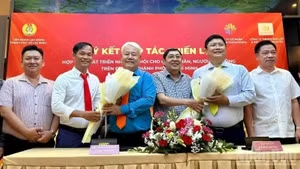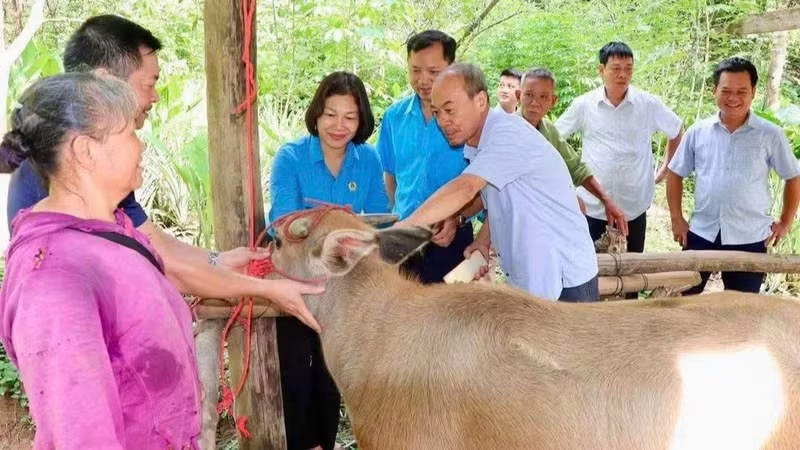
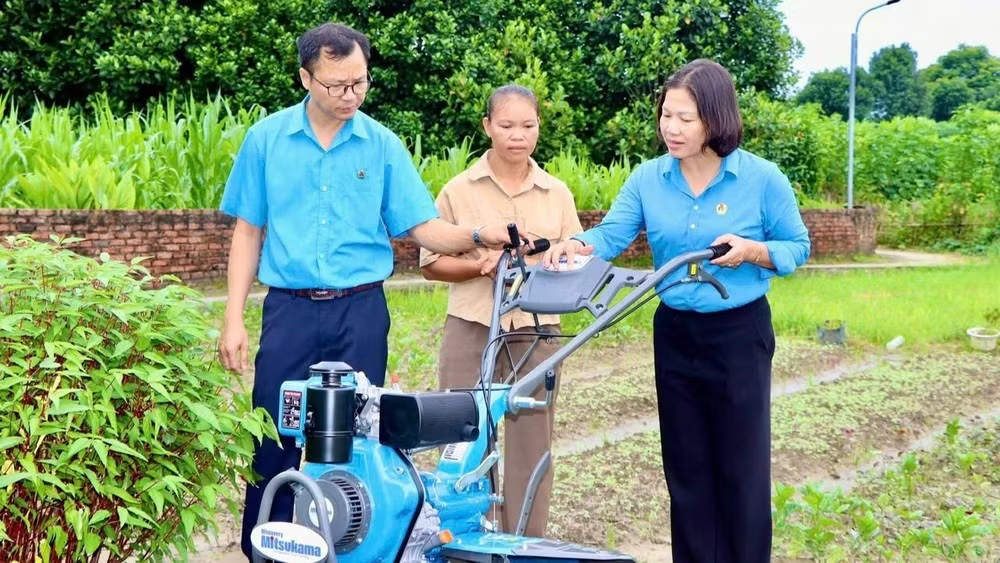
In late August, as part of the livelihood support project, the Thai Nguyen Provincial Federation of Labour visited Phong Quang Commune to distribute breeding livestock and agricultural machinery to four poor and near-poor households.
This time, Phung Xuan Phau (Na Pan Hamlet), Nguyen Van Duong and Ha Dinh Chi (Na Di Hamlet) received funding for breeding buffaloes. The household of Luong Thi Huyen (Phac Trang Hamlet) was provided with a tiller for agricultural production.
Under the project, the Thai Nguyen Provincial Federation of Labour aims to support 40 poor and near-poor households. Support will be provided through in-kind assistance suited to each household's livelihood plan, such as seedlings, breeding animals, materials, tools, and machinery. The total value of support throughout the 2026–2030 period is expected to be at least 400 million VND.
According to Do Thi Hien, Chairwoman of the Thai Nguyen Provincial Federation of Labour, the initiative reflects a spirit of solidarity, sharing, and responsibility towards the community, helping to bring social security policies closer to the people.
It is also a practical way to foster self-reliance and empower poor and near-poor households to improve their circumstances, motivating them to proactively develop their livelihoods, improve their living standards, and gradually escape poverty sustainably.
In recent months, provincial-level socio-political organisations and 100% of the commune-level Viet Nam Fatherland Front Committees in Thai Nguyen have simultaneously rolled out livelihood support programmes for poor and near-poor households.
Instead of providing only cash or essential goods as short-term assistance, the livelihood support model focuses on equipping households with direct means of production, such as breeding animals, seedlings, labour tools, and production equipment.
Following the administrative boundary merger, Thai Nguyen continues to have a high number of poor and near-poor households, particularly in mountainous areas and areas inhabited by ethnic minority communities, requiring more fundamental and sustainable solutions.
Therefore, the development and implementation of the project holds practical significance, shifting from “relief-based support” to “teaching people how to fish,” enabling them to actively expand production and increase their incomes. This approach represents an innovation by the Viet Nam Fatherland Front Committee of Thai Nguyen Province and makes a significant contribution to local poverty reduction efforts.
The project aims to support at least 1,000 poor and near-poor households during the 2026–2030 period, providing at least 20 million VND per household through the provision of means of production, including seedlings, breeding animals, materials, and production equipment.
Specific targets include providing training and technical transfers to 100% of participating households; ensuring 100% of households have access to preferential credit; helping at least 60% of participating households escape poverty; and establishing effective livelihood models with potential for replication.
The project emphasises the principle of not providing direct cash assistance, but focusing instead on in-kind support linked to specific production plans, with regular monitoring and evaluation to ensure substantive results.
To ensure effective implementation, each assigned unit has been given specific targets and guidance on how to execute the project.
Accordingly, the Viet Nam Fatherland Front Committee of the province will support at least 50 households; each socio-political organisation will support at least seven households; 100% of other member organisations of the provincial Viet Nam Fatherland Front will contribute resources to support at least eight households; 100% of commune-level Viet Nam Fatherland Front Committees will support at least one household; and ward-level Viet Nam Fatherland Front Committees will support at least two households.
The initial funding level is at least 20 million VND per household, to purchase seedlings, breeding animals, materials, and equipment for production and business activities. At least 65% of supported households must be located in mountainous, highland, or ethnic minority communes.
The Viet Nam Fatherland Front Committee of Thai Nguyen Province has also requested that Viet Nam Fatherland Front Committees at all levels and socio-political organisations spearhead or incorporate the inspection and supervision of the project's implementation. All poor and near-poor households receiving livelihood support in 2026 will be monitored and evaluated after receiving assistance.
According to Dam Quang Tuyen, Vice Chairman of the Viet Nam Fatherland Front Committee of Thai Nguyen Province, the units will focus on training beneficiaries to improve their household economic management skills, sharing scientific and technical expertise, and promoting the application of information technology so that they can use the support effectively, minimise risks, and enhance their capacity to sustain their livelihoods over the long term.
Viet Nam Fatherland Front Committees at all levels will also mobilise businesses, cooperatives, and production and trading establishments to join the initiative of “accompanying poor households” in developing livelihood models and connecting them with markets for selling their products. This will gradually improve the stability of market outlets, increasing the effectiveness and sustainability of the models.