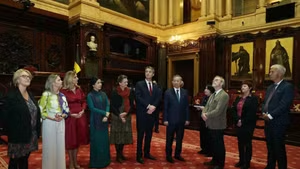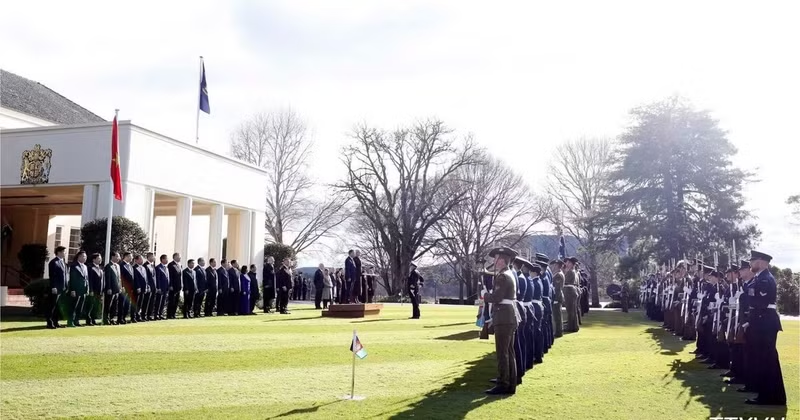
The Resolution of the 6th National Party Congress in 1986 set out the policy of strengthening and expanding friendly relations with Sweden, Finland, France, Australia, Japan, and other Western countries on the basis of equality and mutual benefit. At subsequent National Party Congresses, the Asia-Pacific region in general and Australia in particular have consistently been among the priorities in Viet Nam’s foreign policy. This has provided an important foundation for the steady development of bilateral relations.
For decades, Australia has been one of the leading providers of official development assistance (ODA) to Viet Nam across a wide range of areas, making a practical contribution to the country’s sustainable development. The My Thuan Bridge spanning the Tien River was the first cable-stayed bridge in Viet Nam. Open since 2000, it has served as a vital transport artery, helping drive economic growth in the Mekong Delta.
In 2018, Cao Lanh Bridge was also put into operation, further contributing to improvements in the region’s socio-economic development. These projects have become symbols of Viet Nam-Australia friendship. In times when economic conditions were difficult, Australia continued to increase its ODA to Viet Nam.
In education, RMIT University Viet Nam was the first foreign university to operate in Viet Nam. Australia has also provided Viet Nam with numerous scholarships through long- and short-term programmes. Universities and academies in the two countries regularly run joint training programmes. Australia is currently Viet Nam’s seventh-largest trading partner, while Viet Nam is Australia’s tenth-largest. Both countries have strengths in agriculture and have opened their domestic markets to high-quality agricultural products from each other, increasing the diversity of goods available to consumers.
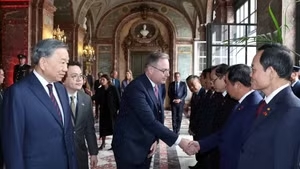
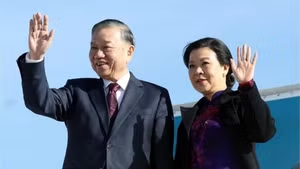
After more than 50 years of cooperation, both countries now occupy important positions in each other’s foreign policy strategies and have a solid foundation for further unlocking their respective strengths and expanding cooperation across a wide range of fields. During his meetings with Australian leaders, General Secretary and State President To Lam expressed Viet Nam’s appreciation for Australia’s companionship and support throughout the country’s development. He voiced his wish to deepen bilateral relations in a more substantive, effective, and practical manner, serving the development goals of both Viet Nam and Australia.
The first stop of the Vietnamese high-level delegation’s visit to Australia was Sydney, the vibrant harbour city and a leading financial, economic, and technological centre of the country. Here, General Secretary and State President To Lam attended the Tech Connect at the University of Technology Sydney (UTS). The event was a highlight of the visit and marked the first time the two countries had jointly organised a large-scale event to connect education, science, and technology, featuring the participation of senior leaders from both countries along with numerous scientists, businesses, universities, research institutes, and policymakers.
Emphasising that investment between the two countries remained modest, the general secretary and state president shared his vision of a stronger, deeper, and more strategic new model of partnership in science, technology, innovation, and human resources development. The two countries, he said, should move from cooperation to co-creation; from technology transfer to joint research and development; and from links between individual organisations to an interconnected innovation ecosystem in which businesses, universities, research institutes, and investment funds work together to innovate and grow. He expressed his hope that Tech Connect would become a regular forum, serving as a platform for promoting new initiatives and cooperation programmes and, ultimately, as a space for joint technology creation between the two countries.
Also at the forum, Minister of Science and Technology Vu Hai Quan said Viet Nam was implementing policies to attract talent to conduct research and master strategic technologies, with income policies benchmarked against remuneration at Singapore’s Agency for Science, Technology and Research (A*STAR). A list of national testing centres and key national laboratories had also been issued. The information is of particular interest to Vietnamese students and scientists studying and conducting research in Australia. There are currently about 31,000 Vietnamese students and research students studying in Australia. The Vietnamese community in Australia numbers around 375,000 people and serves as an important bridge for cultural exchange, trade, investment, and economic connectivity between the two countries, while also representing a valuable and potentially significant long-term resource for Viet Nam.
It is clear that, thanks to a convergence of strategic advantages and naturally complementary strengths, Viet Nam-Australia relations are shifting from a one-way development assistance relationship towards a partnership for shared development, becoming increasingly deep and substantive and meeting the interests and expectations of the peoples of both countries. Numerous important cooperation agreements have been signed at government level and between research institutions and businesses. Australia is stepping up implementation of its Southeast Asia Economic Strategy to 2040, building resilient and self-reliant supply chains with Southeast Asia, with Viet Nam among its key partners.
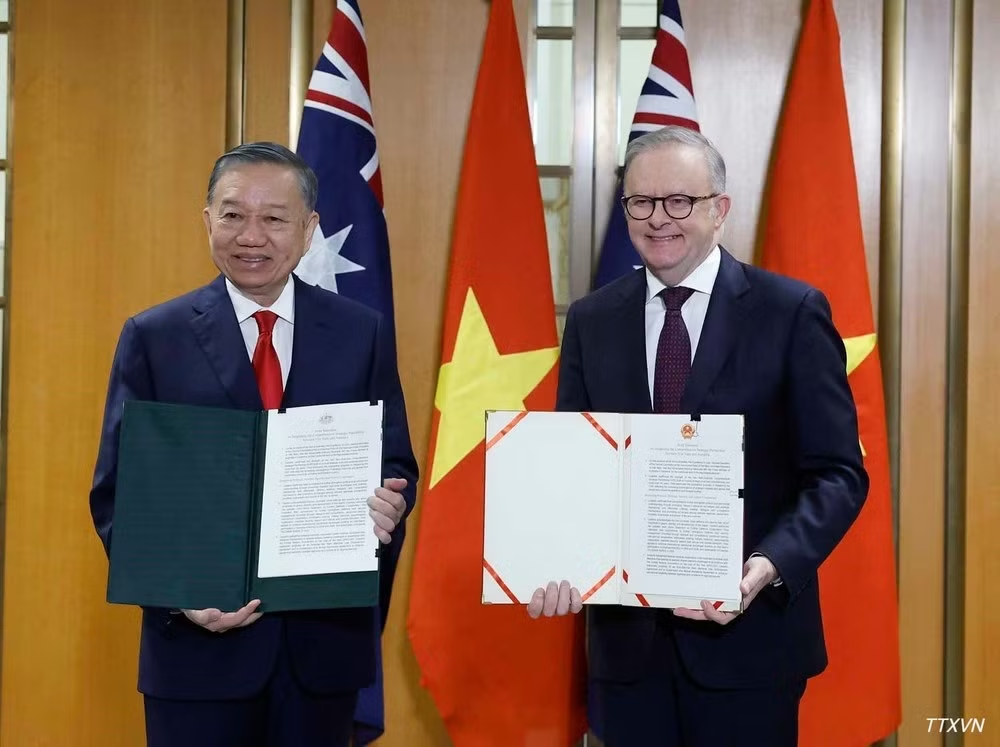
During the visit, the leaders of the two countries discussed and agreed to make science, technology, innovation, and digital transformation new drivers of bilateral relations. Governor-General of Australia Sam Mostyn expressed her admiration for Viet Nam’s dynamic development, particularly its rapid economic, scientific, and technological transformation and international integration. She said Australia and Viet Nam share many similarities in their development visions, providing a favourable foundation for expanding cooperation into new areas. She also affirmed Australia’s desire to become a trusted partner of Viet Nam, ready to accompany and support the country in achieving its development goals.
In terms of the economy, trade, and investment, the two sides agreed to make better use of the complementary nature of their economies, take advantage of the free trade agreements to which both countries are party, remove barriers, and facilitate business activities. The two countries aim to increase bilateral trade turnover to 20 billion USD, strengthen supply-chain linkages, attract high-quality investment, and expand cooperation in the green economy, digital economy, new energy, and future industries. Education, training and people-to-people exchanges will continue to serve as important pillars of bilateral relations.
Building on mutual understanding and in-depth discussions of issues of shared concern, the leaders of the two countries agreed to adopt three joint statements: the Joint Statement on Deepening the Comprehensive Strategic Partnership; the Joint Statement on Economic Resilience Cooperation; and the Joint Statement on the Enhancement of Science, Technology and Innovation Connectivity between the two countries. These represent the highly positive outcomes of the visit. The declarations focus on key areas aimed at deepening bilateral relations and making them increasingly practical and effective.
Notably, the two countries affirmed that the cooperation in strengthening economic resilience, adaptation, and recovery constitutes a foundation for national security and prosperity, as well as an important pillar of their shared vision for a peaceful, stable, and prosperous Indo-Pacific region. Accordingly, the two sides will work together to support the development of transparent, diversified, secure, sustainable, reliable, stable, and economically efficient and resilient supply chains in areas such as critical minerals, semiconductors, and clean energy. Cooperation in critical and emerging technologies will play an important role in strengthening the two countries’ capacity for economic resilience, adaptation, and recovery.
With a foundation of political trust, increasingly interconnected interests and new drivers for cooperation, Viet Nam-Australia friendship is entering a deeper phase of development, bringing practical benefits to the peoples of both countries and making a positive contribution to peace, stability, and development cooperation in the Indo-Pacific and around the world.
![[In Pictures] General Secretary and President To Lam and his spouse visit and present books to Royal Library of Belgium](https://en-cdn.nhandan.vn/images/3NY4Z6Du1Md1PrS_s0ZZOrwc5xDfq4rRua69depr-TBkwatGjBcD9lagzrI2BmGDo4nKYA9qjKDjuB3-yYloL_1KbNBr00klMZQFyHQxQ6Jq6GzFfAiY0m5agKw6jNtArN4QnVntX8RQeUmD7pdCq7nwvn3e235v3kufpokBN_s/1-tong-bi-thu-chu-tich-nuoc-va-phu-nhan-tham-tang-sach-cho-thu-vien-hoang-gia-bi.jpg.avif)