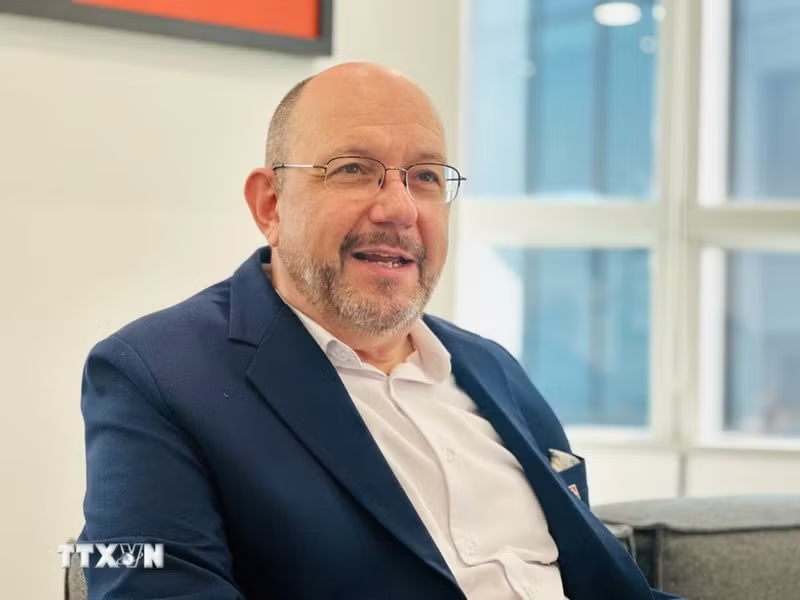
In an interview granted to the Viet Nam News Agency (VNA) ahead of the visit, Swiss Ambassador to Viet Nam Thomas Gass recalled that in 1971, amid the challenges of wartime, Switzerland, Norway and Sweden were the first Western countries to establish diplomatic ties with Viet Nam.
President Parmelin’s visit offers an opportunity to reflect on 55 years of bilateral cooperation and recognise Viet Nam’s remarkable economic and social progress. Switzerland has maintained humanitarian cooperation programmes with Viet Nam since 1971, while bilateral ties have increasingly focused on economic cooperation over the past 15 years, supporting Viet Nam’s deeper integration into the global economy and enhancing its international standing.
Gass described the upcoming signing of a free trade agreement (FTA) between Viet Nam and the European Free Trade Association (EFTA), comprising Switzerland, Norway, Iceland and Liechtenstein, as another major milestone. Together, the President's visit and the prospective agreement demonstrate how decades of sustained cooperation are translating into tangible benefits for both countries.
Viet Nam’s visa exemption for Swiss tourists since last year has also given fresh impetus to people-to-people exchanges and bilateral tourism cooperation, he said.
The visit is expected to further consolidate the bilateral relationship and advance cooperation in key areas, particularly trade and investment, science and technology, innovation, finance and sustainable development. The two sides will also exchange views on regional and international issues of mutual concern.
Negotiations on the Viet Nam-EFTA FTA concluded on July 2, 2026, following 14 years of discussions, Gass said, adding that Switzerland was among the first countries to initiate FTA discussions with Viet Nam after the latter's accession to the World Trade Organisation (WTO). Following a period in which both sides focused on other trade priorities, negotiations regained momentum over the past 3-4 years, drawing on the achievements of previous trade agreements and adapting to the evolving global trading environment.
According to the ambassador, the agreement reflects a shared commitment to a predictable trade framework, tariff reductions, respect for innovation and intellectual property rights, and the complementary strengths of the participating economies. It is expected to provide a common policy framework and boost business confidence, particularly among small and medium-sized enterprises (SMEs) considering investment in a geographically distant country. By strengthening intellectual property protection, encouraging innovation and facilitating trade through lower tariffs, the agreement will create more favourable conditions for businesses of both sides.
Switzerland welcomes Viet Nam’s commitment to reducing tariffs on machinery and technical products, which would help the country integrate more effectively into international trade and global value chains, Gass said.
At the same time, Viet Nam’s expanding middle class is expected to create greater demand for advanced Swiss healthcare solutions and pharmaceuticals. Vietnamese products meeting high environmental and social standards will also have better access to EFTA markets, where consumers have strong purchasing power and are increasingly willing to pay higher prices for sustainably developed goods.
Regarding Viet Nam’s establishment of international financial centre (IFC) in Ho Chi Minh City and Da Nang, Gass expressed Switzerland’s readiness to work closely with Viet Nam to support its ambition to turn itself into an IFC.
Switzerland has long cooperated with the State Bank of Viet Nam and commercial banks in management training, operational standards and financial technology (fintech). Drawing on Switzerland’s experience, Gass stressed that a strong and stable domestic financial and banking system, ensuring broad access to financial services, was fundamental to the success of an IFC.
Switzerland would therefore continue to prioritise strengthening the core capabilities of Viet Nam’s domestic banking system, rather than focusing resources solely on the newly established IFC, he said.
According to the diplomat, scientific research and innovation have become key pillars of bilateral cooperation. The Swiss National Science Foundation (SNSF) and the National Foundation for Science and Technology Development (NAFOSTED) of the Vietnamese Ministry of Science and Technology have launched two joint research calls, supporting around 20 collaborative projects involving leading universities in both countries. A third call is expected next year. Research spans a broad range of fields, including automation, automotive technology, energy, pharmaceuticals, medical diagnostics, quality testing, biotechnology, green energy, the digital economy and agriculture.
Swiss companies, many of which have operated in Viet Nam for more than 30 years, are also making substantial investments in vocational training and in strengthening Vietnamese workers’ technical and management skills.
Working with local universities, these companies provide students with hands-on experience in factories and train workers in high-tech fields such as robotics, smart grids, medical equipment and tourism. These initiatives are helping equip Viet Nam’s workforce with the skills needed to meet future economic and technological demands.
As members of the International Organisation of La Francophonie (OIF), Viet Nam and Switzerland can also leverage this multilateral cooperation mechanism to enhance people-to-people exchanges and mutual understanding.
Gass praised Viet Nam’s active engagement in the Francophone community at both regional and international levels, noting that the organisation promotes not only the French language but also cooperation in education, research and tourism.
Language remains a powerful bridge between cultures, he added, recalling his pleasant surprise at being able to communicate in French with Vietnamese people. The Francophone framework enables Swiss people to gain a deeper insight of Viet Nam’s beauty and hospitality while fostering greater understanding between the two nations' people, he said.
Gass commended Viet Nam’s strong economic growth and firm commitment to the United Nations Sustainable Development Goals (SDGs) and its target of achieving net-zero emissions by 2050.
Viet Nam’s combination of strong economic development, commitment to multilateralism and focus on sustainability has made it an important partner with significant potential for Switzerland, he said.
Against this backdrop, the stronger trade, investment, scientific and technological cooperation expected from President Parmelin’s visit could provide fresh momentum for bilateral relations, enabling the two economies to supplement and prosper together.