The above statement was made by Professor Qu Qiang from Minzu University of China at the Central University of Ethnicities, and a commentator for CGTN, during his interview with Huu Hung, Nhan Dan Newspaper’s correspondent in China.
According to Professor Qu Qiang, this historic event can be explained from three perspectives: the elevation of status, the choice of strategic timing, and the consolidation of ASEAN’s central role.
First, the Shangri‑La Dialogue is the highest‑level security forum in the Asia‑Pacific region. Over the past two decades, its agenda has been largely dominated by major powers.
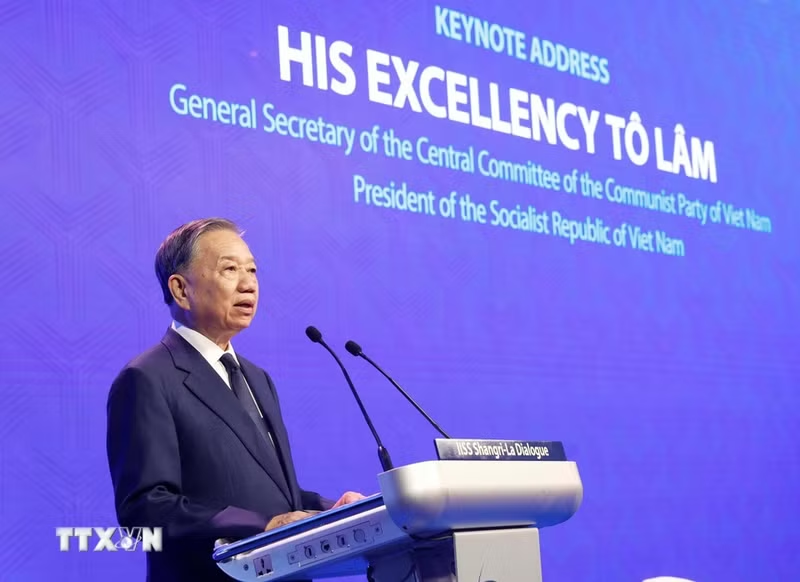
General Secretary and State President To Lam’s delivery of an important opening keynote at the forum marks Viet Nam’s formal shift from being a “listener” and “participant” to being one of the “agenda‑setters.” This was not merely a personal‑style diplomatic debut but also a concentrated expression of Viet Nam’s rising national standing.
General Secretary and State President To Lam’s delivery of an important opening keynote at the forum marks Viet Nam’s formal shift from being a “listener” and “participant” to being one of the “agenda‑setters.”
Regarding the choice of strategic timing, the international landscape is currently in a period of considerable instability — great‑power competition is intensifying, regional hotspots recur frequently, and the global governance system is under strain.
Viet Nam’s decision to speak up in this moment not only seizes the opportunity to attract international attention but also demonstrates to the world that small and medium‑sized countries can proactively propose systemic solutions.
In his speech, General Secretary and State President To Lam repeatedly emphasised the need to perfect the regional architecture with ASEAN at its centre, conveying a common message from the ASEAN bloc about maintaining ASEAN’s core coordinating role on regional issues.
Regarding the observations made by General Secretary and State President To Lam in relation to the three fundamental crises unfolding in the world, and concerning Viet Nam’s orientations and proposals, the Chinese professor believes these are sound viewpoints which confront the essence of the matters with a distinctive perspective.
Accordingly, General Secretary and State President To Lam identified the major challenges humanity faces, such as the weakening binding force of rules, the erosion of commitments, and the mindset that prioritises the use of force when the strong prey upon the weak.
In such an environment, small and medium‑sized states face mounting pressure to choose sides and are increasingly vulnerable to coercion in the economic, technological, financial, and security domains. At the same time, connective spaces such as seas and oceans, cyberspace, supply chains, digital infrastructure, and undersea cables are at risk of becoming arenas of strategic contestation.
In particular, General Secretary and State President To Lam stressed that for many nations, development is not secondary to security. Development is the very foundation of enduring security.
This breaks with cold war thinking, when many states prioritised security over development. It also reflects Viet Nam’s fundamental concern as a developing country, and its resolve to maintain independence and autonomy.
According to the professor, the six recommendations put forward by General Secretary and State President To Lam for jointly shaping the Asia‑Pacific are highly practical and feasible.
They emphasise the role of rules and dialogue; an open and inclusive regional architecture with ASEAN at its centre; human security and societal resilience at the core of sustainable security; responsible norms for emerging technologies and the defence industry; the need to strengthen societal foundations and resilience at the core of sustainable security and to protect the information space; and the capacity for preventive diplomacy, mediation, and conciliation in the region.
Through his visits to three ASEAN countries and his speech at the Shangri‑La Dialogue, General Secretary and State President To Lam demonstrated a diplomatic style that combines theory and practice, manifested in the following aspects:
General Secretary and State President To Lam’s speech displayed a highly pragmatic style with strategic vision, using systematic arguments to elevate Viet Nam’s position on the international stage.
First, constructing a discursive system framed by the three crises and six recommendations demonstrates the robust theoretical foundations of Vietnamese diplomacy, showing its capacity for international communication and the design of appropriate agendas.
Second, a steady diplomatic art: while criticising coercion and imposition, it welcomes responsible participation; while upholding sovereignty, it encourages cooperation. As such, it reflects Viet Nam’s balance and flexibility, as well as its sagacity in securing independence, autonomy, and development.
Third, harmonising both bilateral and multilateral dimensions by emphasising multilateral principles such as peaceful development and the rule of international law, and by being more proactive in regional and international integration.
The Chinese scholar concluded that General Secretary and State President To Lam’s speech displayed a highly pragmatic style with strategic vision, using systematic arguments to elevate Viet Nam’s position on the international stage.
In today’s turbulent international context, through the important messages delivered at the Shangri‑La Forum, Viet Nam will gain substantially greater international influence, becoming a new force of significant influence in Southeast Asia and across the globe.